
Zoltan Schwartz 2
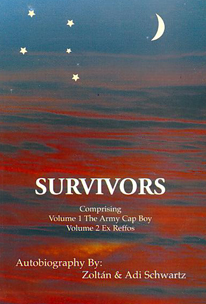 Title: Survivors: Autobiography
Author: Zoltan Schwartz
Publisher: Lina Publishing
Place of publication: Melbourne
Year of Publication: 1998
Location of Book: Rare Books Collection, Sir Louis Matheson Library, Monash University Clayton Campus
Cities/town/camps: Hungary: Budapest, Nyircsaholy, Germany: Bergen-Belsen, France: Paris
Note: those cities/towns/camps underlined are those which are most central to the narrative
Survivors is a book comprised of two volumes. The first volume, The Army-Cap Boy is the reprint of a previous book by the same name published 16 years earlier (MacMillian, Melbourne, 1983). The second volume, Ex-Reffos, is 178 pages in length and tells of Zoltan and his wife’s new life as migrants in Australia.
The Army-Cap Boy is the story of Zoltan Schwartz, a Hungarian Jew. The book covers the period from 1935, when Zoltan was six years old, to 1948 when he arrived in Australia. The first 27 pages deal with his life in Nyircsaholy in the years prior to the war; pages 28-73 with survival in Budapest during German occupation; pages 64-109 with the struggle for survival in Bergen-Belsen; and pages 110-162 with his life in Europe, predominantly Paris, following his liberation. The final part of the first volume, pages 163-176, describe Zoltan’s journey to his new homeland of Australia. Survivors was published by Lina Publishing in 1999. Note: Zoltan and Edi Schwartz are pen names.
The first section of the book deals with Zoltan’s life in Nyircsaholy, a small village in the North East corner of Hungary. Born in 1929, Zoltan describes the life of his village and his family, who operated a small shop attached to their home. The family had deep roots in the village, and Zoltan’s father had served in the Hungarian Army. Zoltan provides a brief account of his six years of schooling and the anti-Semitism he experienced. In 1943 he moved to Budapest to pursue a trade as an apprentice tailor. This proved to be short lived and Schwarz ended up switching between odd jobs. He was able to move about the city with relative ease, despite the threat of the Hungarian Fascist party, the Arrow-Cross, and its gang of thugs.
When the Germans entered Hungary in 1944, a number of anti-Semitic measures were imposed. Amidst the chaos, Zoltan heard rumours of atrocities occurring in the east. He simply could not believe that such a civilised people as the Germans could act so barbarously. Zoltan soon learnt first hand when in December 1944 he was marched into a cattle train bound for Bergen-Belsen. Zoltan describes the terrible conditions of the journey, the intense hunger and thirst, and the humiliation of being told where and when they could go to the toilet. In Bergen-Belsen Zoltan is again bewildered by the savagery of the ‘cultured’ German guards. He describes the daily battle for survival in the camp, and fondly recalls those who helped him live another day. As the German retreat hastened, Zoltan and his fellow prisoners were packed back in to trains headed for another camp. The train was liberated by American soldiers on April 13 1945. After liberation, Zoltan was taken to Paris where he reveled in the return to freedom and humane conditions. In 1948 he emigrated to Sydney to begin a new life.
Zoltan Schwartz employs a sophisticated lexicon to portray the senseless horror of his experiences. Nonetheless, black humour finds its way into the narrative wherever possible. Schwartz’s story is both intimate and honest. No detail, however personal or unflattering, is spared from this tale of one mans battle against the callousness of humanity.