
Zwi Lewin
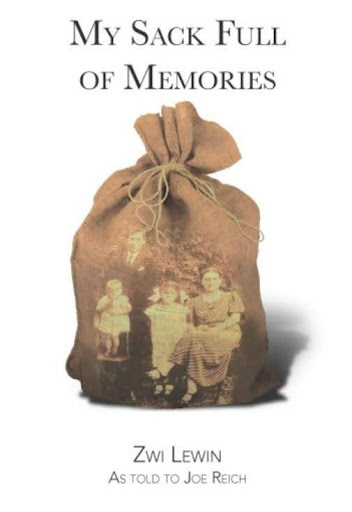 Title: My Sack Full of Memories
Author: Zwi Lewin and Joe Reich
Publisher: Hybrid Publishers
Place of publication: Ormond, VIC
Year of Publication: 2019
Location of Book: Lamm Jewish Library, Melbourne Holocaust Museum, Sydney Jewish Museum and many public libraries
Cities/town/camps: Poland: Bielsk Podlaski, Białystok; Lithuania: Veisiejai (Vishay), Jurbarkas (Yurburg), Kaunas (Kovno); Belarus: Vitebsk; Russia: Kovylkino; Uzbekistan: Tashkent; Fergana; France: Paris; Australia: Melbourne
Note: those cities/towns/camps underlined are those which are most central to the narrative
Genre: Memoir
Key events/experiences: Jewish refugee; child survivor; Soviet collective farm
My Sack Full of Memories is the moving 238-page memoir of child survivor, Zwi Lewin, who fled Nazi-occupied Poland to the Soviet Union where he survived the war in an orphanage in Uzbekistan.
Pages 1-38 describe his parents upbringing, marriage and the author’s early childhood. Pages 39-66 recount the onset of the war, the Russian occupation of his hometown and the family’s flight from the invading Nazis to the Soviet Union in June 1941 whilst visiting family in Lithuania. Pages 67-96 provide an account of their move to a collective farm in Uzbekistan in early 1942 and Zwi’s time in an orphanage until 1945. Pages 97-123 recount the family’s return to Lithuania and Poland and their eventual emigration to Australia in 1948. Pages 127-225 describe Zwi’s life in Melbourne. Pages 226-238 include an extensive family tree and an afterword by co-author Joe Reich.
Herszel (Zwi) Lewin was born in February 1934 in Bielsk Podlaski in eastern Poland, to middle-class, Orthodox parents Gitel Lasovski and Yitzchak Lewin. He had an older sister, Chaya, born in 1929. His Lithuanian mother fled an arranged marriage to Bielsk Podlaski where she met and married Zwi’s father, who ran a petrol station.
Following the outbreak of war his town was overrun by Soviet forces and though only five years old Zwi recalls the army marching through the streets. In the summer of 1941 Zwi, his sister and mother travelled to the town of Vishay in Lithuania, to reconcile with Zwi’s maternal grandparents whilst his father stayed behind to run the business. After a week the family travelled to Yurburg, near the German border, to visit Zwi’s uncle Yosef and Daniel and his aunt Rivka. Two days after they arrived, the German army invaded and occupied Lithuania. Luckily, Zwi’s quick-thinking uncles were able to evacuate their respective families.
One of his uncles, using a stolen truck, drove members of the family to Kovno. During the chaos, Zwi was separated from his mother, leaving him in the care of his uncle Yosef. In Kovno, Russian-speaking Yosef was able to convince Soviet authorities to place the family on an emergency evacuation to Russia. On 23 June they left in a convoy to Vitebsk, Belarus, where they narrowly avoided German bombers and boarded the last train, arriving at the village of Kovylkino in Central Russia.
In Kovylkino, they were given accommodation with a poor Russian family. After six months, Zwi was finally reunited with his mother and sister. Due to the freezing conditions, Yosef brought his extended family to Fergana, Uzbekistan, where he obtained accommodation at a collective farm. They lived in a stable on the farm where Zwi’s mother and sister worked. Due to the limited food rations, the family nearly starved. Eventually, conditions were so terrible that, in 1942, Zwi’s mother was forced to place Zwi into a local orphanage where he continued to be malnourished and suffered crippling loneliness. In April 1945, near the war’s end, Zwi was reunited with his mother and sister and the family made their way home.
They returned first to Lithuania to search for surviving family. Due to communist restrictions, they were forced to live in Kovno for a year where Zwi resumed his schooling. Finally allowed to return to Bielsk Podlaski in late 1946, they tragically discovered that Zwi’s father had been murdered and found their former maid occupying their home. Shocked by the hostility of their former neighbours the family moved to Białystok where they received aid from the Jewish Reconstruction Committee and made plans to emigrate. After receiving a landing permit from an aunt in Melbourne, they left for Paris in May 1948. Assisted by the JOINT, they lived in Paris for six months whilst awaiting passage for Australia, boarding a ship in Marseille and arriving in Melbourne in November 1948.
In Melbourne, Zwi’s mother obtained work and accommodation in the Montefiore Homes. Zwi began attending school in February 1949 and became active in various Jewish groups. He was given his nickname, Zwi, by friends in Bnei Akiva. In 1964, he met and married wife Ahuvah. The couple had five children, Leora, Jonathon, Daniel, Simon and Jeremy.
My Sack Full of Memories is a vivid account of the terror, confusion and dislocation suffered by a young, wartime Jewish refugee. The author provides considered reflections on his fractured memories alongside careful historical reconstruction of the events which embroiled him as a child. The memoir was written with the help of the author’s son-in-law, Joe Reich, who aided Zwi in the writing and historical research, and was published commercially by Hybrid Publishers.