
Sustainable Skyscrapers and 3D Printed Food: Students Reimagine AI and Energy in Future Schools
This project worked with young people to imagine the sustainable energy implications of an AI-rich world, and how we might progress toward desirable ‘AI energy futures’. At present, issues around energy and environmental implications of AI technology are absent from the school curriculum. The program was a collaboration between Monash University and Monash Tech School to develop a world-first ‘AI Energy Futures’ curriculum and learning resources.
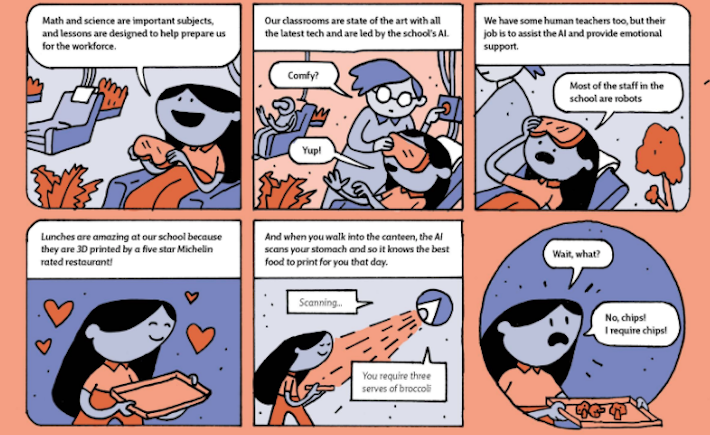
Current debates around how AI will change future schools need to be expanded to include environmental and energy issues and the perspectives of children – a Monash research team has been exploring how this might be done.
Digital future schools: AI and energy curriculum for future learning was run by an interdisciplinary team from Monash University. The team developed and piloted a world-first ‘AI Energy Futures’ curriculum with 70 students from two Melbourne-based high schools (Years 7-9) over three days. Students used a variety of resources including generative AI tools to build their own future school scenarios, which have been translated in comic-style illustrations.
Education policymakers, businesses and the IT industry are all having their say about what AI in education might look like in the future, but one voice is missing from this discussion – the students who it will impact.
“'School of the Future' scenarios have become increasingly popular among policymakers anticipating the impacts of emerging technologies. In more recent years, the scenarios have become particularly important for all stakeholders navigating the bold promise that AI will transform schools and lead to radically different forms of education. But we are also now seeing emerging concerns over the energy demands of AI, and doubts over its long-term harmful impacts on the environment. We reviewed 70 ‘schools of the future’ scenarios and found that discussions focused on technology-driven changes (e.g., robot teachers, personalised learning), neglecting energy implications, climate change impacts, and student input. Digital future schools was borne of the belief that schools of the future should be reimagined from a top-down approach towards a collaborative effort that puts student voices at the centre” said Dr Fareed Kaviani
To address this gap, an interdisciplinary team of energy futures researchers, computer scientists, anthropologists and digital sociologists from Monash University partnered with the Monash Tech School to develop a world-first ‘AI Energy Futures’ curriculum and learning resource for students to engage students in futures thinking.
Seventy students from two Melbourne-based high schools (Years 7-9) participated in the program, which involved discovering the AI and energy impacts of their school and building their own future school scenarios.
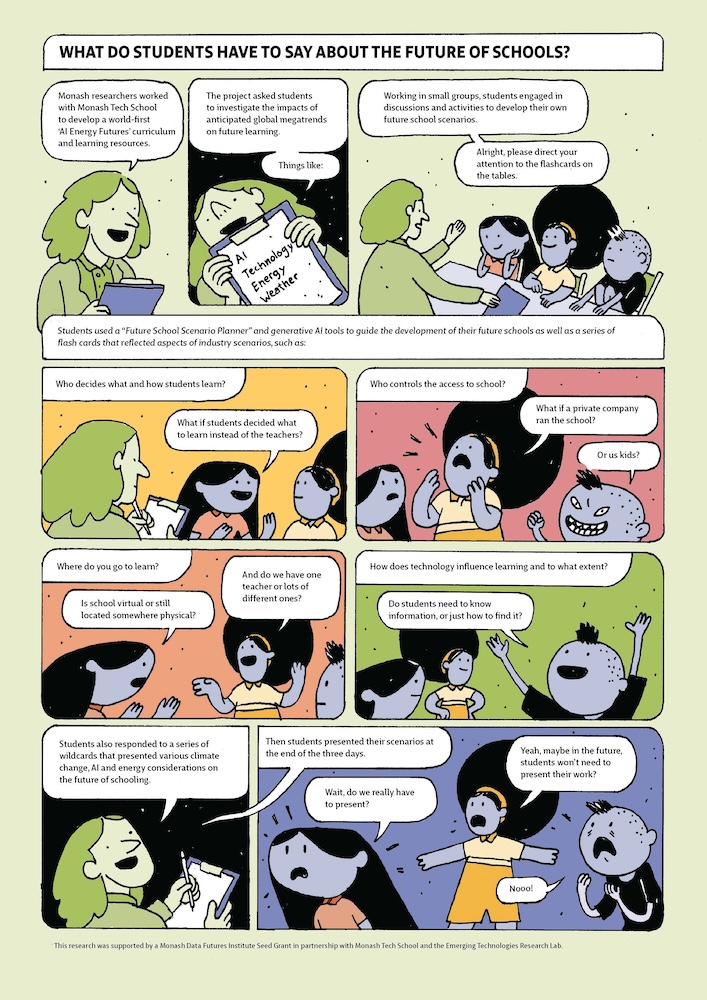
The research finds that when young people are involved in speculating about future schools they raise a range of ideas and agendas that are currently sidelined in mainstream discussions – including what traditional aspects of schooling that we should be looking to keep.
Students are current ‘experts’ in what it is like to go to school (as well as being the future generation of parents and teachers). Any discussion of what we want schools to be like in the future can benefit greatly from including their ideas, ambitions and concerns.
“The scenario building exercise was a lot of fun, so we brought their visions to life by having them professionally illustrated” said Dr Fareed Kaviani
Overall, the program helped students see potential positive outcomes for the future and increased their awareness of complex issues such as the environmental impact of technology.
“Surprisingly, they seemed less concerned about catastrophic climate change outcomes. They expressed confidence in renewable energy adoption and believed current adults should take responsibility for addressing climate issues” said Dr Fareed Kaviani
Contact: Fareed Kaviani
Email: fareed.kaviani@monash.edu