
Tracing time, light and domestic ritual: Ebony Maurice-Wilmott at ‘Hatched’ 2025
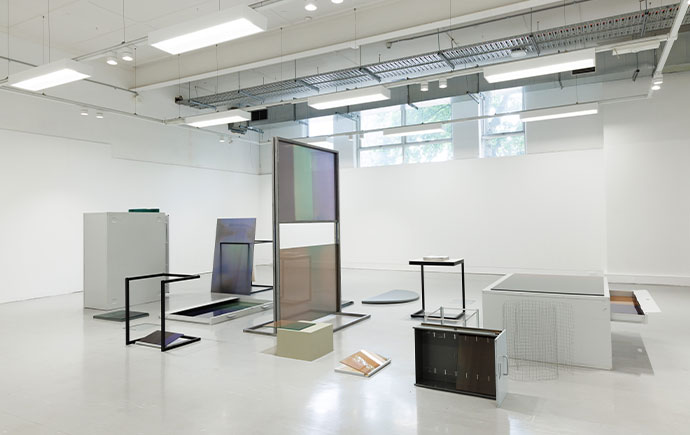
Image: Ebony's installation at MADA Now 2024.
For Monash University alum Ebony Maurice-Wilmott, art is less about final outcomes and more about the process of noticing, collecting and connecting. Her installation work ‘Index’, selected for the 2025 ‘Hatched: National Graduate Show’ at the Perth Institute of Contemporary Arts (PICA), reflects this deep engagement with trace, memory and the overlooked details of everyday life.
From Queensland to Monash: A move to deepen practice
Ebony completed her undergraduate degree at Queensland College of Art (QCA) before moving back to Melbourne to join the Bachelor of Fine Art (Honours) program at Monash in 2024. Drawn by the strong reputation for research and the ambitious graduate shows she’d seen documented on Instagram, Ebony was eager to be part of that legacy.
“Monash blends theory and practice really well,” she says. “The program was practical, engaging and offered the critical depth I was looking for.”
This year, Ebony begins the Master of Fine Art, continuing to build on a practice she’s always been determined to push further.
Recognised on a national stage
Ebony, is one of just 24 emerging artists from across Australia nominated for ‘Hatched’, a national platform showcasing the most promising graduates from art schools nationwide. For her, the recognition was a moment of quiet validation: “I felt relieved that the work I put into the year had produced fruits,” she says.
A practice built on index and intuition
Her multi-disciplinary practice—spanning frottage1, expanded printmaking, glasswork, and 16mm film—centres not on one medium but on a fascination with the ‘indexical’: a concept she explored throughout her Honours year.
“I’m drawn to materials and methods that point to something else—what’s left behind, what gets recorded unintentionally,” she explains. “It’s not about the medium, but the trace it captures.”
1 the technique or process of taking a rubbing from an uneven surface to form the basis of a work of art.
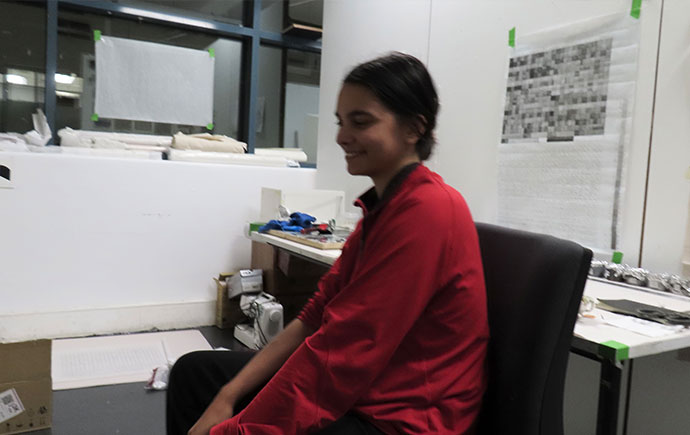
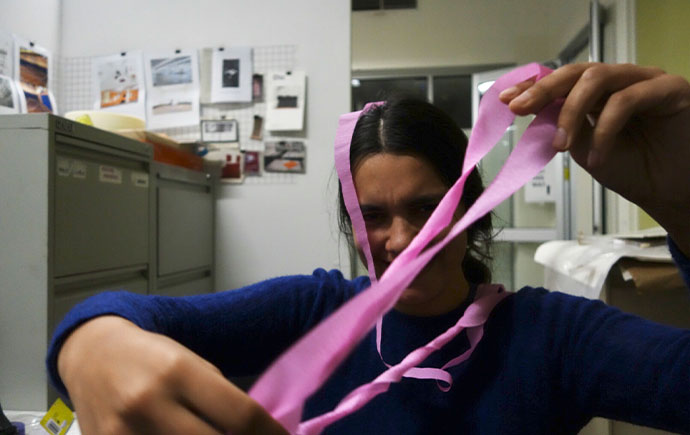
Images: Ebony in the Fine Art Honours studio
Index: Documenting the domestic and the obsolete
Her ‘Hatched’ work ‘Index’ comprises several interrelated series. One of these, ‘Affiliation Ritual’, features graphite frottages of discarded ironing boards sourced from suburban streets—capturing the unique patterns and forms of domestic structures often overlooked. “It’s about time and space, about how we compact and classify everyday objects,” she says. “There’s something tragic and beautiful in trying to document a slice of life.”
Alongside this is ‘SiO2’ previously titled ‘Film Glass’, a striking suite of coloured glass panels produced in collaboration with a commercial printer in Melbourne. Based on celluloid film frames depicting colourful light leaks, the works explore the aesthetics of obsolescence and the materiality of vision.
“What I love about glass is it can be both colour and light at the same time,” Ebony says. “There’s this seductive transparency. It reminded me of old slide projectors and the way artists used to share exhibition documentation before Instagram.”
A space to experiment and fail safely
This conceptual approach is a hallmark of Ebony’s time at Monash.
“The Honours year was like a pressure cooker—in the best way,” she reflects. “It was demanding and formative. There was space to fail safely, which is so important for developing a practice.”
At one point, when she needed a large space to trial a 20-metre-long tram track print, Monash reimbursed Ebony for hiring out an on-site badminton court. “That kind of support allowed me to test ambitious ideas.”
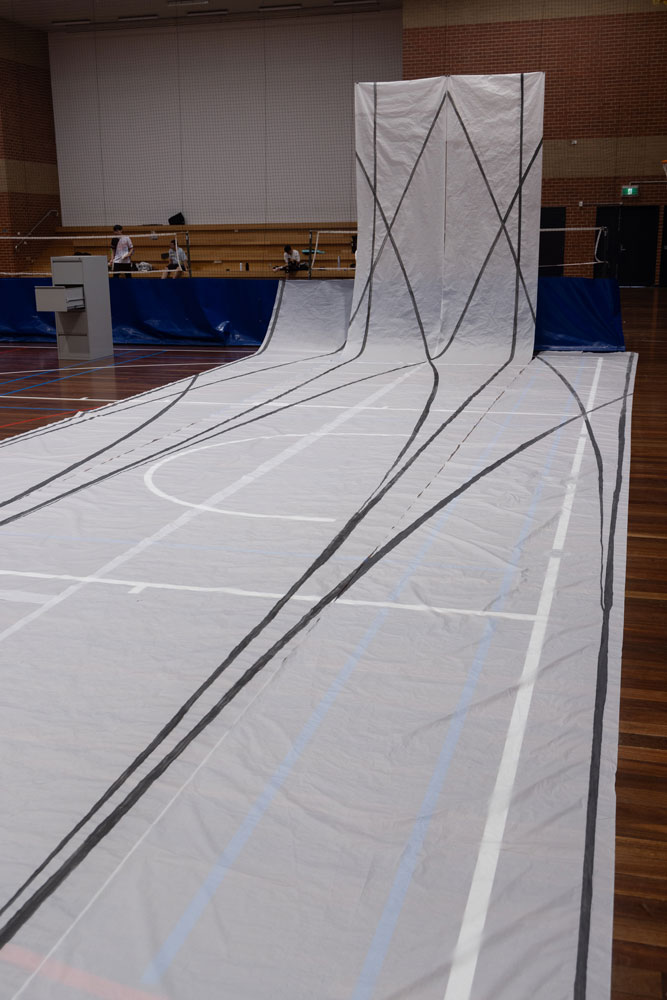
Image of trial installation.
Mentorship and creative growth
Supervision also played a key role in her development.
“Tamsen Hopkinson, my supervisor, really pushed me. We set weekly goals—questioning everything from scale and context to what it meant to use a particular paper. She deepened my critical awareness over the course of the year.”
She also credits the generosity of staff across the program, from spontaneous book recommendations to studio conversations.”
Digression as process
Ebony’s art practice has always been expansive and intuitive, evolving through what she calls a “digressive” process—a term she borrows from filmmaker Lars Von Trier.
“Digressionism is a model that forgives indecision and finds meaning in divergence. That’s how I work: one thing leads to another.”
Whether it’s walking past a manhole cover, encountering an old ironing board, or stumbling on a light leak in a film strip, her work begins in the ordinary and spirals outward into the poetic.
Masters, residencies and beyond
Looking ahead, Ebony is focused on her Master of Fine Art project, which will centre on artist-run and facilitated exhibitions, including a planned show in Colombo, Sri Lanka in 2026. She’s also interested in residencies—particularly the Australian Tapestry Workshop—and has her sights on studying abroad. “I’ve been checking out some European art schools,” she says.
Advice for emerging artists
For fellow emerging artists, her advice is grounded in realism and resilience.
“Treat Honours and studio time like a job. Invest financially and emotionally in your practice. You have to be your own patron, registrar, and publicist to begin with. Also, allow for an ego death. Take critique, be flexible, and filter what’s useful.”
New possibilities
Ebony’s participation in ‘Hatched’ provides a new platform of opportunities.
“It opens my practice up to the rest of Australia,” she says. “I’m excited to meet other artists and have conversations that will keep the momentum going.”
In a practice defined by layered meaning, archival gestures and quiet accumulations, ‘Hatched’ is the next point of departure in Ebony’s unfolding journey—one marked by curiosity, reflectiveness and care.
‘Hatched: National Graduate Show 2025’ runs at PICA from 2 August to 5 October 2025.