
West Java backs Monash and UI nature-based water security project
The West Java Provincial Government has formally received the Phase 1 Concept Design for the Citarum Oxbow Remediation and Enhancement (CORE) Project on the Citarik River, led by Monash University and Universitas Indonesia. The first project of its kind in Indonesia, CORE will turn degraded oxbows, river bends cut off from the main river, into constructed wetlands that treat river water and recharge groundwater for up to 15,000 people in Cibodas and Padamukti.

Image: Citarik River
Professor Tony Wong of Monash University and Dr Reni Suwarso of Universitas Indonesia presented the design to the Regional Secretary of West Java at the Provincial Government House in Bandung. The Regional Secretary will share it with all relevant government agencies.
The handover signals the province’s intent for agencies to work together to deliver the project. It follows a commitment from the Bandung Regency Government to acquire the land, backed by the Governor of West Java, for whom water security is a key priority.

Image: Herman Suryatman (Regional Secretary of West Java) signing CORE Design Acceptance.
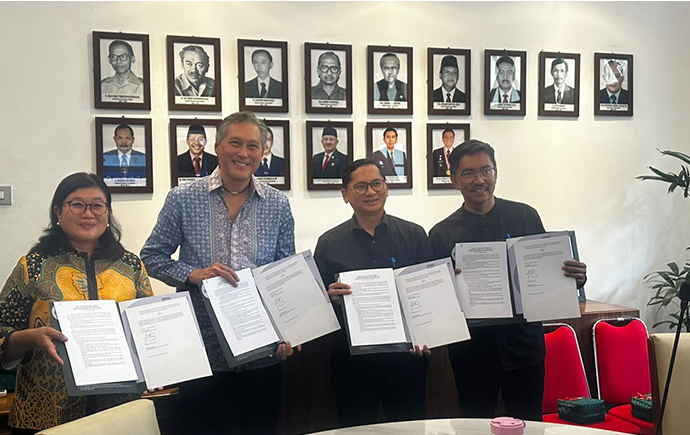
Image: L-R : Dr Reni Suwarso (UI); Prof Tony Wong (Monash); Dr Indra Maha (Expert Staff to the Governor of West Java Province for Economic and Development); Dicky Achmad Sidik (Head of the West Java Water Resources Agency)
Professor Tony Wong, Monash Art, Design and Architecture, said:
“CORE treats nature as infrastructure in using the landscape’s own features to clean river water to a standard suitable for groundwater replenishment, close to the people who need it. With the strong support of the West Java Government, this can become a blueprint for decentralised, climate-resilient water security across rural and peri-urban Indonesia.”
A local model for water security
CORE offers a decentralised, nature-based alternative to large centralised water infrastructure. It turns neglected oxbows into community water assets that also restore habitat and support biodiversity. Many oxbows in the region are former river bends cut off from the main river by river engineering. In the Citarik River, a tributary of the Citarum River, they have been degraded by farming, aquaculture, housing encroachment and waste dumping.
Near the villages of Cibodas and Padamukti, CORE is developing a water security system that works in five steps.
- Polluted river water is pumped from the Citarik into the oxbows during suitable hydrological conditions.
- Constructed wetlands, planted with local species and finished with a sand filter, treat it naturally.
- The treated water recharges underground aquifers, which act as natural storage through the dry season.
- Communities draw it through wells for non-potable use, typically within a five-minute walk.
- Dedicated communal filtration plants will improve groundwater quality to potable standards.

Image: CORE team examining plants at the Citarik River bank.
Dr Reni Suwarso, Universitas Indonesia, said:
“True ecological restoration only succeeds when the people living along the riverbanks are at the heart of the solution. From day one, the CORE project has been built on close engagement with the West Java Government, BBWS Citarum, and the local communities of Cibodas and Padamukti. This Concept Design is a shared blueprint that empowers residents to become long-term stewards of their own environment, directly advancing SDG 11 (Sustainable Cities and Communities) and proving the power of SDG 17 (Partnerships for the Goals) in action.”
The project targets about 340,000 cubic metres of groundwater replenishment a year and improved water access for up to 15,000 people. It will also remediate around 0.75 hectares of degraded oxbow landscape.
The need is urgent. The 2026 dry season was the most severe in the 45-year rainfall record, leaving river flows so low that abstraction could stop for up to two months. Storing treated water underground helps communities ride out increasingly frequent extremes as the climate changes.
Built on partnership
The project supports Indonesia’s national policy on conserving and recharging groundwater. It is designed to be replicated along the Citarum and in other river basins across Indonesia.

CAPTION
Dikky Achmad Sidik, Head of the West Java Water Resources Agency, said:
“Revitalising oxbows through the CORE project aligns directly with our agency’s core mandate to safeguard river functions and raw water supplies. Building on our pentahelix collaboration with the Citarum Harum Task Force since 2020, this initiative ensures that ecosystem restoration progresses sustainably from technical design to direct community benefit. CORE directly translates our July 2021 Letter of Intent with Monash University and the Citarik River Area Masterplan, jointly developed with our agency in 2021 and ratified under Bandung Regent Regulation No. 247/2025, into tangible action on the ground.”
What happens next
The next phase covers land confirmation, detailed engineering design, permitting and procurement of wetland plants. Further aquifer testing will confirm storage capacity and the best recharge locations. Early surveys at both sites indicate strong potential for groundwater recharge.
Dr Herman Suryatman, Regional Secretary of West Java Province, said:
“Water resilience is among West Java’s highest priorities, aligning directly with our Jabar Istimewa vision to restore environmental sustainability through river normalisation and spring protection. The CORE project demonstrates how we can rehabilitate watersheds while securing vital water supplies for our communities. Today, we are calling on all relevant regional agencies to work in synergy to advance this project swiftly from planning to on-the-ground implementation, setting a replicable benchmark for other regions across the province.”
About CORE
CORE is part of the Citarum Action Research Program. It is delivered by Monash University (Australia and Indonesia), Universitas Indonesia and Universitas Padjadjaran, in partnership with the West Java Provincial Government, Bandung Regency Government and the communities of Cibodas and Padamukti.