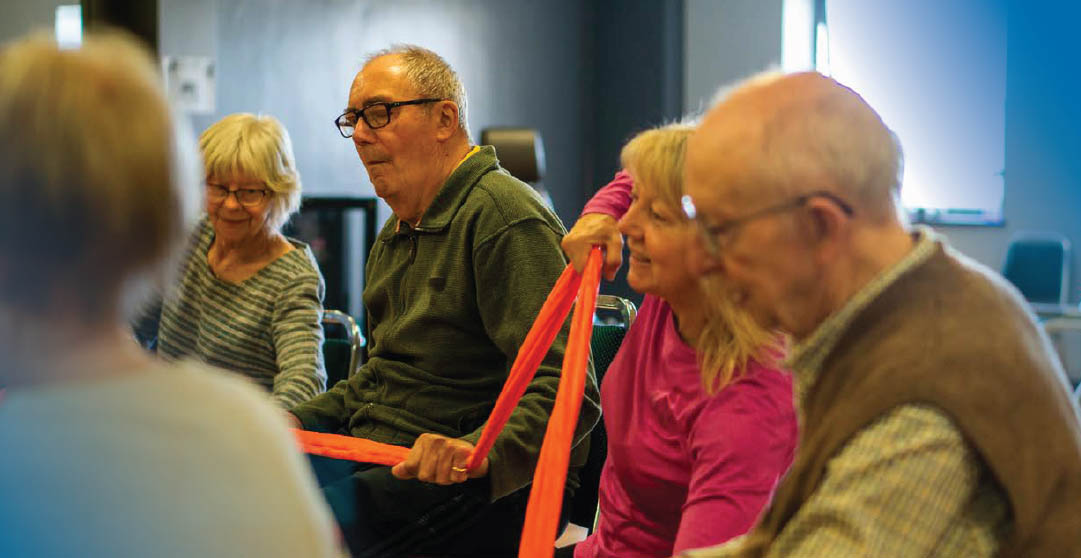
Lower and declining activity levels are common for people with dementia – however they also likely contribute to a decline in physical and cognitive health, increasing the risk of chronic disease and falls, reduced quality of life, and social isolation. This study is developing and evaluating a new model of care to facilitate community-based physical activity engagement for people with mild dementia.
Impact
Creating a new model of care for community-based physical activity engagement for people with mild dementia.
Developing new resources to support training of health care providers and information for people with dementia and their carers.
Outputs
ViewClose
Training program for physical activity providersView
We have developed and launched a training program for physical activity providers.
Please note: this program is not currently publicly available. Contact Professor Keith Hill: keith.hill@monash.edu or Dr Angel Lee: angel.lee@monash.edu if you would like to find out more and/or register to access the program.
Peer-reviewed article: PLOS One (2024), select here to access the article "Changing the focus: Facilitating engagement in physical activity for people living with mild dementia in a local community - Protocol for a pre-post mixed methods feasibility study"
Audio interview: Life Matters, ABC Radio National (2024), Select here to listen to the interview "Could addressing frailty help reduce our dementia risk?" “Professor Keith Hill was interviewed together with Professor Ruth Hubbard (a geriatrician) and Heather Cooper (peer leader and advocate with Dementia Australia, who was diagnosed with dementia in 2019) discussing factors influencing dementia risk. Professor Hill drew on the approach of the Changing the Focus project to share recommendations about increasing physical activity for people living with dementia.”
Associate Professor Michele Callisaya (Peninsula Clinical School, Monash University and Peninsula Health), Dr Claudia Meyer (Bolton Clarke and Adjunct with the RAIL Research Centre, Monash University), Dr Morag Taylor (Neuroscience Research Australia and the University of New South Wales), Dr Katherine Lawler (La Trobe University), Professor Pazit Levinger (Nari and Adjunct with the RAIL Research Centre), Associate Professor Susan Hunter (University of Western Ontario), Associate Professor Dawn Mackey (Simon Fraser University), Associate Professor Elissa Burton (Curtin University), Professor Terry Haines (Head of School of Primary and Allied Health Care, Monash University), Associate Professor Natasha Brusco (RAIL Research Centre, Monash University), Associate Professor Christina Ekegren (RAIL Research Centre, Monash University), Dr Amelia Crabtree (Monash Health)
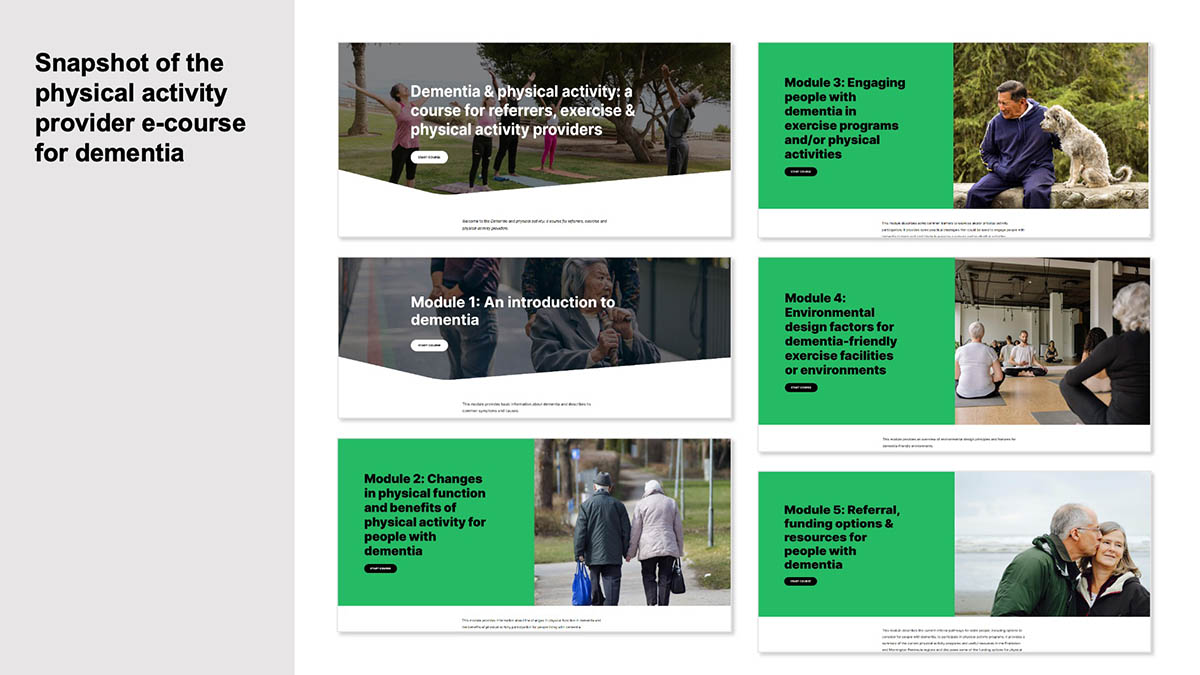
Example modules of E-course for physical activity providers interested in working with people living with dementia
About the research: This study aims to address and improve the low physical activity levels among people with mild dementia through a novel shared decision-making and motivational support program, "Changing the Focus".
Our approach is underpinned by shared decision making with the person with dementia and their carer to improve and maintain function, independence, safety, and quality of life.
The research team is aiming to recruit 60 community living older people with mild dementia and their care-partner in Frankston or Mornington Peninsula region, as well as the City of Casey, City of Greater Dandenong, City of Kingston, and City of Bayside in Victoria. Participants are supported with the help of a research therapist to engage in targeted community-based physical activities for 12-months, to progress towards the recommended physical activity guidelines of 150 minutes per week. Three home visits (baseline, 6- and 12-months) and seven motivational support phone calls (within the first six months) by the research therapist helps support the participant to stay engaged.
Some highlights:
Primary outcomes include participants continuing with the program after 12-months, physical activity per week and program acceptability.
Secondary outcomes include physical performance, mental health, wellbeing measures, and impact on care-partners. Reach, maintenance, safety (falls, other adverse events) and an economic evaluation is being conducted.
Results will inform feasibility, potential benefits, and challenges associated with implementing this innovative physical activity program.
Findings will guide future large-scale studies and contribute to enhancing physical activity opportunities for people living with mild dementia.
Commonwealth Government of Australia through the Community Health and Hospitals Program Grant Scheme (through the National Centre for Healthy Ageing), October 2022 – December 2025.