
There is no demonstrated ‘best’, ‘all purpose’ instrument for measuring quality of life.
Numerous non-utility and multiple multi attribute utility (MAU) instruments exist. Choice unavoidably requires judgement by the researcher. The wrong choice can invalidate measurement.
Choice should reflect three considerations:
The last criterion is commonly given excessive weight. None of the MAU instruments take more than 5-6 minutes to complete. If QoL is an important part of a study, it is unwise to jeopardise the integrity of its measurement for a minimal time saving. We suspect this occurs due to the wrong belief that any ‘validated’ instrument satisfactorily measures QoL.
| Instrument | Items | Completion time | Dimensions included |
|---|---|---|---|
| AQoL-8D | 35 | ~ 5 min | Independent Living, Happiness, Mental Health, Coping, Relationships, Self Worth, Pain, Senses |
| AQoL-7D | 26 | 3-4 min | Independent Living, Mental Health, Coping, Relationships, Pain, Senses, Visual Impairment |
| AQoL-6D | 20 | 2-3 min | Independent Living, Mental Health, Coping, Relationships, Pain, Senses |
| AQoL-4D | 12 | 1-2 min | Independent Living, Mental Health, Relationships, Senses |
Maxwell, A., Özmen, M., Iezzi, A., & Richardson. J. (2016). Deriving population norms for the AQoL-6D and AQoL-8D multi-attribute utility instruments from web-based data Quality of Life Research 25(12), 3209-3219 doi: 10.1007/s11136-016-1337-z
See Research Paper 94 for all published and supplementary tables.
Hawthorne, G., Korn, S. and Richardson, J. (2013). Population norms for the AQoL derived from the 2007 Australian National Survey of Mental Health and Wellbeing, Australian and New Zealand Journal of Public Health 37(1), 7–16 doi: 10.1111/1753-6405.12004.
As generic instruments, the AQoL questionnaires are applicable to all public health and clinical interventions, and can be used in different ways.
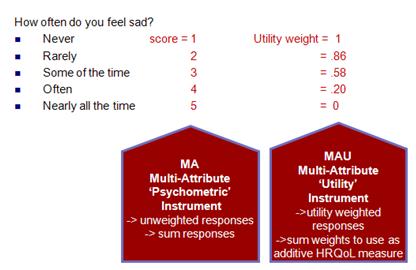
As a 'psychometric' measure: Each instrument can be used to derive a simple psychometric score for health related quality of life (HRQoL) and to provide profile scores on the different dimensions or items of the descriptive systems. The score is derived by adding the unweighted response order of each question.
As a 'utility' measure: When utilities are computed, these instruments can provide dimension scores and an overall index of the health state utility which can be used in economic evaluations, and specifically, cost-utility analysis requiring the computation of quality-adjusted life years (QALYs). The ‘utilities’ are, in effect, preference weights and final utility scores should reflect peoples’ preferences more accurately than unweighted aggregates.
The following example question about feeling sad demonstrates the two ways of scoring:
Please choose the appropriate instrument, statistical package and instructions, then download the algorithms to calculate your scores.
Right click on the hyperlink, as indicated below, to access the zip files containing the algorithms for instruments as required
AQoL-8D utility algorithms
This zip file contains an instruction page and the SPSS and STATA algorithms for AQoL-8D
AQoL-7D
AQoL-7D utility algorithm using AQoL-7D instrument
AQoL 7D utility predicted from VisQoL data
AQoL-6D utility algorithms
SPSS-6D or STATA-6D
AQoL-6D (ADOLESCENT) utility scoring SPSS
AQoL-4D utility algorithms
SPSS-4D or STATA-4D
AQoL-8D
There is an issue with this algorithm, presently being investigated.
AQoL-8D unweighted scoring - Excel
AQoL-7D
AQoL-7D unweighted scoring - Excel
VisQoL unweighted scoring - Excel
AQoL-6D
AQoL-6D unweighted scoring - Excel
AQoL-6D ADOLESCENT unweighted algorithm - Excel
AQoL-4D
AQoL-4D unweighted scoring - Excel
VISQOL
VisQoL Scoring psychometric and standardised - Excel
NB: Correction to the AQoL-6D algorithms
AQoL-6D for adults versus AQoL-6D ADOLESCENT Utility Scores
In the OPIC study adolescent utilities for Australia, New Zealand, Fiji and Tonga were derived by adjusting the AQoL-6D scores for Australian adults. The original 6D utility study estimated 9 separate models.
Model 1 scores may be obtained from the formula:
AQoL-6D (model 1) = [AQoL-6D (Multiplicative)]0.59
This may be further adjusted to obtain the adolescent scores described in Moodie et al. (2010).
AQoL-4D
AQoL-6D
The Multi-Instrument Comparison study allowed mapping to be calculated between multi-attribute utility instruments.
Each instrument has a set of 5 equations that allow transformed scores to be calculated for comparison.
Transformations do not allow the substitution of one instrument for another.
Their purpose is to adjust scores, as far as possible, for differences in the content of instruments. But adjustment is necessarily incomplete.
Consider a health state made up of the various dimensions in Box 1 and outlined according to the descriptive system of the HUI-3 and EQ-5D. The health state includes difficulty with vision and hearing. Omission of vision and hearing from the EuroQoL (EQ-5D) results in a high utility score of 0.8. The HUI which places considerable weight on vision and hearing gives a score of 0.14 to the same individual. (With vision and hearing omitted the HUI score would have scored 0.74). No transformation of the EQ-5D could achieve the HUI-3 result because the base data concerning vision and hearing is not collected by the EQ-5D.
At best, a transformation will alter the relative importance of dimensions which do exist. If the single question relating to emotional state in the EQ-5D underrates its importance then the relative weight might be increased in a transformation from the EQ-5D to the AQoL-8D.
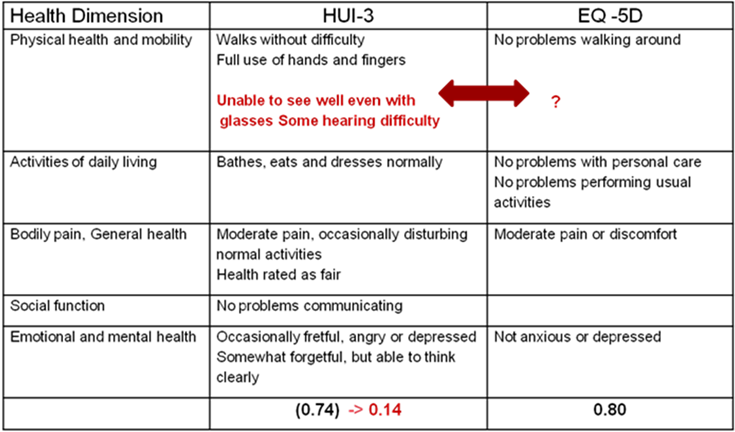
Source: Hawthorne G, Richardson J and Day NA. 2001, ‘A comparison of the assessment of quality of life (AQoL) with four other generic utility instruments’, Annals of Medicine, vol 33, no 5, pp 358-370.
To date, transformations are only available between AQoL-4D and 6D.