
Sustainability and insecurities
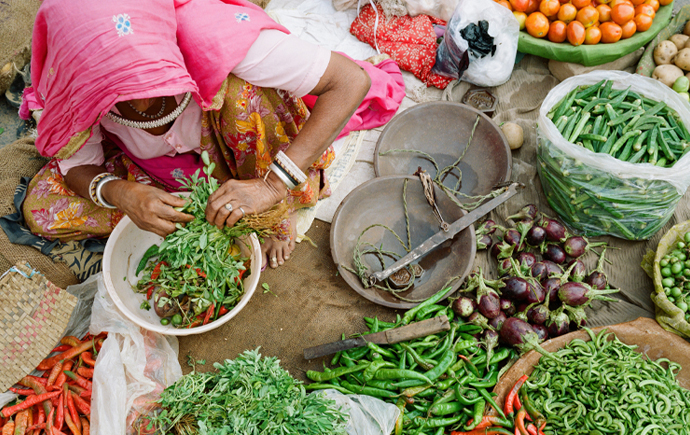
Our work focuses on working with community-based organisations across the geographies to build resilience to climate change by facilitating the expansion of low-carbon agroecological farming systems.
The Intergovernmental Panel on Climate Change (IPCC) has identified the key role of land use change, including agriculture, in driving greenhouse gas emissions. The IPCC’s Fifth Assessment Report (Working Group III) warns that reducing emissions in the agricultural sector is key to limiting climate change in the 21st century.
While the agri-food sector is a major contributor to greenhouse gas (GHG) emissions, agriculture production (which involves millions of farming households in the five countries) is highly vulnerable to climate change. Fostering climate-smart and climate-resilient agriculture and food systems will support decarbonisation and ensure livelihood security, enabling UN signatory countries to meet Nationally Determined Contributions (NDCs).
Our work involves deep engagement with community organisations in South Asia, South East Asia, Africa and the Pacific Island Nations to support their work in the following areas:
- Management of sustainable and equitable agri-food systems
- The role of women in agroecological system change
- Carbon offset markets and human rights.
Our work also focuses on the displacement of people, their meaningful integration into the broader communities and associated geopolitical insecurities.
Our researchers
Collaborators
Monash
External
Our partners
We work in collaboration with the Filipino non–government organisation MASIPAG (Magsasaka at Siyentipiko para sa Pag-unlad ng Agrikultura or Farmer-Scientist Partnership for Development), which focuses on the area of peasant–led sustainable agriculture.
A/Prof Jagjit Plahe is also working in collaboration with the Centre for Sustainable Agriculture (India) and World Vision South Asia Pacific.
Featured publications
- Plahe, J. and Cornwall, W. Agriculture and Technology, (2024) in Cullet, (ed.) The Oxford Handbook of Environmental and Natural Resources Law in India, Oxford University Press: Oxford
- Habiburahman, & Alamgir, F. (2024). Organizing our situated solidarity against misrecognition: The de facto stateless Rohingyas and the political economy of slow and ongoing genocide. Organization, 31(8), 1281-1297.
- Jack, G., Plahe, J., & Wright, S. (2022) Development as Freedom? Insights from a Farmer-led Sustainable Agriculture NGO in the Philippines, Human Relations, 75(10), 1875–1902.
- Bull, A. C., Plahe, J. & Gregory, L., (2021), International Investment Agreements and the escalation of private power in the global agri-food system, Journal of Business Ethics. 170, p. 519-533.
- Plahe, J., Kukreja, N. and Ponnamperuma, S. (2021) The review of Article 27.3(b) and the patenting of life forms: Hitting a BRIC wall in the WTO?, International Negotiation: a journal of theory and practice, 26:2: 289–318.
- Vicziany, M. and Plahe, J. (2017) Food security and traditional knowledge in India: the issues, South Asia: Journal of South Asian Studies, 40(3): 566-581.
- Gregory, L. Plahe, J, and Cockfield, S. (2017) The Marginalisation and Resurgence of Traditional Knowledge Systems in India: Agroecological Islands of Success or a Wave of Change?, South Asia: Journal of South Asian Studies, 40(3): 582-599.
- Plahe, J. Wright, S. and Marembo, M. (2017), Livelihood crises in Vidarbha, India: food sovereignty through traditional farming systems as a possible solution? South Asia: Journal of South Asian Studies, 40(3): 600-618.
- Vicziany, M. and Plahe, J. (2017) Extending traditional food knowledge into new marketing institutions for small farmers in India. Journal of South Asian studies. 40(3): 645-668
Impact
We have engaged with Asian communities through DFAT fellowships which have played a key role in changed practices. The project titled Building resilience in agri-food systems in Asia through sustainable and equitable practices included a series of workshops that encouraged fellows to reflect on the applicability of the learnings and make plans to integrate some of the insights into their own practice.
Following the DFAT program, several organisations diversified their market options through changing agricultural practices relating to planting garlic and ginger following successful field visits to Aussie Garlic (a broad-acre organic farm growing garlic, ginger and turmeric), and Orama Garlic.
One partner is working with the People of Coffee NGO to develop a teaching case for business studies students about issues relating to effective supply chain management, ethical sourcing and purchasing, scaling up small enterprises, and building international markets.
The DFAT program led to a very rich exchange between the organisations from Asia. For example, one of our partners from Caritas (Vietnam) has initiated trials for new marketing and promotional techniques. Also as a direct result of the DFAT program, Caritas has initiated a program of organic certification for their agricultural products. This program, the Participatory Guarantee System (PGS), was introduced to them by MASIPAG in the Philippines.
Funding agencies
| 2023 | Department of Foreign Affairs and Trade, Australian Award Fellowship Project 160086, Building Climate-Resilient Agri-Food Futures: Reducing Emissions and Improving Food Security Through Agroecology; $245,076.91 (Plahe, Lyons and team). |
| 2018 | Sight and Life Foundation, Switzerland; Parenting, Food Practices and Health Conceptions in Bhaktapur. |
| 2017 | Australian Research Council Discovery Grant Project DP170100747, Food security and the governance of local knowledge in India and Indonesia; $257,000 (Plahe and team). |
| 2017 | Department of Foreign Affairs and Trade, Australian Award Fellowship Project 160086, Building resilience and agri-food systems in Asia through sustainable and equitable practices: $291,336 (Plahe, Wright and Jack). |
| 2015 | Department of Foreign Affairs and Trade, Australian Award Fellowship Project R150134, Understanding/promoting links between traditional culture/knowledge, food security and sustainability in South Asia; $292,990 (Plahe and team). |
Watch, listen, read
- The geopolitics of food security: Shifting to sustainable agriculture through global system change, Monash Business School, 2023.