
Building climate resilience through agroecology
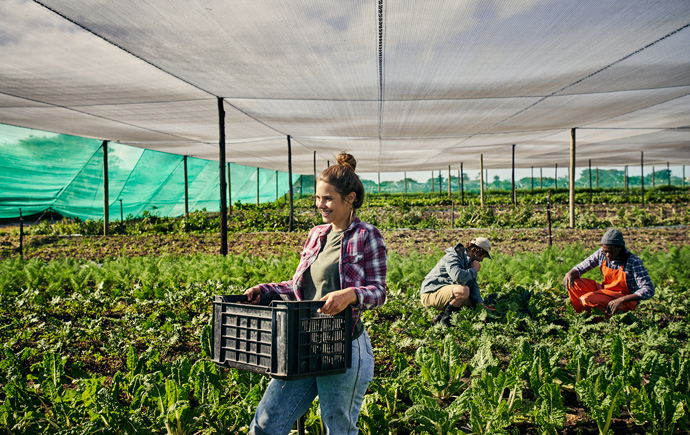
Every year agriculture, forestry and land use are responsible for 22% of global greenhouse gas (GHG) emissions. The Intergovernmental Panel on Climate Change (IPCC)’s Fifth Assessment Report (Working Group III) warns that reducing emissions in the agricultural sector is key to limiting climate change. While the agri-food sector is a major contributor to GHG emissions, agriculture production (which involves millions of farming households across the world) is highly vulnerable to climate change. Fostering climate-smart and climate-resilient agriculture and food systems is vital to supporting decarbonisation and ensuring livelihood security.
In response to this urgent call for transformative change, a pioneering project undertaken by research leaders at Monash University and the University of Queensland took a collaborative approach to inform understanding of the role agroecology plays in supporting the development and scaling of climate-smart and climate-resilient agriculture and food systems. Our focus was to build the capacity of agroecology practitioners in Australia, the Asia Pacific and Africa through knowledge exchange, network development and immersive experiences.
Specifically, this project aimed to develop a shared understanding between 14 internationally based agroecology practitioners and change agents (“Fellows”) from government and non-governmental organisations (India (7), Sri Lanka (2), the Solomon Islands (2) and Uganda (3)) through a rich intercultural exchange of knowledge skills, and solutions needed to develop and promote climate-resilient agriculture along with sustainable and secure food systems. The vision was for the Fellows to become empowered catalysts for change upon returning to their home countries, where they would establish community and regional networks of their organisation to share new knowledge and train other farmers and relevant allies to implement these strategies.
The project consisted of a 20-day residency fellowship program in Australia, including:
- Four online agroecology and climate resilience workshops before the fellows arrived in Australia.
- A series of workshops designed and run by Monash and UQ subject area experts and external collaborators. E.g. CERES and Crystal Waters.
- 13 days of field visits in regional Victoria and in regional Queensland.
- A two-week extension program in India (for Indian-based fellows)
- Two follow-up online workshops on research and writing skills.
The project's success and highly impactful outcomes are rooted in the extensive foundations and networks Associate Professor Plahe and Professor Lyons have developed with organisations in these countries over the past twenty years.
Outcomes
- An agroecological plan has been developed and is being implemented by the Suubi Education and Community Development Centre in Uganda
- A research project on organic agriculture has been instigated and funded in Sri Lanka
- New curriculum materials have been developed for primary schools on agroecology in West Bengal, India
- A collaborative agroecological research study spanning India, Bangladesh, and Sri Lanka, led by World Vision Asia Pacific.
- A research project is underway on how participatory organic certification systems are helping farmers in India.
- A project in India measuring the impact of agroecology on soil and biodiversity.
Monash researchers
Want to know more?
- Sustainable agricultural practices could be the solution to quell concerns of Indian farmers: Analyst, Channel News Asia (CNA)
- Building Climate-Resilient Agri-Food Futures: Reducing Emissions and Improving Food Security Through Agroecology No. R180673
Acknowledgement
The project was part of the Department of Foreign Affairs and Trade (DFAT) Australian Fellowship Program. A grant of AUD $245,076 was provided by DFAT for this project.