
Research studies currently seeking recruits
The return to work after traumatic brain injury (TBI) phone app
Calling all individuals with brain injury who are returning to work!
Calling all clinicians who provide vocational support to individuals with TBI!
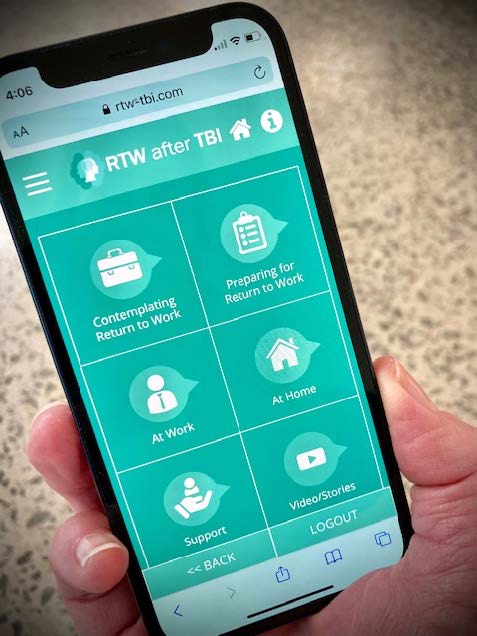 Dr Lauren Libeson, Dr Pamela Ross, Dr Marina Downing and Professor Jennie Ponsford, expert clinicians and researchers in brain injury and vocational rehab, have developed a return to work after traumatic brain injury (TBI) phone app: The "RTW after TBI app".
This brand-new app contains practical information to help plan for returning to work. It includes some of the difficulties encountered when returning to employment after brain injury and strategies to manage these challenges. It also contains videos of individuals with brain injury who share their experiences of return to work.
It has been designed to provide useful information and emotional support to assist you during your return to work journey.
To determine whether the app can improve return to work experiences for individuals with brain injury, we are conducting a clinical trial.
We are looking for...
1) Individuals with TBI
We are looking for individuals with TBI who are returning to work to take part in this trial by downloading the app (assistance to do this is available) and using the app to find out information about, and support with returning to work following a brain injury. You will be asked to complete some short surveys upon commencing the study and again at 6 months. You may also be asked to participate in an interview to provide your views on the strengths and weaknesses of the app. More information (PDF, 0.8 MB).
2) Clinicians who provide vocational support to individuals with TBI
We are looking for vocational and return to work providers to take part in this trial by a) providing us with your feedback on the app and b) assisting us to recruit your clients to take part.
You will then be asked to invite your clients with TBI to use the app to assist their return to work, and participate in the trial. You and your clients will be asked to complete some short surveys upon commencing the study and again at 6 months. You will also be asked to participate in an interview to provide your views on the strengths and weaknesses of the app. More information (PDF, 0.78 MB).
If you are interested in participating, please contact Emily O'Kearney
Email: emily.okearney@monash.edu
Ph (03) 9426 8923
Longitudinal head injury study – Influence of cultural background
Within a multicultural society, people from different cultural backgrounds often have different beliefs and practices with regard to illness and injury. Little is known about the experiences of people from different cultural backgrounds following traumatic brain injury. This study will aim to obtain a better understanding of the ways in which cultural beliefs influence rehabilitation and outcomes following traumatic brain injury. By obtaining this information, health professionals can provide the most appropriate care to a culturally diverse patient population and their families.
Participation will require approximately one hour of your time. You will be asked to complete a series of questionnaires, covering demographics, preferred language, and views regarding injury and recovery and assessing your English language proficiency. You will also complete a measure of your motivation and attitudes toward rehabilitation and rehabilitation therapists, a measure of your ability to carry out day to day activities (e.g., housework) and your employment status, and a measure of physical, social and occupational functioning. In addition, we will also be obtaining information relating to your injury and your rehabilitation history from your medical files.
Recruitment is ongoing for this study.
Inclusion Criteria
- Have sustained a traumatic brain injury
- Born overseas (excluding UK, USA & NZ)
- Non-English speaking background
- Aged 18 or above
Exclusion Criteria
- Patients who have had a previous TBI, or currently have a degenerative condition including any form of dementia, Parkinson’s disease, Multiple Sclerosis and brain tumour
Contact: Elinor Fraser
Phone: 03 9426 8923
Email: Elinor.Fraser@monash.edu
Cognitive behaviour therapy for sexuality disturbance after traumatic brain injury
Traumatic brain injury (TBI) often results in sexuality changes which can interfere with the person’s sexual satisfaction, self-esteem, body image, mood, social participation, relationship intimacy, and overall quality of life, for some years after the injury. This study aims to evaluate the effectiveness of a holistic cognitive behaviour therapy (CBT) program addressing sexuality difficulties in individuals with traumatic brain injury. Participants will receive 8 one-on-one therapy sessions with a clinical psychologist. Participants will be asked to complete research questionnaires throughout the course of the study. This study can be completed in person (Melbourne) or via telehealth (Australia-wide).
Recruitment is ongoing for this study.
Inclusion Criteria
- History of traumatic brain injury
- Sexuality difficulties resulting from TBI
- Aged between 18–65
Exclusion Criteria
- Presence of other neurological disorders (e.g., multiple sclerosis, dementia)
- Severe psychiatric symptoms or substance abuse
- Insufficient English language or cognitive capacity
Contact: Elinor Fraser (Study Coordinator)
Phone: 03 9426 8923
Email: elinor.fraser@monash.edu
Understanding, preventing and treating cybercrime after acquired brain injury
Cybercrime includes scams (being cheated or ripped off), identity theft and online bullying. Cyberscams are common and can be very upsetting. People with brain injury may be at more risk of being scammed and they may find it harder to get help. There are currently few training tools or information for people with brain injury to learn about scams and recover from being scammed. Together with people who have lived experience of brain injury, we are creating on online education program to help people with brain injury improve their ability to identify and avoid scams.
We are looking for people with brain injury who have experienced a scam to help us co-design this resource by taking part in up to 3 focus groups. A focus group is when a small group of people come together to discuss a new product. In the focus group, we will ask you for feedback on our online resource, for example, what you like or dislike about the online training we have created. The focus groups will be held in Notting Hill, Victoria and online using Zoom. There will be 2-6 people in each group. The groups are being held in April, May and June.
Recruitment is ongoing for this study
Inclusion Criteria
- Have an acquired brain injury (e.g. traumatic brain injury, stroke)
- Have experienced a scam
- Are 18 years of age or older
- Have sufficient cognitive capacity to understand a plain language explanatory statement, provide informed consent, and participate in up to 3 focus groups of approximately 1.5 hours each (with breaks)
Exclusion Criteria
- Live outside of Australasia
- Do not have a sufficient cognitive capacity to understand a plain language explanatory statement, provide informed consent, and participate in up to 3 focus groups of approximately 1.5 hours each (with breaks)
Contact: Kate Gould (Study Coordinator)
Phone: 0473 370 030
Email: Kate.Gould@monash.edu