
Indigenous Knowledges and nutritional, health and wellbeing
Acknowledgements
The information within this project was largely from Maningrida (Manayingkarírra) community located on the traditional lands of the Kunibídji People and several surrounding homelands including Nardilmuk, Ji-bena and Gupanga located in the central coastal Arnhem Land region of Northern Territory, Australia. We recognise the Aboriginal People of those regions and their continuing culture and connection to the land and waterways, and we pay respect to their Elders past, present and emerging. We acknowledge and thank the members of the Maningrida arts and culture sub-committee who provided support of the project. We thank all participants of the research and key Traditional Owners who were extensively engaged in the research: Don Wilton, Jimmy Olsen, Stuart Ankin/Yirawara, Michael Anjaramarr and Randall Darcy
Recent project outcomes
Our partners
Bawinanga Aboriginal Corporation, Charles Darwin University (Research Institute for the Environment and Livelihoods) and Monash University.
What is the fisheries research project?
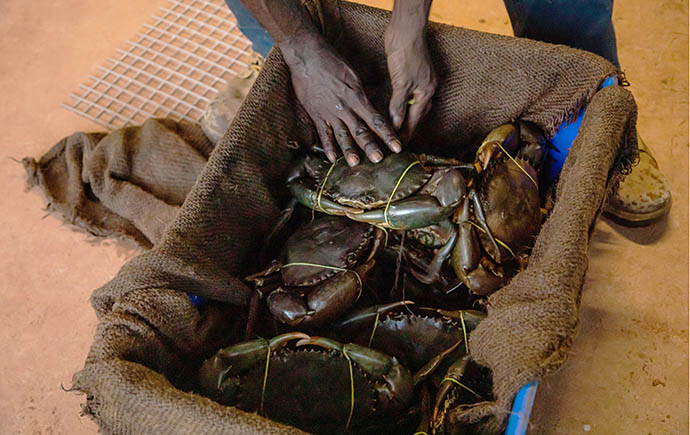 Aboriginal fishing enterprises in the Northern Territory aim to improve community livelihoods by providing access to nutritious, diverse, and culturally significant food supply. This research project seeks to further understand from an Indigenous perspective how seafood accessed through Indigenous fishing enterprises can strengthen nutrition, health, and wellbeing outcomes. Currently there a missed opportunity to support Indigenous fisheries role in improving health and wellbeing as there are gaps in the literature that don’t fully recognised the contributions of Indigenous fisheries to collective sociocultural values linked to Indigenous health outcomes. This project seeks to explore this gap through methodologies that centre Indigenous ways of knowing, being and doing through ensuring the research was led, undertaken, and interpreted by Aboriginal people. This approach was taken to create appropriate outputs that align with Indigenous worldviews and aspirations related to Indigenous fisheries. It is hoped through this project a contribution can be made to strengthening fisheries sectors across the Northern Territory and Australia to positively impact health and wellbeing outcomes that is aligned with Aboriginal and Torres Strait Islander people’s priorities and aspirations.
Study aims
In consultation with Traditional Owners of Maningrida and Bawinanga Aboriginal Corporation it was acknowledged that there was a need to make the findings of this research available to the community to enhance inter-generational knowledge and support strengthening the Aboriginal fishing enterprise. The following objectives have been developed to document and communicate the nutritional, health and wellbeing benefits of seafood from an Indigenous knowledges’ perspective
- To document Indigenous Knowledges on the understanding of the nutrition health and wellbeing benefits and the value and meanings of locally caught and consumed seafood
- To develop outputs (e.g., poster, booklet) based on Aboriginal Knowledge and nutrition profiling of identified seafood species for intergenerational knowledge transfer
- To develop a description of Indigenous nutritional, health and wellbeing values that are linked to seafood and represent key values linked to the Indigenous Knowledge system understanding of health
- Understand how health and wellbeing values are conceptualised and represented in current coastal, marine and fisheries policies in Australia’s NT from and Indigenous perspective
Investigator team
- Dr Beau Jayde Cubillo (Larrakia and Wadjigan) (Project Lead), Menzies School of Health Research
- Prof Julie Brimblecombe (Principal Investigator), Monash University
- Prof Natasha Stacey (co-Investigator), Charles Darwin University
Research methods
This project comprises of three distinct parts guided by Indigenous research methodologies to position the research within an Indigenous worldview. This informed the design, implementation, analysis, and synthesis of the research to centre and privilege Indigenous ways of knowing, being and doing. PART A.) of the project utilised an Indigenist inquiry lens with Yarning as a data collection method; PART B.) utilised a content analysis approach to a policy analysis; and PART C.) involved a nutritional analysis of key seafood species undertaken in scientific laboratories within Australia and guided by Bawinanga Aboriginal Corporation.
Who will benefit?
This research will provide new insights to ensure the development of Indigenous fisheries that respect the nutritional, health, and cultural values of seafood. It will also document and share Indigenous knowledges and nutrition information about specific seafood species for future generations in the Maningrida community.
Related publications
Cubillo, B., Stacey, N. &Brimblecombe, J. How is nutrition, health and wellbeing conceptualised in connection with seafood for coastal Indigenous Peoples’, Food Policy, Volume 116, 2023, 102434, ISSN 0306-9192, https://doi.org/10.1016/j.foodpol.2023.102434.
Cubillo, B., Brimblecombe, J. & Stacey, N. The representation of Aboriginal health and wellbeing values within coastal marine and fisheries policies of the Northern Territory of Australia. Maritime Studies 23, 27 (2024). https://doi.org/10.1007/s40152-024-00370-4
Cubillo, B. (2023). The conceptualisation and representation of coastal Indigenous Peoples' health values in connection to seafood and the implications for policy, Monash University.
Seafood builds physical and cultural health of indigenous communities: https://www.frdc.com.au/seafood-builds-physical-and-cultural-health-indigenous-communities
Contact
Dr Beau Jayde Cubillo
beau.cubillo@menzies.edu.au