
Jurie Tashkandi
Bachelor of Biomedical Science (Honours)
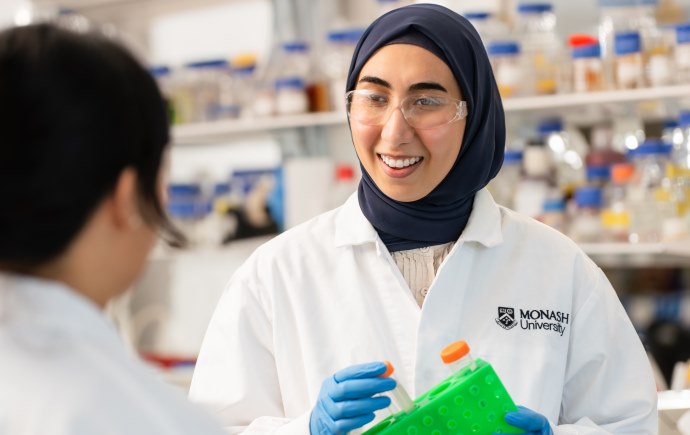
Jurie Tashkandi grew up in a home where curiosity about science was part of daily life. Her father is a doctor and she was surrounded by people working in the medical field. This has sparked an active interest in the potential of science to unlock mysteries and to make a valuable contribution to solving complex medical issues.
“I studied biology, chemistry and physics at high school but biology always made the most sense to me because it had the potential to make an impact on someone’s life and help manage disease.”
During her undergraduate degree, Jurie completed a short research project and spent time in a lab conducting experiments, which led her decision to do Honours in 2020.
“As an undergraduate I remember the first time I used a microscope and saw the bright colours of some cells I’d stained with different dyes – I realised this was real science.”
Jurie attended the Honours information night, spoke to various lab heads and chose a research area she’d never encountered before — nanotechnology. She was supervised by Dr Karen Alt in the NanoTheranostics lab in the Australian Centre for Blood Diseases who is also Jurie’s PhD supervisor.
The key objective of Dr Alt’s NanoTheranostics lab is to develop imaging techniques to better understand the underlying mechanisms of different disease progression and the impact of targeted therapies.
Theranostics is an emerging medical field which combines diagnostic and therapeutic capabilities with one single agent for more specific, individualised therapies for various diseases. Recent advances in nanoscience provide opportunities to design and combine three aspects: targeting, diagnosis and therapy with one nanoparticle for a more personalised treatment.
Using targeted drug-loaded nanoparticles to deliver therapies to pathological sites could improve patient treatment efficiency with less adverse effects than currently available treatments. Incorporating a targeting biomolecule, such as an antibody or peptide, also allows the precision delivery of a drug payload that can distinguish between healthy and diseased tissue.
Imaging functionality can also detect diseases at an early, potentially curable stage and identify patients likely to respond to certain treatments.
Jurie’s Honours research used nanoparticles called metal organic frameworks that were modified to attach antibodies to their surface.
“Antibodies are targeting agents that can bind specifically to a type of cell you want them to bind to. My research project used antibodies specific to platelets in the blood that are involved in stroke – when you have a stroke, you have a lot of platelets in a specific region. The aim was for the nanoparticles to go to the platelets and bind to them so we can image them and detect early signs of stroke, before a full blockage of an artery triggers a full stroke.”
This research could help people identified at high risk of stroke undergo a scan after being injected with nanoparticles. Any blockage could be treated early, before stroke occurs and lifestyle changes to prevent stroke could be discussed.
Jurie had to ‘characterise’ the nanoparticles to ensure they were the correct size and carried out the task they were designed for. She used a technique called flow cytometry to detect specific platelets and then see if the nanoparticles were binding to those platelets using fluorescent signals.
“I learned how to use a flow cytometer that uses lasers to excite the fluorescent tags attached to the nanoparticles and showed if they were binding by emitting light back at a certain colour that the machine detects. I’d never worked with nanoparticles or used a piece of equipment like that before. Karen knew everything was new to me and took me through the theory and while she gave me the opportunity to figure out how to run experiments, I could ask for help when I needed it.”
Jurie’s PhD research has used similar techniques but focuses on how nanoparticles can aid tumour detection.
“I want to remain in research and I’d like to do a post-doc and perhaps go overseas to broaden my research experience at some point. Research is a high-risk, high-reward area but the science behind it intrigues me.”
“It has been a pleasure working with Jurie during her Honours and now seeing her pursue her PhD in my lab. She is focused, curious about science and an excellent problem-solver — qualities essential to scientific research,” says Dr Alt.
“Supporting and following a young scientist on their journey, especially one as talented as Jurie, is truly rewarding.”