
Lachlan Bradbury
Bachelor of Science (Honours)
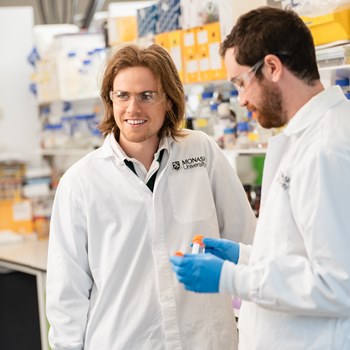
On 30 January 2020, the World Health Organization (WHO) declared the novel coronavirus outbreak a public health emergency of international concern and six weeks later, it was declared a pandemic. By May 2024, 775 million COVID-19 cases had been reported to WHO.
While vaccinations were swiftly mobilised to counter rising COVID-19 infection rates, for some people vaccinations may offer less protection.
Lachlan Bradbury is spending his Honours year researching COVID-19 vaccine responses in people with inflammatory bowel disease who are on a range of immunosuppressant medications to control their disease.
He is part of a larger research team working on an Australian Medical Research Future Fund (MRFF) funded study — the PROPHECY study — that is examining immune responses to COVID-19 vaccination, particularly in at-risk populations such as people on immunosuppressive medication.
“Because these patients are on drugs that inhibit the immune pathways that are important for generating an immune response and memory, the COVID-19 vaccine response may not be as effective. The immunosuppressant drugs inhibit certain immune cell pathways from acting as they normally would, so there is not as powerful a response to the vaccine.”
Lachlan’s project is entitled ‘Assessing immune competence to SARS-CoV-2 vaccination in inflammatory bowel disease patients with Infliximab treatment’.
Working within Monash University’s Department of Immunology, he is based in the Burnet Tower at The Alfred and spends about three days a week in the lab, and the remainder of his time completing coursework and analysing the outcomes of his experiments.
Lachlan decided to do Honours during the third year of his undergraduate studies after completing a 12-week Research in Action unit at Monash University’s Clayton campus examining immune peptides associated with Multiple Sclerosis.
“I enjoyed the lab work and the discovery – the idea of not knowing something and then problem-solving to work it out. I had an interest in immunology and cellular biology and during the Honours Night last year, I discovered Dr Paul Gill’s work with the PROPHECY Study.”
Lachlan is being supervised by Dr Gill and Associate Professor Miles Sparrow, Director of the Inflammatory Bowel Disease Unit at The Alfred.
Inflammatory Bowel disease is believed to affect approximately 1 in 250 Australians and numbers are rising although the reasons behind the increase aren’t clear. Crohn’s disease and ulcerative colitis are the two most common types of inflammatory bowel disease.
“My research is focusing on the formation of immunological memory, particularly looking at Memory B cells that contribute to antibody production and are very important for immune protection in the longer term.”
Lachlan is using blood samples from patients with inflammatory bowel disease to check antibody and Memory B cell levels at various periods after they receive a COVID-19 vaccine, to see the strength and durability of response to the vaccine.
“So far, we have seen a quicker decline in immune response to the vaccines in patients on infliximab combination therapy, rather than those just on one medication. The research may inform clinicians that patients on immunosuppressant treatment need these vaccines more frequently, or need the newer vaccines that are designed to combat emerging variants of COVID.”
Lachlan is also using his Honours experience to help him decide whether to continue his research and begin a PhD.
“If you come into an Honours year, you have to be fully prepared for the work involved. You have to be in the right headspace to deal with some of the stresses and to know your research won’t always be smooth sailing. There will be failures but there are plenty of people on hand to support you through that, and you will build your knowledge and skills. It’s a valuable experience.”
“The translational nature of Lachlan’s project really piqued his interest and it’s very rewarding to generate data that can be directly applicable to patient care,” says Dr Paul Gill.
“Lachlan has been a quick learner and he has developed plenty of technical skills in the lab to really make this project his own.”