
Meltem Karadeniz
Bachelor of Science (Honours)
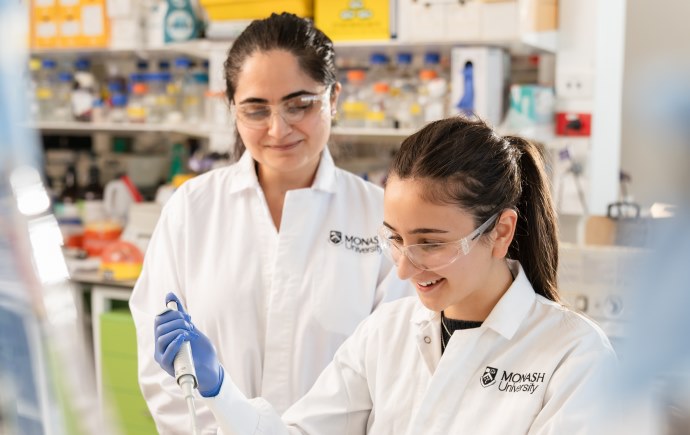
Meltem Karadeniz knew she wanted a career in science while she was still at high school. During biology classes, she was fascinated by immunology and how immune cells interacted to create complex pathways and processes.
She also wanted to explore diseases of the immune system and this curiosity was instrumental in Meltem’s decision to study a Bachelor of Science at Monash University and to complete an Honours year in 2023.
The first few years of Meltem’s undergrad degree covered a broad range of subjects, but by the third year she was specialising in immunology and preparing to choose an Honours project that further her knowledge while developing her lab-based and research skills.
“As an undergrad, you get into the lab a little, but Honours is when you take steps towards becoming an independent researcher and discovering if research is for you. I knew it would also open up opportunities for me to do a PhD.”
A technical assistant in one of Meltem’s undergrad classes gave her advice when choosing an Honours project.
“He told me to find a supervisor whom I liked and the project should come second, and I kept that in mind at the Honours information night. I found two projects that interested me and I spoke to the supervisors to find someone I felt comfortable asking questions.”
Meltem’s supervisor was Associate Professor Mastura Monif, Head of Neuroimmunology, Neuroinflammation & Neuro Oncology Lab at Monash University, and Meltem’s project centred on understanding biomarkers of Multiple sclerosis (MS) relapse versus remission. She was based at The Alfred Centre where she was supervised by A/Prof Monif and Dr Robb Wesselingh.
MS is a disease in which the body’s immune system mistakenly attacks the protective myelin coating on the nerve cells in the brain and spinal cord. It affects around 2.8 million people worldwide.
Early stages of MS are often characterised by disease exacerbations or ‘relapses’ that worsen symptoms such as limb weakness, blurred vision, numbness or pins and needles. Between relapses, symptoms may stabilise – referred to as remission.
Currently, there are no sensitive or specific markers to diagnose MS relapse and Meltem’s project examined potential relapse versus remission biomarkers.
“In an immunological sense, we don’t know what distinguishes a relapse from a remission, but a biomarker could separate the two disease states, help diagnosis, and be a target for immunotherapy. I looked at different cells and proteins to see whether there were a higher or lower frequency of certain cells in relapse or remission.”
Meltem found important changes in peripheral blood lymphocyte, monocyte and neutrophil counts during relapse versus remission.
“When I started Honours, I had imposter syndrome and I was nervous as I learned new techniques in the lab and dealt with patient blood samples. However, there was always someone to show me how to use equipment or to perform the next experiment.”
Meltem has started a PhD to continue her research with larger sample sizes and to also examine whether brain lesions in certain areas relate to specific MS symptoms.
“Meltem’s Honours project was highly successful,” says A/Prof Monif.
“She is a very diligent and hard-working student and we are all very proud of what she has achieved. We know that Meltem will go on to achieve many greater scientific discoveries in the years to come.”
On a personal level, Meltem is motivated to progress understanding of MS as her father has lived with MS for years.
“A big concern for patients with MS is the uncertainty surrounding the disease. A biomarker would allow a practitioner to tell a patient they are or aren’t having a relapse so it can be treated appropriately. If we find a biomarker, treatments could be developed to reduce the cells or proteins that are elevated during relapse to improve patient outcomes.
“As I child I remember Dad would read articles about new developments that promised to improve life for people with MS — it would be nice to contribute to that.”
To learn more about the Monif group, visit - https://www.monash.edu/medicine/translational/neuroscience/research/monif-group