
Svetlana Brillantes
Bachelor of Biomedical Sciences (Honours)
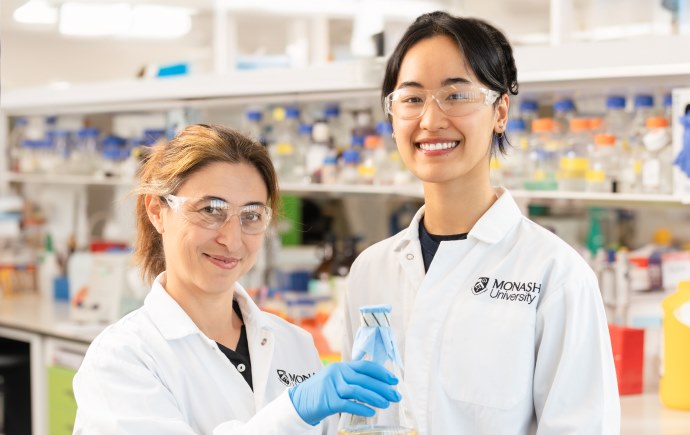
Last year, more than 2,500 Australians were diagnosed with gastric (stomach) cancer and worldwide, it’s the fifth most common form of cancer. As many early symptoms such as indigestion are overlooked, often the disease is not diagnosed until it is well advanced.
Once people are diagnosed, the chance of surviving at least five year is 34 per cent.
Monash University Honours student, Svetlana Brillantes, is hoping to shed light on the function of a specific gene implicated in the development and progression of gastric cancer, and the information she discovers could eventually contribute to new therapies and treatment options for gastric cancer patients.
Svetlana is completing her Honours year in the Department of Gastroenterology under the supervision of Department Head, Professor Alex Boussioutas, and Dr Rita Busuttil. Much of Svetlana’s research will be completed in the new Paula Fox Melanoma and Cancer Centre.
“During my undergrad degree I didn’t do much research and I decided to do Honours to see what the world of research is like. So far, it’s pretty cool! I wanted to feel comfortable in the lab environment. I threw myself in at the deep end and I’ve had to learn lab techniques from scratch but I’ve been well-supported by my supervisors who’ve been with me at every step.”
During the Honours information event in 2023, Svetlana spoke to potential supervisors to discover more about their projects. She chose cancer research because she sees it as being at the ‘forefront of research’ and because the disease’s underlying mechanisms have not yet been fully explored.
“In my final year of Biomedical Science, I began to gain an appreciation of how difficult it is to try and treat cancer. It’s an intelligent disease that knows how to take advantage of our body and to become aggressive.”
Specifically, Svetlana is researching a gene called IGFBP7 (Insulin Growth Factor Binding Protein 7) that previous studies have found is implicated in the progression of gastric cancer.
“The aim of my research is to tease out the role that IGFBP7 plays in gastric cancer. We can use these findings to determine whether IGFBP7 levels could help diagnose gastric cancer and diagnose it earlier. Alternatively, IGFBP7 could also be a target for generating treatments that target gastric cancer more effectively.”
Svetlana uses actual gastric tumour samples to carry out her experiments such as functional assays where she targets the gene, dampens its function and then assesses how that dampening affects cancer mechanisms. She’s also learned to perform techniques such as immunohistochemical staining to gauge how much IGFBP7 is expressed in a tumour sample.
When she isn’t carrying out experiments, Svetlana has learned how to record, organise and analyse clinical data.
“The most exciting moments are when I get to a point in an experiment where I can do what I need to do confidently on my own. Then I’ve got a true feel for what I’m doing and a deeper understanding of the principles behind the experimentation. You can follow a simple lab protocol, but if you don’t understand the fundamentals behind it, there is less room to be innovative in the future.”
Dr Busuttil says Svetlana’s Honours research could potentially lead to further exploration of IGFBP7 as a therapeutic target for gastric cancer.
“To get the most out of an Honours year, it is important for students to be engaged and interested in their topic. Svetlana has been great in this regard and we are all excited to see the outcomes of this research,” she says.
At the end of the year, Svetlana will choose between research and a PhD or a career in medicine.
“Medicine has been an interest for some time but because of the experiences I’ve encountered during Honours, I may continue the work I’m doing in cancer research. I’m keeping both options open for now.”