
Yixuan Wang
Bachelor of Biomedical Science (Honours)
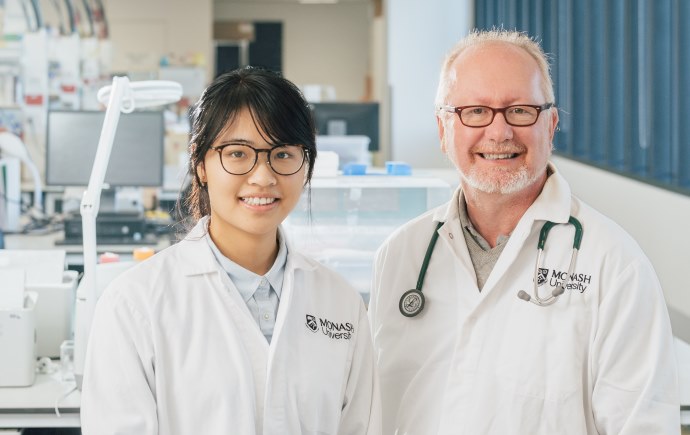
The development of an inhaler that could effectively dial down inflammation in diseases affecting the lungs, such as asthma, bronchitis and chronic obstructive pulmonary disease (COPD), could improve the quality of life for millions of people across the globe.
Knowing the potential far-reaching impacts of such a treatment motivates Yixuan Wang as she completes her Honours year in the Department of Diabetes at Monash University’s School of Translational Medicine.
“I knew I wanted to do translational research – I wanted an Honours project that involved developing a drug or therapy that could help people improve their health. To design a drug that actually helps cure someone – that would be the most exciting achievement.”
Yixuan discovered an interest in research during the second year of her Biomedical Science degree, so she was keen to find an Honours year project that would allow her to pursue that interest.
During the 2023 Honours Night, she learned more about Professor Merlin Thomas’s work in the field of RNA therapy and its potential to treat chronic inflammatory diseases, such as chronic kidney and lung disease, by reducing inflammation.
Yixuan’s Honours research project is on changing the expression of a cytokine, called granulocyte colony-stimulating factor (G-CSF) using Antisense Oligonucleotides (ASOs). G-CSF is a growth factor that stimulates the production and function of neutrophils, and elevated levels of G-CSF are associated with certain chronic inflammatory diseases such as diabetes and chronic lung inflammation. ASOs are incredible versatile molecules that can target messenger RNA (mRNA), so changing protein expression.
In particular, inhaled ASOs are able to selectively modulate G-CSF in the lungs, where is can exert its effect locally. This reduces the overall exposure of the body to the drug, potentially decreasing side effects and increasing the efficienty of the treatment. Yixuan’s research is focused on changing protein production to dampen down inflammation.
“Our aim is to decrease neutrophils, a specific immune cell in the lung that increases inflammation, by decreasing G-CSF that attracts neutrophils into the lung.
“We are using ASOs to target the G-CSF sequence and cut out part of that sequence so when the protein is made, it doesn’t work. As less G-CSF is made, less neutrophils are attracted into the lungs and inflammation decreases.”
The ultimate aim of Yixuan’s Honours research is to find an effective way to use ASOs as a therapy, preferably as an easy-to-use inhaler, like an asthma inhaler.
“But as the drug would remain in the lungs, we think it would only be used once a month for a few months and then the inflammation would be controlled.”
The next step is to move testing into mice models and Yixuan is already considering continuing her research with a PhD.
“Before Honours, I wasn’t sure if I wanted to focus on medicine or research but I’m more inclined towards research. Later this year we will take the therapy into mice models and if it is effective, we’d like to see if it can be an effective therapy for humans. I’d hope to discover that during a PhD.”
At the beginning of her Honours year, Yixuan was unfamiliar with laboratory techniques but she’s received plenty of support from Professor Thomas and her co-supervisor, Arpeeta Sharma.
“I have learned how to grow and culture cells, how to do tests such as polymerase chain reaction tests (PCRs), the western blot and ELISA plate-based assays. My co-supervisor has taught me step-by-step and explained what I am doing and why.
“You quickly learn that experiments aren’t like cooking — you can’t add a bit of extra salt and sugar! You must follow procedures and protocols exactly and I like that precision.”
For anyone considering Honours, Yixuan recommends a Science in Action research unit where students undertake a small research project, work with a supervisor, and complete basic experiments.
Professor Thomas says Yixuan has been an ‘outstanding and motivated student’.
“Importantly, she has always asked the right questions, such as ‘why are we using a particular approach?’ This scientific curiosity leads to fundamental understanding,” he says.
For Yixuan, some of her happiest moments are in the lab awaiting results.
“You never know what results you’ll get. The incubation period when you are waiting for results to materialise is always exciting and, each time, you know you’re making progress and are one step closer to your aim.”