
Alpine Shire Council Community Resilience Committee
Project Summary
 The 2009 Bushfires Royal Commission Implementation Monitor identified the Alpine Shire Council Community Resilience Committee (ASCCRC) as an example of good practice. The National Disaster Resilience Grants Scheme funded the development of a case study to provide information about the ASCCRC success factors and support the development of local government and community structures to increase disaster resilience.
Background and Situation Context
History of the Alpine Shire Council's Community Resilience Committee (ASCCRC)
This committee was borne out of the 2006 Alpine bushfires. Its role as a recovery committee was in response to two fires in the Alpine Shire in 2003 and 2006/2007.
Both of these fires had a significant economic impact in the Alpine Shire. This committee consisted of government and non-government agencies looking at ways to rejuvenate the economic viability of the area. The composition of the committee today is virtually unchanged apart from including some community members.
Today the ASC CRC is working to inform people of the need to be aware of the risks they face where they live and to better prepare and plan for an emergency in order to allow them to enjoy living in Alpine Shire.
In the event of an emergency, this committee will automatically revert to a 'Recovery Committee' to assist our affected residents to get their lives back on track.
The vision of the ASCCRC is
'The people of the Alpine Shire will be empowered to choose, influence and respond to change.'
The ASCCRC understands that 'one size does not fit all' in addressing disaster resilience, and offers this case study in the spirit of sharing useful insights with interested communities, agencies and governments seeking to collaborate and share responsibility for community resilience.
The Alpine Shire is situated in the north east of Victoria approximately 300km from Melbourne. In recent times, the shire has experienced a prolonged drought, major bushfires (4) and flood events (3) and the loss of agricultural industries.
The Community Resilience Committee is central to the Alpine Shire Council's long-term commitment to working together to build individual and community resilience, thus enabling all residents and visitors to look to the future with hope. For further details about Alpine Shire's resilience planning, please see the Resilience Plan 2012-2015 at www.alpineshire.vic.gov.au Emergency- Being Prepared - Community Resilience.
Activities and Results
Bushfires – including Black Saturday and the Harrietville fire, Bogong power station development, flooding and storms, loss of tobacco industry, changing agricultural conditions, chestnut blight, drought, climate change, and black spot communications.
Relief and Recovery activities: Black Saturday bushfire relief centre & coordination of recovery services to fire affected people - accommodation, food, counselling, financial assistance, volunteer support, fencing, grants, potable water, feed stations, information & newsletters, ‘No Bull’ workshops, Men’s Health nights, Pamper Days, Mental Health First Aid courses, advocacy letters.
Projects looking beyond the immediate: Coordinating Victorian bushfire recovery funding applications and projects, communication black spots lobbying, disaster anniversary events, recognising volunteers, Neighbourhood Safer Places vulnerable person’s register, Victorian bushfire recovery funding applications and projects volunteer training, Victorian Bushfire Appeal Fund Into Our Hands development, safety DVD, information kits and fridge magnets.
Building resilience with communities: Resilience Workshop, Resilience Week, CFA community planning, National Broadband Network planning, Disaster Recovery.
Toolkit workshop, Business Continuity workshops, ‘It’s Up To You for 72’ project, Resilience Month, Farming Seminar – Succession.
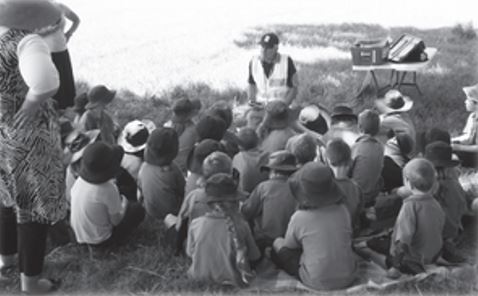
Planning & suicide/trauma, Teens and Alcohol Forum, Resilience Emergency Action Prepare (REAP) school sessions, Myrtleford.
Show – Emergency Management Display, Family Violence workshops, Harrietville Community Plan, Community Foundation workshops, Resilience Champions Project, Emergency Information Kits, Health Promotion, Food Security.
Research, planning and policy: Bushfire research, Murray Darling Basin plan submission, ASC Community Resilience Plan, Through Women‘s Eyes project, heatwave planning, input to Department of Justice Bushfire planning report, Monash University Disaster Resilience Initiative presentations, ASC Liveability Plan, ‘Just Ask’ conference, Victorian state gender & disaster taskforce, heatwave planning, ASC CRC case study.
Next Steps
We are talking about resilience in community, and one of the roles the ASCCRC could look at is how it gets other communities involved and encourage people at the grassroots that have a project and are going to motivate within the community.
Critical Success Factors
The relationship building between community/agencies + agencies/agencies that happens at the ASCCRC was clearly identified as the heart of all the success factors, because it improves networking, communication, avoids duplication and ‘adds value’, adds new knowledge and enables the agencies and communities to build on existing community resilience and use resilience activities to enhance response and recovery capacity.
Participants are from emergency management agencies, local government, state and federal government departments, local community groups, primary industries, volunteer emergency service organisations, employer groups, environmental organisations, community service agencies, infrastructure providers, academic researchers and local community representatives.
Barriers to Success
Sustainability and potential for replication in other settings
ASCCRC operational success and sustainability factors
- Bringing a broad range of agencies, community representatives and sectors to the table
- Providing paid facilitator role and local government support
- Creating a safe and trusted meeting place
- Nurturing and valuing members
- Supporting local knowledge
- Nothing is off limits
- Very professional, very timely, very routine
- Taking on change
- Amazing cooperation
- Staying focussed on resilience and involving community
- Building relationships and partnerships
- Being responsive to new members
- Bringing community development approach into a traditional emergency response culture
- Aligning with and contributing to state and federal resilience strategies and emerging research
Sustainability = 8 years of successful action since 2007 following the 2006/7 bushfires
Meetings = 51 bimonthly meetings during the case study period (January 2007 - December 2014)
Attendance = 840 attendees at CRC meetings came from 55 different agencies/groups, average of 19 participants at each meeting, with the minimum number of people at any one meeting being 9 and the maximum being 26.
Additional Project Details
| Lead organisations | Alpine Shire Council |
| Partner/s |
Membership consists of: Alpine Shire Council VicPol DHHS DELWP ParksVic DHS (Federal) Department of Justice CFA SES VCC EM Red Cross Alpine Health Integrated Primary Mental Health Landcare Groups Into Our Hands Community Foundation Victoria University University of Melbourne Local Neighbourhood Centres In all 55 different agencies/organisations have been represented over 49 meetings. |
| Funding source | National Disaster Resilience Grants Scheme |
| Funding amount | Not specified |
| Contact name |
Jan Mock, Community Development Officer, Alpine Shire Council Steve Tucker, Emergency Management Co-Ord, Alpine Shire Council |
| Contact email | jennyc@alpineshire.vic.gov.au |
| Contact telephone | (03) 5755 0555 |
| Hurdles submitting details of project | Nil |
| Project URL | This Case Study is best viewed in its original format as per the link here. |