
Survive and Thrive Program – Anglesea Fire Education Partnership
Project Summary
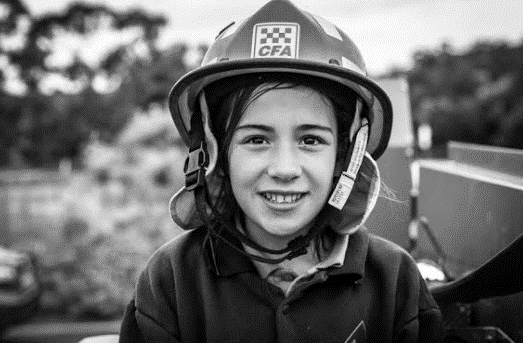 The Survive and Thrive Program is a partnership between the Anglesea Primary School (APS) and Anglesea Fire Brigade (AFB).
Utilising a student led approach students are taught bushfire behaviour and explore bushfire knowledge and understanding in relation to increasing their own and their communities’ resilience to bushfires in their environment.
To support the students learning, the partnership includes many informal relationships between local and state emergency management professionals.
The later stages of the program conclude with the students designing and delivering Bushfire workshops to their families, peers, community and schools of like bushfire risk.
Background and Situation Context
The Program is being conducted in Anglesea, an extreme bushfire risk area. Both the brigade and the primary school saw the need to support the students and the community to enable best access and means to learn about the local environment in regards to bushfire in order to be empowered, to understand, and make the best informed decisions possible.
- The CFA and APS developed the Survive and Thrive Program for the Anglesea community whereby the students of the school gain knowledge and understanding of the local environment and its link to bushfires.
- The Program is innovative with benefits to the Anglesea community and, in time, to other communities.
- The Program is an authentic learning experience for students.
- The Program provides an opportunity for students to be innovative and creative in formulating learning experiences around bushfire safety and awareness, that are engaging and worthwhile for others.
- Students demonstrate their capacity to take an active role in bushfire awareness and safety.
- Students understand the threat to them and their community, with regard to bushfires.
- Students teach and inform their peers, families and visitors about bushfire safety and awareness in Anglesea.
- Students then work with their families to develop an effective and realistic fire plan.
- A strong relationship has been developed between the CFA, AFB and APS.
- The relationship between the CFA, school and community is nurtured due to the work done within the Program.
- The Program will be used by the University of Melbourne to build evidence relating to children’s capacity to have an active role in bushfire safety.
Grade 4, 5 and 6 students from APS are the primary audience, the secondary audiences are their families, their peers, local school students, local community and schools of a like bushfire risk visiting Anglesea.
Activities
- At the end of Grade 4 the students begin their introduction to the Fire Brigade, Radio Communications and how to use field weather instruments.
- Grade 5 begins with a series of bushfire behaviour lessons about the principles of fire, weather, landscape, forest fire danger index calculations, fire danger ratings, overall fuel hazard calculations, map reading, hand plotting of predicted fire behaviour, fire investigation, local traditional aboriginal fire use (cultural and environmental fire) fuel reduction and local brigade fire history.
- During the second half of Grade 5, students practice what they have learnt and start to develop presentation skills. Their soft introduction has the students coordinating a tour of the station and a workshop with their family.
- During the last term of Grade 5, students create workshop/presentations that share a message with the audience as to how they can ‘Survive and Thrive’ in a bushfire. A student-led process, these workshops are conceptualised by the whole cohort. Individuals then select a workshop/group and in some cases are allocated. Each group then proceed to develop their workshop.
- At the end of the term the students present their workshops for the first time to their families and local fire agencies.
- In Grade 6 the students continually improve their workshops and present to a variety of audiences from their town, local towns and visiting school groups from like-bushfire risk areas.
The first cohort of students have now graduated the Survive and Thrive Program and two other groups are currently in progress.
In addition to Anglesea, Strathewen Primary School in partnership with Arthurs Creek-Strathewen Fire Brigade have created their own Fire Education Partnership and commenced the Survive and Thrive Program.
These two Community Based Fire Education Partnerships that deliver the Survive and Thrive program are now formally supported by a CFA facilitator and supported organisationally as a CFA pilot project.
Results
Outputs produced from this Program
- 12 students have completed the program and 45 currently in the program.
- 8 x Bushfire workshops and 4 more bushfire workshops in progress – presented to over 300 people – families, community, fire experts and local schools from High to Extreme Bushfire Risk Areas.
- 2 x presentations – Station Tour and Bushfire Mapping 1 in progress.
- 1 x Photography exhibition, 1 more in progress.
- 1 x Book produced, 1 more in progress.
- 8 x interviews, 1 video of students interviewing people that have experienced bushfire with 6 more interviews in progress.
- 2 x videos of the program – 1 for the ABC news and 1 for the Living with Bushfire Conference
- A fire board game (in partnership with Surf Coast Shire).
- Clay animation about the Fire Danger Ratings in progress.
- Installation of Field Weather Sensors in partnership with RISER. The students have informed the improvements for the second installation. Term 4 2016 the Field Weather Sensors will be installed at Anglesea and Strathewen.
POSITIVE impacts/changes/benefits for the target beneficiaries
This is a list of the first cohort’s reflections of the Leadership and Life skills – experience, knowledge, skills and understanding that the students have gained from being part of the Anglesea Fire Education Initiative
- Preparation before and after fire
- Fire plans
- Forest fire danger index calculations and fire danger ratings
- All the knowledge about fire
- Public speaking
- Being on the news
- Being the first to pilot the Program and use the field sensors
- Confidence
- Teamwork
- Persistence
- To be clear
- Be interesting
- Commitment
- First student to run a burn table
- Gathering details
- Fire language
- Taught other schools
- Learnt to use technology
- Evolved and developed using feed forward
- Feel safer
- Not as worried by the FDR, now know what it means
- Know how to understand weather and fire, know the variables that change fire behaviour
- Flow, ability to link, to explain topic clearer
- Increased knowledge
Next Steps
The program has now been brought into CFA as a pilot project and see if it can be replicated in other communities and to continue the Anglesea Fire Education Partnership. It has now extended to Strathewen.
The next steps are to continue the Partnerships during the pilot and evaluate the program before assessment of long term continuation or growth to other communities.
Reflection
Factors that were unique/good practice
The Program is based on child centred disaster risk reduction principles. The approach has been a collaborative teaching and learning process. The program is led by the students, what they show interest in, how they show interest, how they learn, what they want to learn about and what they wish to teach. Relationships are developed with the students and create opportunities for them to develop relationships with other leaders in the community, in particular fire agencies.
Critical Success Factors
- Commitment of the project partners to the program.
- It is a community led Program founded on good relationships, mutual trust and respect for all.
- The diversity of the people involved in the program – skills, knowledge and experience.
- Versatility/Adaptability – when opportunities come up that will benefit the students we can respond easily to take up good opportunities. We can adapt to suit the students learning needs.
Challenges Faced and Solutions
- The Program has been challenged by a lack of financial support, currently funded as a pilot. Uncertainty beyond the pilot will remain until the evaluation is completed to help inform a future plan for the Program.
- A facilitator to support the brigade to fulfil the student led vision of the program was required. South West Region supported the Program with a Brigade Sustainability Coordinator – Emma Taunt as a subject matter expert in creating community partnerships, designing experience based activities, student led programs and workshops. A business case was accepted by the CFA board and Emma Taunt is now employed to facilitate the program during the pilot.
Sustainability and potential for replication in other settings
- Evaluation yet to be completed. With ongoing staffed support the Program has the ability to be a demonstration site to trial different methods of teaching about bushfire and for visiting schools to learn from and observe to consider their interest to replicate a variation suitable for their school and network with the existing Program to share lessons learned.
Additional Project Details
| Lead organisations | Anglesea Fire Brigade (AFB) and Anglesea Primary School (APS) |
| Partner/s |
Country Fire Authority (CFA) Lisa Gibbs - Melbourne University Riser/ThinkSpatial Informally associated with the program is - DELWP, Parks Victoria, Wadawurrung, Surf Coast Shire, Victoria Police and EMV |
| Funding source |
Contributions have been made by CFA Anglesea Community Anglesea Fire Brigade Department of Justice Rebecca Hosking Photography EMV sBendigo Bank Camp Wilkin YMCA Surf Coast Shire |
| Funding amount | Amount not available |
| Contact name | Jamie Mackenzie and Emma Taunt |
| Contact email | j.mackenzie@cfa.vic.gov.au e.taunt@cfa.vic.gov.au |
| Contact telephone |
Emma Taunt, Survive and Thrive Program Coordinator Community Based Fire Education Partnerships – Anglesea and Strathewen M: 0418 621 761 |
| Hurdles submitting details of project | Nil |
| Project URL | N/A |