
Community-Based Bushfire Management
Project Summary
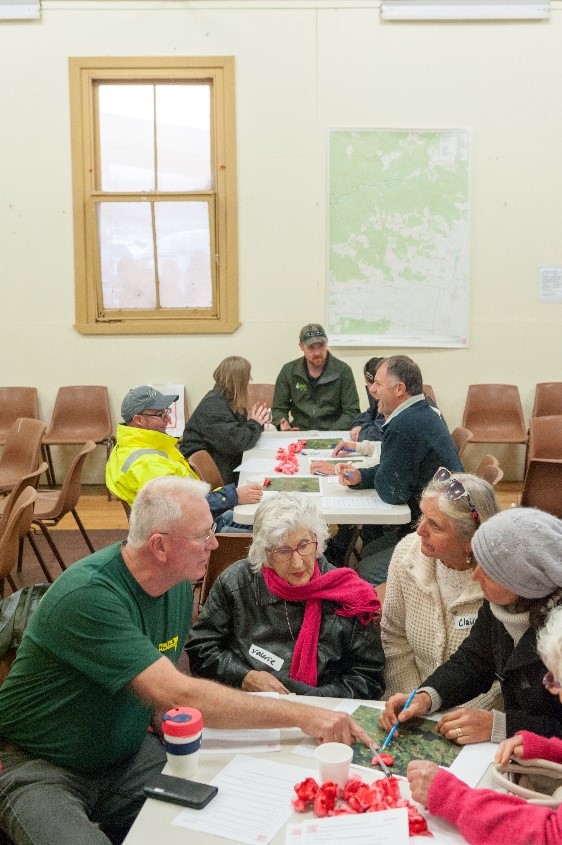 Community Based Bushfire Management (CBBM) is a long-term, facilitated and community-centred approach to bushfire management. It supports people to be actively involved in decisions about bushfire risk that affect them and the places they care about.
CBBM focuses on developing and strengthening relationships between agencies and communities. It brings together people with diverse perspectives to build a shared understanding of local bushfire risk and to address and manage these risks together.
Each CBBM community is supported by a dedicated facilitator, who builds and strengthens connections between the community, fire agencies, local government and other partners.
CBBM facilitators guide meaningful collaboration processes to build shared understanding of local bushfire risk, with space for diverse perspectives and community leadership in shared decision-making processes.
Background and Situation Context
CBBM is a key component of the Safer Together Community First program. Safer Together is a Victorian Government policy that combines stronger community partnerships with the latest science and information to more effectively target our actions to reduce bushfire risk. It is a key initiative of the Victorian Bushfire Management Strategy.
CBBM Facilitators work closely with communities to support open dialogue and collaborative problem-solving, explore options together and take local action alongside fire agencies. Facilitators work with two or three place-based communities at a time, focusing on strategic, long-term engagement rather than ‘one-off’ activities and events.
Working in partnership with communities in bushfire management recognises the valuable expertise, knowledge and experience that exists within those communities. This approach empowers local people to make informed decisions and take active roles in managing bushfire risk, ensuring that solutions are locally relevant, inclusive, and sustainable.
Activities
CBBM is a process designed to improve how agencies engage with communities, positioning the community as an equal collaborative partner. Initially, work within the CBBM communities focuses on the development of open, trusting relationships between all partners and a mutual understanding of the place-based values and priorities. These values help decision-making about the strategy or action the group wish to take to address bushfire risk, which can vary widely across the state.
Approaches can encompass a broad range of initiatives, including resolving conflicts over land management practices; developing community-wide materials or plans; coordinating local events such as ‘bush walks and talks’; hosting bushfire scenario workshops or landscaping for bushfire sessions; establishing local emergency network groups; contributing to agency or government strategies; taking practical, collaborative action to reduce local vegetation risk; and supporting social connections following displacement from a fire.
CBBM is a collaborative process that considers the concerns and priorities of all participants. Decisions about which priorities to address and what actions to take are made through a shared decision-making process, where community voices are valued equally alongside those of agency stakeholders.
Results
Findings from evaluation studies completed over the years have provided valuable insights into the CBBM practice. Key insights include:
- Community-led, place-based bushfire management is an effective approach to engagement. The evaluation reports indicate that when communities are empowered to identify local risks, set priorities, and collaborate with agencies, they develop stronger ownership of bushfire preparedness, increase risk awareness, and build more resilient local networks. This approach also strengthens trust and shared responsibility between communities and government agencies.
- Building and maintaining strong relationships and partnerships are key factors to the programs’ success. Strong local leadership, skilled facilitators, and collaboration between agencies such as CFA, DEECA and local government were repeatedly identified as critical enablers. The evaluations found that community-centred engagement, local knowledge, and sustained relationship-building produced practical outcomes and reduced barriers between agencies and communities.
- CBBM has influenced a shift in agency practice towards shared decision-making and improved partnerships. The evaluations highlight that CBBM has influenced how agencies engage with communities, moving from a traditional, agency-led model toward one that values local knowledge, shared responsibility, and collaborative decision-making. This shift has helped embed community-centred principles into bushfire management practice, improving trust, encouraging more meaningful engagement, and demonstrating the benefits of working with communities, rather than delivering solutions to them.
There are also numerous anecdotal accounts of the positive outcomes produced by the CBBM process. One example is the fire-impacted community of Wye River in 2015, which resulted in the loss of 116 homes, but with no lives lost and timely and ordered community evacuation. In part, this is attributed to the CBBM group requesting a community bushfire exercise approximately six weeks prior to the fire – and consequently being well prepared for the event.
Another example is the development of the Hill & Ridge Emergency Network, established as part of CBBM in Red Hill/Main Ridge after the severe weather events of October 2021. A facilitated process brought together a group of community leaders with agency stakeholders to develop community connections and increase bushfire preparedness and resilience. Over time, the network has grown into a trusted and effective collaboration between community members, emergency services, and local government. The success of this network has informed the development of other community-led preparedness initiatives, including a similar network in nearby Shoreham. Around 800 residents are now connected via WhatsApp, with 40 street level coordinators in Red Hill/Main Ridge, and 25 in Shoreham. The effectiveness of this network was demonstrated during the January 2026 fires, when timely smoke warnings shared through the network helped keep the community informed and reduced demand on Triple Zero services.
View the Hill & Ridge Emergency Network Video Case Study here: Community engagement
Over the years, CBBM reporting has highlighted the relationships that have been developed and strengthened – within communities and with agencies, local government representatives and emergency services. This has improved trust between stakeholders and developed a greater understanding of the issues affecting communities.
Reflection
CBBM provides an effective model of community-centred engagement and a fundamental shift in the way agencies and local governments have traditionally interacted with the community. CBBM aims to empower the community and seeks their leadership in shared decision-making and action to address local bushfire risk. In essence, it is a shift from ‘command and control’ or information provision to a ‘bottom-up’ approach, that acknowledges community knowledge, wisdom, values and experience.
Critical Success Factors
CBBM requires a willingness of the community to embrace and participate in the process. Likewise, agencies and local government need to be ready and willing to collaborate with communities and recognise that people within those communities have knowledge and experience to contribute to addressing local bushfire risk.
CBBM requires a skilled facilitator who values and respects diverse perspectives, and who can bring communities and agencies together to collaborate, build shared goals, and use their collective strengths, skills, and experience.
Facilitators often prefer to remove their uniforms and become a neutral entity – someone working to connect people in the room and advocate for those who may not have previously had a voice in this space, without allegiances. The positive impacts of CBBM are far-reaching and are testament to the effectiveness of a community-centred approach. Furthermore, the development of trusting and respectful relationships has widespread benefits. Community members illustrate the success of CBBM best, no more so than in the following quotes:

Barriers and Solutions
- CBBM moves away from the traditional agency top-down model of engagement to a more collaborative way of agencies and communities working together to develop goals and solutions. A major challenge has been improving agency transparency so local communities can better understand what agencies, local governments and emergency services organisations do and how they do it. The solution to this challenge is to facilitate inclusive discussions, collaborate consistently with a range of stakeholders, and build trusting relationships over time.
- Not all communities or locations are suited to a CBBM approach. There are several factors that should be considered in identifying and endorsing potential new CBBM communities. Key factors include:
- leadership and willingness within the community to participate in a long-term process;
- commitment to multi-agency, place-based approach across key stakeholders;
- scale of local issues that can meaningfully be addressed via a community-based process;
- local bushfire risk.
- CBBM has developed a set of community selection criteria to support an effective ‘selection process’ for potential communities. These criteria have proven invaluable, resulting in success with the communities endorsed for partnership.
- There may be a sense of division in some communities, which are often well-established, and over matters unrelated to CBBM. These divisions are naturally a challenge for CBBM Facilitators working within those communities. The solution to this issue focuses on strengthening connections within communities, building trusting relationships, learning to understand diverse perspectives and treating one another with respect. Facilitators work closely with communities and agencies to develop a shared understanding of risks and develop goals and solutions together.
- CBBM is characterised by its place-based, community development approach and its emergent processes —- where outcomes may not be explicitly predetermined at the beginning of the partnership or relationship but evolve through the practice. It is often difficult to communicate successful outcomes of the practice in line with more traditional forms of quantitative reporting such as recording numbers of participants at an activity for example. The preferred and more relevant approach to reporting is to look at more qualitative forms of evidence, including changes in agency practices, mindset, power dynamics, relationships or improved understanding between agencies and communities.
Additional Project Details
| Lead organisations | CFA |
| Partner/s |
Current CBBM positions are based in CFA. CFA and DEECA lead the implementation of Safer Together and work in partnership to deliver on the Victorian Bushfire Management Strategy. Local Government is usually involved as an essential partner. Other partners may include; CMA, Landcare, local schools, Neighbourhood House representatives, Parks Victoria, local healthcare agencies and more. |
| Funding source | Victorian Government |
| Contact name | Helene Agius, Senior Officer – Community First Partnerships, CFA |
| Contact email | helene.agius@cfa.vic.gov.au |
| Project URL | https://www.safertogether.vic.gov.au/community-first |