
Dig-In Community Café
Project Summary
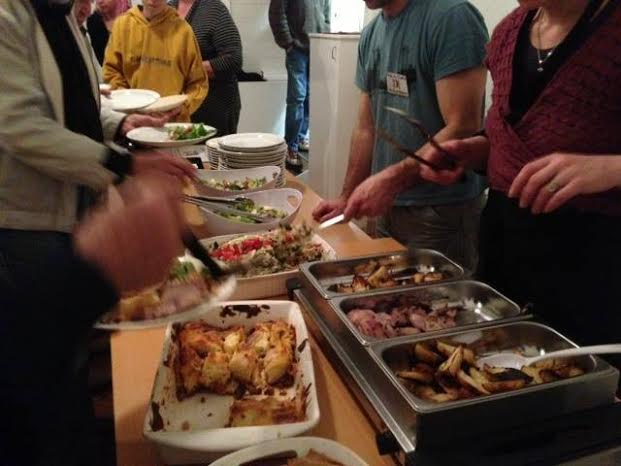 Emerald Community House team of volunteers creates meals from food donated by local businesses and community through a food collection/donation partnership on a regular monthly basis. The Dig-In Community Cafe brings together experiences and people with an opportunity to practice feeding the community in a spontaneous environment participating in a shared responsibility exercise.
Background and Situation Context
The Dig-In Community Cafe is held on the last Friday of the month at Emerald Community House Hall in Emerald, Victoria between 6-8 pm.
Emerald Community House collected stories and data about
- emergency food relief
- provision of food in emergency situations
- recovery of a community after disaster, and;
- community dining models
- Journal entries from diners
The Dig-In Community Cafe was developed to provide volunteers an opportunity to participate and train in spontaneous community dining. It also increased the working relationships with other organisations and businesses such as Woolworths, local bakeries, local community groups and green grocers to participate in a shared responsibility model. ECH manages the hall and local council owns the hall. By partnering with diverse groups, collecting ingredients, donating services, cooking and serving food for the monthly meals, this project is a great mirror of the National Strategy for Disaster Resilience statement which identifies local government, business, organisations, families and individuals as key shared responsibility stakeholders.
Emerald Community House, through a small fund donated to us, also provides formal training for food handlers to attain food safety skills by paying for half of the cost of this training and the council pays for the other half. That training not only puts more food safety education into the community (important when power goes out and food spoils), it also gives them a marketable skill and experience to get a job in hospitality or care services - this is employment resilience.
The people who come to dine (anywhere from 50-100+ diners a night) can be isolated, marginalised, just want to commune and chat about local subjects or try out their skills in the kitchen in a spontaneous environment. They all mix it up with local community leaders, followers, volunteers, CFA members, politicians, tradies, retired people, artists, musicians, tourists, visitors, children and family members. Monetary donations are appreciated but not required and usually cover the cost of anything extra that needs to be purchased for the meal.
Activities
We set our goals to
- Proactively increase and practice capacity building in community to be resilient in good times or hardship
- Promote well-being through social inclusion
- Increase safe food handling skills throughout the community
- Receive donations for equipment and resources that connect suppliers who support the program
- Provide training opportunities for public dining and hospitality skills for youth
- Promote healthy eating, use seasonal produce where possible, sourced locally, and cater for special dietary needs (vegetarian, vegan and gluten free at a minimum), and;
- Encourage self-reliance with smart food storage and pantry supplies at ECH and at home.
We publicized the date, and used outdoor signage, a Facebook page with website promotion. We then developed the model guidelines document for roles and responsibilities based on our experiences as we went along.
So far, we have successfully run the program sustainably for 3 years with donations and interest now increasing. We have served to over 1500 people in that time. Others have come to train in our program and go to their communities to create something similar. Our volunteer base has grown and food sources have stabilized in regularity. Uniting Care modelled their community-dining model after our program acknowledging ECH as the creator of the project.
Volunteers attain food safety skills, and ECH pays for half the cost of Food Safety courses and council pays for the other half. That training not only puts more food safety knowledge into the community (important when power goes out and food spoils), it also gives them a marketable skill and experience to get a job in hospitality or care services - more employment resilience.
The Dig-In Community Café continues to be a donation based self-funded training program, gaining no funding from government other than council's partial coverage of half the fee for food safety. This contribution is offered to all community groups in the shire, not specifically for the Dig-In program. We use this training to embed further benefit within the community.
This project is still in progress. We continue to run this program not only because it is beneficial and yielding results, it's just plain fun!
Results
- The Dig-In Community Cafe Guidelines Manual
- Over 200 people have attended our Food safety training.
- We have increased our number of volunteers who have been enticed by a program that involves ‘mystery box’ cooking and food interests.
- We have increased our working relationships with local businesses and other community groups and churches.
- We have provided training for youth in food service and they have gone on to get employment because of that experience.
- Some people who initially came because they were lonely, isolated, looking for connection or just curious about what was going have now become volunteers, feel increased connection and valued in their community. They have gone on to attend courses and functions or even joined our committee of management. In fact, one of our diners joined the committee and is now our Chairman.
The 2016 Resilient Australia Awards recognised the Emerald Community House’s Centre of Resilience as a Victorian ‘Highly Commended’ Community Award. CoR has begun to take the “next steps,” recognising Morwell Neighbourhood House (MNH) as a Centre of Resilience in its own right, based on MNH’s local community development and strengthening projects that meet the environmental, built, social and economic goals consistent with a CoR philosophy. Moreover, MNH achieves with very little or no external funding for key projects to support their community. While disaster risk represents a common feature that influences a CoR practice, it is not always the dominant factor. However, such adversities may create opportunities to develop CoR strength in communication, connectedness, durability, local voice and self-reliance within communities.
http://www.emeraldcommunityhouse.org.au/morwell-neighbourhood-house-centre-resilience/
CoR and Dig-In are still wholly self-funded by ECH and resistant to economic pressures or downturns.
Next Steps
We are looking now for other community partners to share the program and spread out the responsibility of running it. In this way, we reduce a single point of failure and increase our flexibility and relationships. In fact, the future goal is to find a different organisation to run the dinner each month to spread the experience, service, resources and connections.
Reflection
Factors that were unique/good practice
The Dig-In Community Cafe is self-funded and run completely on donations. We just started the program, developed the model based on experience and have run continuously for 3 years. It is important to remain flexible to take advantage of opportunities as they arise and empower people to make decisions with sufficient knowledge to solve any problems.
Critical Success Factors
- Ensure that business partners understand what you are doing and what their role in that process.
- Get a freezer or use others that exist in the community already.
- Make sure everyone understands safe food handling.
- Cater for vegans, vegetarians and gluten free diets, cultural diets
- Have fun!
- Do not overburden volunteers with paperwork and rules when they show up to help.
- Welcome them and let them work at their pace, partnering them up with a regular volunteer, gradually allowing them to gain more responsibility.
- Make sure that every volunteer signs in on the Volunteer Register.
- Do not try to do labour intensive meals. Good food, healthy ingredients and enough food to go around is good enough.
- We serve all of our meals using china dinnerware and glassware and use no disposables.
- Keep the washing up to a minimum.
- Get a good commercial stove that can handle the demand and commercial dishwasher that can turn the dishes around fast.
- Make sure you have a Dig-In Coordinator to set the menu and manage every session.
Barriers to Success
- Occasionally, holiday periods are hard to get volunteers yet the food donations will overflow. Always accept the food and find a place for it. Availability of cold storage has provided challenges but we have had a freezer donated to us recently. We have run Dig-In for the last two Christmas holidays.
- Occasional availability of volunteers early for food prep is a challenge. The program has been designed to run with one person at a minimum to start all of the cooking. Can be done by one person if organised well. Others usually come a few hours before the event. Even diners will roll up their sleeves if they see that you are struggling. We have run Dig-In for the last two Christmas holidays but gave everyone a holiday in 2015.
Future recommendations
- Would be good if we could write a recipe book - big demand for our recipes.
- Would like other organisations to now pick a Friday in a month and run the Dig-In to spread the experience and capacity building.
- Need a commercial stove and commercial dishwasher - one day....
Additional Project Details
| Lead organisations | Emerald Community House (ECH) |
| Partner/s |
Woolworths Emerald Bakery Bakers Delight Other volunteers from local groups Random donations |
| Funding source | ECH and community at large, food from partners listed above. |
| Funding amount | We receive between about $150-$250 in donations during each meal. ECH provided the first seed money originally. We received access to $2,000 from Country Women’s Association (CWA) through Monash Health from their disbanded kitchen program. This money is for the community to train people in food safety skills. |
| Contact name | Mary Farrow |
| Contact email | emhouse@iinet.net.au |
| Contact telephone | 03 5968 3881 0403765314 |
| Hurdles submitting details of project | Nil |
| Project URL | http://www.emeraldcommunityhouse.org.au/events/digin-cafe/ https://www.facebook.com/DigInCafe |