
Enhancing Networks for Resilience
Project Summary
The National Strategy for Disaster Resilience acknowledges that community organisations are at the forefront of strengthening disaster resilience in Australia. Enhancing Networks for Resilience (EN4) is a comprehensive study of the Southern Grampians Glenelg Primary Care Partnership (SGGPCP) using social network analysis to investigate how these networks contribute to disaster resilience.
Background and Situation Context
SGGPCP is a partnership of 19 health and wellbeing agencies in South West Victoria that have identified the impacts of climate change on health and wellbeing as a priority for action. SGGPCP has facilitated projects around heatwave, food security and improving household energy efficiency to increase capacity of the partner agencies and reduce the vulnerability of the community. One recent project Rural People; Resilient Futures highlighted the leadership platform of the SGGPCP as well as the strength of the network particularly to reduce the impacts of extreme climatic events on the community. In terms of disaster resilience, the work of SGGPCP partner organisations is critical to helping communities to prepare, cope with and recover from a disaster. Priorities of the NSDR emphasise the role of partnerships and networks based on shared responsibility, coordinated planning and response. In support of these priorities, the NSDR funded SGGPCP, in collaboration with RMIT University, to examine how partnerships and networks contribute to disaster resilience outcomes in the Enhancing Networks for Resilience Project (EN4R).
Activities
Due to the complexity of the project, it was important to involve partner agencies in co-design of the methodology from the beginning. This co-creation enabled partners to not only input into design, but also build their understanding of the importance of their agency role in disaster resilience, strengthening the case for project participation. Subsequently, semi-structured interviews (n=19) were conducted with partner agencies and significant stakeholders. The interviews followed a schedule of questions that sought to understand the inter-organisational relationship mechanisms, enablers and barriers and dynamics of the networks. Next SGGPCP partner agencies were invited to participate in a very comprehensive on-line survey. This survey generated quantitative data for the social network analysis (SNA). Possibly, due to the ongoing engagement of partners as well as the leadership and support role provided in the PCP platform, 100% of agencies completed the survey. A participatory workshop was also undertaken with SGGPCP partners and stakeholders designed to provide a base level understanding of SNA as well as present preliminary data and to obtain feedback on participant perceptions of networks to inform final reporting.
Results
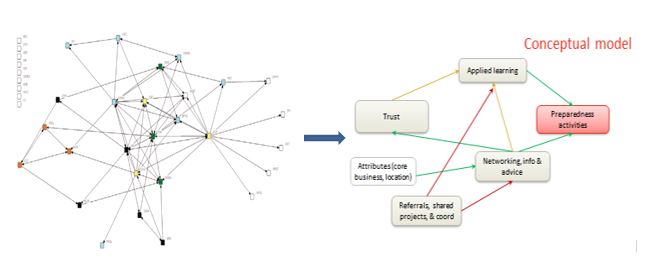
Results of the SNA revealed which SGGPCP Partner Agencies were collaborating; what disaster management activities they were collaborating on: and how they collaborate. The findings also show which organisations are important bridges or brokers for a range of important disaster risk management activities. Exponential Random Graph Models (ERGMs), an innovative statistical approach, were applied to provide a deeper understanding of the multiple factors that contribute to the formation of networks. The ERGM results support characteristics of network governance and adaptive co-management that are described in theoretical frameworks and academic literature. The ERGM found that those with informal relationships, and those that apply inter-organisational learning in their work, were more likely to collaborate on disaster preparedness. The modelling also revealed that informal relationships were a precursor to trust. More complex findings emerged in relation to inter-organisational learning. Interviewees expressed appreciation of learning-type benefits from collaboration, such as innovation and breaking down silos. However, the perceived importance of these benefits did not correlate with SNA results. Applied learning was a sparse network, highlighting the difficulty of employing new knowledge in practice. Investigation into enablers of learning revealed no statistically significant links with trust, informal and formal relationships, therefore raising more questions about enabling conditions and challenging existing understanding of social learning processes. Sharing organisational goals and understanding each other’s organisation and its leadership were stated by participants as the most significant enablers of collaboration, where time, distance, resourcing, lack of shared goals or understanding were considered barriers to collaboration. The social network and interview data supported the notion of a network administrative organisation to achieve network effectiveness. The SGGPCP team were shown to be important brokers and bridges in disaster preparedness, through informal relationships and formal activities like working groups. They were also viewed as providing essential administrative and coordination support. Next Steps: Future work will use these findings to trial interventions to build the capacity of SGGPCP partner agencies to enhance the resilience of their communities.
What knowledge or product outcomes did the project accomplish?
A comprehensive research report was completed. A short paper Social Networks and disaster resilience: an introduction was developed to unpack the complexity of SNA in the context of disaster resilience - both available at www.sggpcp.com
Reflection
The community sector is well placed to enhance the resilience of the community founded on established relationships and local knowledge. Umbrella organisations such as SGGPCP provide a leadership platform to engage with the community sector, build capacity and provide a link to research and policy. Co-creating the research approach with the end-users (the partners of SGGPCP) proved invaluable not only in project design, but as a further opportunity to identify roles, ongoing engagement and development of relationships. This was particularly evident given the take up of semi-structured interviews and 100% participation in the very comprehensive survey. Social Network Analysis methodology is complex and based in mathematics and statistical approaches. It became clear to the team that in order to complete the research effectively there was a need to increase understanding of the methodology. Partnering with experts in the field increased the capacity of the research team, allowed for the development of a short paper to provide an introduction to SNA, particularly in the context of disaster resilience and facilitate a workshop to increase understanding.
Additional Project Details
| Lead organisations | Southern Grampians Glenelg Primary Care Partnership (SGGPCP), Southern Grampians and Glenelg Shires, Victoria |
| Partner/s | RMIT University |
| Funding source | National Disaster Resilience Grants Scheme |
| Funding amount | $167,000 |
| Contact name | Jo Brown Manager Health and Wellbeing Southern Grampians Glenelg Primary Care Partnership |
| Contact email | joanne.brown@wdhs.net |
| Contact telephone | (03) 5551 8563 |
| Hurdles submitting details of project | Nil |
| Project URL | http://sggpcp.com/wp-content/uploads/2015/11/EN4R-Report-FINAL.pdf |