
Managers of Spontaneous Emergency Volunteers Pilot Program – G21 Region
Project Summary
The Managers of Spontaneous Emergency Volunteers (MSEV) Pilot Program - G21 Region (City of Greater Geelong, Borough of Queenscliff, Colac Otway Shire, Golden Plains Shire and Surf Coast Shire) harnesses the power of Spontaneous Volunteers in an Emergency. It initiated the establishment of a trained and engaged voluntary workforce of experienced volunteer managers who can be effectively deployed to assist in managing spontaneous emergency volunteers during relief and recovery activities.
The initiative has increased the G21 regional capability to provide relief to volunteer managers in emergencies without compromising recovery efforts within communities.
Background and Situation Context
Emergencies can strike anywhere and at any time. Whether planned or not, spontaneous volunteers will come forward with offers of assistance. While these volunteers can be an invaluable workforce to help with relief and recovery efforts, emergencies including the 2009 Victorian Bushfires, highlight that most communities are not able to cope with a mass influx of spontaneous offers of assistance, and in some instances, these volunteers can put themselves and others at risk.
The challenges posed for emergency managers by spontaneous volunteers was acknowledged in the 2012 Victorian Emergency Management White Paper, which recommended the development of ‘strategies to manage spontaneous volunteers during relief and recovery efforts.’
The Managers of Spontaneous Emergency Volunteers (MSEV) G21 Pilot project has been designed to help build community resilience by recruiting, training, supporting, deploying and debriefing a workforce of skilled MSEVs to assist during emergency relief and recovery activities.
The Geelong pilot project focused on building capability of organisations providing relief and recovery services to manage spontaneous volunteers in the G21 region, in the event of an emergency. The G21 region comprises the City of Greater Geelong, Borough of Queenscliff, Colac Otway Shire, Golden Plains Shire and Surf Coast Shire.
Activities
Regional Development Victoria as part of the Resilient Communities Program funded the Pilot Initiative. A Reference group supported Volunteering Victoria appointed a Project Manager and Coordinator.
Project activities included
- Development of best practice training and professional development to upskill and support a workforce of MSEVs.
- Establishment of a central register, managed by Volunteering Victoria, of experienced and trained MSEVs willing to be called on in times of emergency.
- Development of an online Resource Centre to house a suite of resources to support volunteer MSEVs in managing spontaneous volunteers in a variety of settings and disaster events.
- Establishment of a communications program to recruit and retain MSEVs and keep them engaged with the project through the central register.
- Through Volunteering Victoria’s local, state and national networks, share learnings from the pilot development and specific emergency events.
- Ongoing research and evaluation tracking the development and capability, management and effective deployment of volunteers in emergencies, and best methods of collaboration between volunteer program managers and agencies.
Volunteering Victoria has subsequently received 3-year funding (based on yearly results) for a state-wide rollout of the MSEV program.
Results
Outputs
- Recruitment and selection materials including position description, email invite, website content, registration portal, application form, interview guide, referee checklist and program acceptance form.
- Full day training program including Participants Handbook, video case studies and train the trainer materials.
- Thirty-four volunteer managers participated in the full day training session. Of these 21 applied and have subsequently been approved as MSEVs on the central database.
- Central register
- Database platform to record details of trained MSEVs including deployment history.
- Templates for communications to MSEVs before, during and after a deployment.
- Online Resource Centre for MSEVs.
- MSEV introduction pack including
- Welcome letter.
- Outline of deployment process.
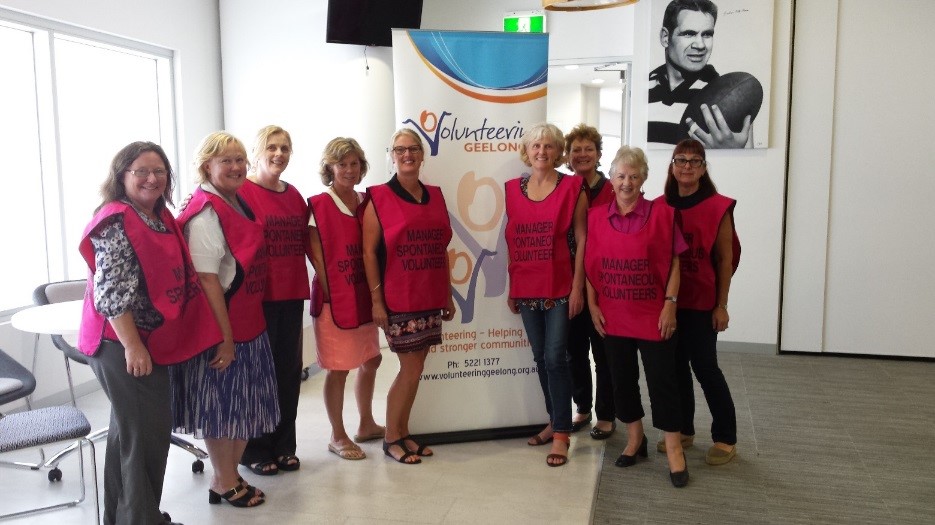
- MSEV tabard – for use when deployed for identification of spontaneous volunteer managers.
- Volunteering Victoria name badge and lanyard – for use when deployed for practical identification/validation.
- Engagement activities with stakeholders to build understanding of potential utilisation of MSEVs.
- MSEV Peer support network to provide an opportunity to share knowledge and learnings.
Impact/Change/Benefits
The project has developed a systematic and organised approach to coordinating volunteer manager resources and experience across the G21 Region during relief and recovery activities.
Impacts, changes and benefits include
- A workforce of 21 trained volunteer managers who can be deployed to help coordinate and more effectively manage spontaneous volunteers who want to assist in times of emergency.
- A community-demand driven MSEV deployment model, ensuring the affected community is assisted and remains in charge.
- A more sustainable, resilient volunteer manager community, brought together to learn from each other, assist each other, and thus create more resilient and supported communities.
- Improved knowledge of emergency management structures, planning process and practices at Volunteering Victoria and Volunteering Geelong.
- Enhanced emergency preparedness, capability and resilience within G21 Region.
- Volunteering Geelong included on Barwon South West Regional Emergency Relief and Recovery Committee network.
- Tested recruitment model and processes that can be integrated into a Municipal Emergency Management Plan (MEMP).
Stakeholder engagement and collaboration at local, state and national levels has spurred conversation and collaboration to share learnings, processes and resources across sectors.
Next Steps
Volunteering Victoria has now received funding under the Natural Disaster Resilience Grants Scheme (NDRGS) to commence rolling-out the model across Victoria.
Reflection
Factors that were unique/good practice
While there are a number of programs in Australian jurisdictions that aim to pre-register potential spontaneous volunteers, a significant capability gap still exists in terms of how both pre-registered and spontaneous volunteers would be managed. The G21 MSEV Pilot responded to this gap in systems and services and has developed a model that can be replicated throughout the State and beyond.
Critical Success Factors
Initially, engagement by Councils varied, depended on existing emergency management resources and experience. LGAs have different focus, funding, challenges, capabilities and capacity in relation to emergency risk, planning for emergencies, volunteer management and spontaneous volunteering. Many LGAs are challenged by the complexity and expectations of drafting and implementing a MEMP so it was important to ‘add value’ to existing arrangements by streamlining the management of spontaneous volunteers.
Challenges Faced and Solutions
- Concerns over risk and liability of groups involved. Legal advice was sought to gain an understanding about risk implications and a ‘portable’ insurance cover for MSEVs was obtained by Volunteering Victoria.
- Reluctance by LGAs to ‘get involved’ with spontaneous volunteers required ongoing engagement and discussions as to how the Pilot could minimise risk and improve outcomes for all parties.
- The potential for psychological trauma as part of their volunteer work meant that Psychological First Aid training was built into the MSEV training package along with access to follow up training in this area (ie. Rob Gordon’s PFA 1-day workshop)
- Lack of provision for reimbursement of expenses could deter MSEV participation in deployment activities
- Project scope creep – given the lack of existing resources to support spontaneous volunteers, it became imperative to define the program structure by developing a set of ‘Guiding Principles’
- Training participants came from a wide range of backgrounds and experience, which resulted in the initial training program being modified in response to participant feedback, to ensure it met the needs of all participants.
Sustainability
The most resource-intensive phase of the MSEV project is during its establishment, the recruitment of volunteer managers, and the development of partnerships with LGAs. Once these elements are in place, the key resourcing issues are to support the retention and engagement of MSEVs and to manage the deployment process, which is overseen by Volunteering Victoria whilst funding is available.
Additional Project Details
| Lead organisations | Volunteering Victoria, Volunteering Geelong |
| Partner/s | City of Greater Geelong & Red Cross |
| Funding source | Regional Development Victoria |
| Funding amount | Not specified |
| Contact name | Alison Duff |
| Contact email | a.duff@volunteeringvictoria.org.au |
| Contact telephone | 03 8327 8500 |
| Hurdles submitting details of project | Nil |
| Project URL | http://www.volunteeringvictoria.org.au |