
Scotsburn Fire Game- Be Prepared
Project Summary
 A Bushfire provided the impetus for this project, a bushfire that left a community disenfranchised by trauma and loss. As participants of a community leadership group, we wanted to develop a fun and educational board game as a resource for bushfire preparedness. The goal, to build resilience and a sense of control in the face of unexpected events.
Background and Situation Context
On December 19th 2015, a bushfire started on a forty-degree day. It affected Scotsburn and the surrounding community near Ballarat. The fire destroyed 12 homes, over 4000 hectares of bush and farming land, native and farm animals, fracturing lives. In response to the fire affected community, Emergency Management Victoria’s National Disaster Resilience Grants Scheme, Moorabool Shire Council and the City of Ballarat provided funding for ‘The Scotsburn Community Leadership Program’. The program, of three months duration, aimed to build the capacity of participants to become leaders within their local neighbourhoods, acting as community mentors, to promote wellbeing and connectedness. As participants of the program, we wanted to look forward, building hope and resilience to assist in the healing process of the community at large. We took inspiration from the ‘Fire Game’ produced by the Surf Coast Shire. Board games have universal appeal and provide a great way to educate while having fun. We produced a vibrant board game with content specific to the Scotsburn area, highlighting photographic game cards, both pre and post bushfire. The target audience focuses on Primary aged children, from grades 4-6. However, it is appropriate for any age group above this demographic.
Activities
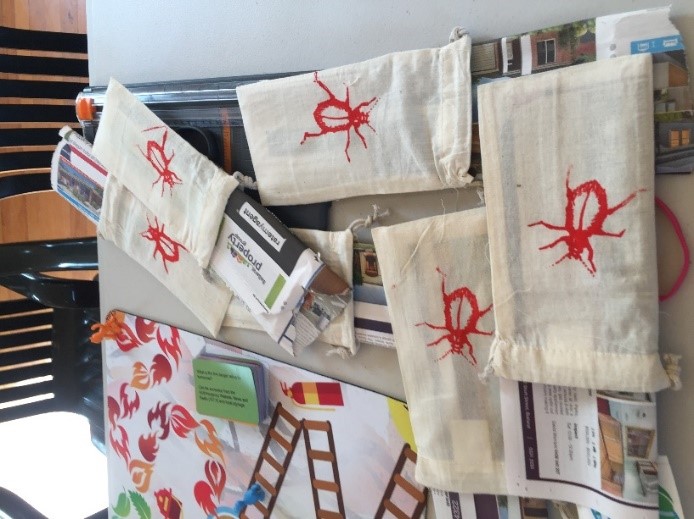
During the Community Leadership Program, the group teased out plans for the Scotsburn Fire Game. Once the leadership program was officially completed, we continued to develop the game. As a group of seven, we met regularly in our homes and a local hall. Via email or at meetings we shared ideas to develop the goal, rules and components of the game. We used original bushfire related artwork, created post bushfire photographs from the Bushfire period, for our playing cards and board. At a screen-printing workshop, we created artwork for canvas bags used to store the small components and for the game in its entirety. The bags’ screen-printing design was of fauna and flora indigenous to the area. The Scotsburn fire game produced ‘Should I stay’ or ‘Should I go - Be Prepared’. We had $5000 as part of the leadership programs pledge to fund a project. None of us had ever conceived the idea of developing a game prior to the program. We are an eclectic bunch of people with diverse occupations and life experiences. Somehow, these skills, attributes and our commitment led us to seeing the game being produced ready for production and distribution.
Results
The Mayors of Ballarat and Moorabool officially launched the Scotsburn Fire Game, at the Scotsburn Primary School on June 15, 2018. We completed a media release and gained some coverage with local and metropolitan media. We produced 100 copies of the game ready to provide as a free resource to local schools and groups. We distributed the games after the launch to School Principals and Leaders of various community groups. Most group members were available to visit the recipient bodies to engage with and play the game with children. We included a feedback sheet in the game to assist in evaluating how well children received and played the game and what improvements may be required. Our intention was to hold a games night to introduce the game to the wider adult community. The Scotsburn Community Leadership Program has concluded but we are continuing as a community group, called Accelerate Scotsburn. We wish to develop further projects and initiatives to build community and promote wellbeing in our post bushfire community. We would like to help other communities affected by natural disasters find avenues to build capacity and resilience in their communities.
What knowledge or product outcomes did the project accomplish?
We created a board game with the actual board made of dense foam, like the composition of some mouse pads. It has a highly decorative stencilled outline with the various parts of a classical board game. There are four starting points in each corner; designated steps to the centre of the board, the centre point indicated the completion point of the game with a ladybird artwork, which is the game logo. There are leaves, fire hoses, and drops of water, flames and ladders decorating the board. Ninety photographs back the question cards, which showcase fire-affected vegetation/land/fences, healthy vegetation, new growth fire risks around the home/farm and local buildings,
We hand drew the layout of the artwork for the game, and then a graphic artist completed the artwork ready for printing on the foam base. We ordered plastic tokens for the game, which are colourful native animals. One of our team members was the photographer for the question cards. At a daylong workshop, we screen printed native fauna and flora onto canvas bags. The larger bags contain all the game components and the smaller bags are for the tokens and cards. A local screen-printing artist worked with us at the workshop to upskill us all on how to screen print. Our game logo is a ladybird with the words “Should I stay or should I go”. We made iron on labels of the ladybird to put on the front of each canvas bag also. We packed the game components ready for distribution upon adding the instructions and contents list.
Reflection
The unique factor of this game was that locals produced it for the local community with content specifically related to the district. The success of the actual game is yet to be determined. We have succeeded in achieving the intended goals of the project. As a group, we formed a cohesive and highly functional group. We started out as strangers or who vaguely knew each other. The leadership program allowed us to listen from the perspective of ‘who is this person and what are their strengths and area needing support’. The challenges we faced during the project were accessing the appropriate resources of the game, staying to budget and working through differences of opinions. We needed to keep the momentum going and not lose sight of our goal when our lives became busy with work and family commitments; we solved all problems through consistently communicating openly and honestly to all members. We had personal regard to discerning what was important for each member of the group and we validated and supported this. We did not allow our egos to hijack the greater good of the team. We have no leader and we allow each person to use his or her specific skills. We are proud of our success as a productive, cohesive and supportive group. What we could have done better was trialled the game with a few school groups before producing the final games. This would have given us feedback that may have highlighted any deficits in the game. On completion of the project, the group itself became more cohesive, resilient and innovative, which strengthened our own resolve to continue to operate entrepreneurially within our community.
Critical Success Factors
- Recognition of strengths. As a group of seven, it was vital that communications with each other was respectful and affirming. We were honest with each other in identifying what our strengths and weaknesses were in relation to the numerous elements of the game’s creation and its promotional aspects. As a group, we supported each other in working outside our individual comfort zone. For example, one group member avoided any form of public speaking prior to the game development but performed a Welcome to Country at the Game launch. We recognised the growth of skills development in others and encouraged them to use these new skills. We had no one leader but had an understanding that we each led in specific area, as that was that individual’s core strength. For example, one group member would ensure we got back on track and kept to the agenda no matter how informal our gathering.
- Regular meetings and communication. We held regular face-to-face meetings to discuss the progress of the game development, obstacles, wins and outcomes. We communicated regularly via email and kept abreast of the progress of each member. We would often step-in and help if a member needed support. We discussed all aspects of the creative process and allowed each person to voice their point. We had an understanding that majority ruled and respected that we each had different views. This did not cause any discord, as our core value was that team takes precedence over singularity. We all found our connection to be unique and affirming. We have all worked as part of teams before but this group dynamic did not fall into the pitfalls of some groups, such as obstruction, overbearing or passive behaviours. We all had real respect for each other and a commonality about experiencing the trauma of a bushfire. We did not speak about our individual bushfire experiences or the bushfire itself until the project was finished.
- Accountability to deliver. We received a grant from which we needed to deliver a product. We took this role seriously, as the project was not about us; it was about providing a resource for our community. Not only did we have fiscal accountability but also we responsibility to create a game that would be positive, inclusive and not token gesture. We wished to create a game that empowered, not a game that was a reminder of the bushfire. We were accountable to a demographic with whom we had no direct relationship. Yes, we knew a few schoolchildren, but mostly, we did not know who the children would be that would benefit from this game. We needed to demonstrate accountability that our resource would ‘fit’ all manner of sub-groups within a school setting. For example, some children may have learning challenges, with deficits in language, sociability, mobility or comprehension. We were mindful of this when designing the game so it could have multiple applications for those who may have had barriers. For example, for some children it can be highly challenging to sit and play a 10-15 minute board game with others. Children could use the photograph cards with answers on the other side, as stand-alone tools for creative writing, drawing, play snap or group into categories. We created a game that can evolve with the imagination of the teacher/student. For us, accountability reflected inclusiveness and this was a high priority for us.
- Balance. We all had busy lives and careers but with a deadline to meet to finalise the project. We committed to a period of 6 months to complete our leadership course and make the game. Once we completed the course, we needed to promote and distribute the game. We gave ourselves time away from the game once we had officially launched at the Scotsburn primary school and attended a media release. We needed to have some balance in our lives and ensure our love and enthusiasm for the project did not dissipate through burnout and over exposure to the whole process. We had about 7 weeks off duty and then proceeded to roll out the game to local schools. We recognised through discussions as a group, that passion could be all too consuming and lead to apathy with balance. Our time away from meetings, gave us space to catch up on things in our personal lives that we had neglected and gain renewed passion to return to work once the hiatus was over. All group participants had personal challenges to deal with during the course of the leadership program and game development. Not only was a time allowance given for dealing with these issue but our cohesiveness as a groups only became stronger.
Barriers to Success
- Time availability. The five adult members had either full-time employment or casual unpredictable work hours and with families and partners to consider. All had to negotiate with employers time off work to attend the game launch and media opportunities. Days off were spent visiting schools and community groups to deliver the game. Our key demographic being primary schools, limited us to school hours and school terms. Schools have highly structured time schedules, which proved difficult to find mutually available meeting times, and scheduling issues created delays in rolling out the game. For example, setting-up a meeting takes numerous emails and phone calls only for a cancellation to occur. Often team members’ work commitments resulted in another team member to step-up at the last minute. Patience and stamina ensured continuity, connection and maintained interest with the school. We could have rolled-out the game in one month, rather six, had we not had full-time work.
- Profile. We had no known local profile, as we did not belong to a recognised community group and had no recognised credentials as ‘Game Creators’. We benefitted from the backing of the Leadership program and support from local councils to back our credibility. Consistent regular media reports helped achieve such credibility. We needed to attend more local functions for opportunities to share our creation and its importance with the community. The website and Instagram account needs more development time and offers of a free resource require special consideration as to its worth. Consistent media coverage would help promote the group and make us memorable. Rolling out the Game in summer, rather than winter/spring, may have attracted more attention for the Game. At this time, Fire Prevention would be at the forefront of media and community thinking.
- Funding. Additional funds could have helped to promote the project. The group self-funded all aspects of media coverage and distribution of the game. Additional funding for fuel could have provided opportunities for more school visits, presentations and teacher education sessions. A free access website for teachers provided associated game resources and access to data, and enabled feedback about the game. Additional funding could have purchased a more functional and engaging website. Equally, more face-to-face meetings could have increased engagement and interest.
Additional Project Details
| Lead organisations | Leadership Group and support from Moorabool Council |
| Partner/s | Nil |
| Funding source | EMV Grant, Moorabool Shire, City of Ballarat |
| Funding amount | $5,000 |
| Contact name | Carol Barnden-Bond Community Member for Accelerate Scotsburn |
| Contact email | carolbarndenbond@gmail.com / acceleratescotsburn@gmail.com |
| Contact telephone | 0425736508 |
| Hurdles submitting details of project | Nil |
| Project URL | https://acceleratescotsburn.weebly.com |