
Fire Recovery Project – Upper Goulburn Landcare Network
Project Summary
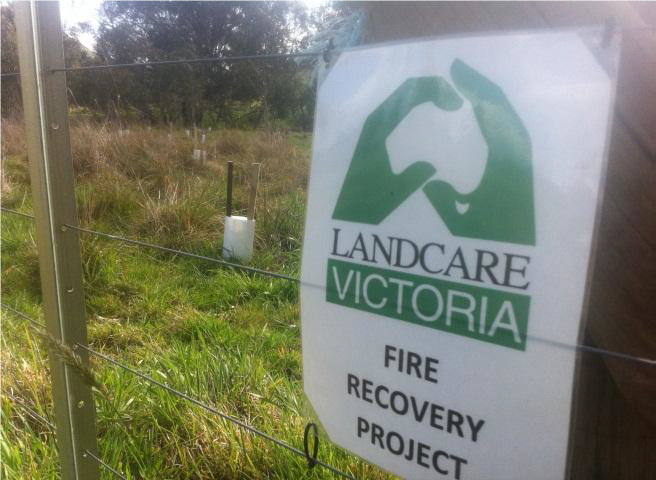 The key aims of the Fire Recovery Project were the implementation of erosion control, weed control, remnant vegetation protection, installing wildlife nest boxes and volunteer assistance coordination.
The Upper Goulburn Landcare Network (UGLN) represents a collective of 14 Landcare and land management groups in the Murrindindi Shire, North-East Victoria. The UGLN has been operating for over 10 years and has a strong and positive relationship with landholders, community organisations and government and agency stakeholders.
The broad role of the UGLN includes
- Landcare group support
- Communication of Landcare and land management information
- Community capacity building
- Sustainable, community-driven land management
- Community education and project management
- Liaison with government and agency stakeholders
- Contribution to catchment Natural Resource Management targets
Background and Situation Context
Since the Victorian bushfires of 2009, which resulted in 173 deaths, mainly around the Kinglake and Marysville regions, the UGLN has been working with landholders and local communities in the Murrindindi and Mitchell Shires to rebuild and rehabilitate the natural environment and assist the local community recover from the tragedy through a series of programs.
Landcare responded in the aftermath of the bushfires by establishing an emergency relief fund. Raising over $100,000 in contributions from corporate Australia, Landcare and the Department of Sustainability and Environment in Victoria worked together to deliver funding to fire affected regions to achieve community and environmental recovery from bushfire (Landcare Online, 2012). Additionally, the Australian Government’s Caring for our Country program funded fire recovery work in the Goulburn Broken Catchment.
Activities
The Fire Recovery Project was delivered through the Goulburn Broken Catchment Management Authority (GBCMA) and UGLN. The project encompassed the following programs
- Fencers Without Boundaries
- Operation Coughing Parrot
- The Lorax Project
- Fauna Surveys in Remnant Vegetation
- Weed ID and ACUP Training
POSITIVE impacts/changes/benefits for the target beneficiaries
Education, awareness and practice change
Multigenerational reach
- The network engaged youth (such as colleges at Benalla and Ballarat and Rotary South Australia) in the process for various tasks (such as construction of the tree boxes) which created a knowledge transfer, increased awareness and the knowledge of bushfires.
Scale of change
- Outcomes included a progression of programs, the reinstatement of assets of environmental value, fencing (the opportunity for fencing to be undertaken by land class, meaning the different areas on the property such as steep hills, waterways, open pasture, remnant bushland etc. to improve productivity) and an opportunity for improved run off (erosion) control.
- The creation of new groups has occurred because of the fires.
Continuous learning
- Improved knowledge of landscape rehabilitation through the Focus on Fauna Program, a program focussing on how wildlife fits into the environment. The program engaged members and non-members with over 70 participants involved.
- Training courses such as a weed control workshop, farm chemicals users’ course, 1080 baiting course and habitat management course had high participation levels, which were critical for the recovery process but also provide ongoing production benefits. As of September 2012, attendance across 19 training courses totalled 327.
Awareness raising
- Landcare was on the ground, had the ability to react using its own resources. This included a ‘Help is at Hand’ form; people were able to nominate problems (such as environmental issues).
Economic contributions
- The fire recovery fencing program 'Fencers Without Boundaries' contributed tens of thousands of dollars to the local community and small businesses by sourcing local accommodation, catering and meals, transport, machinery, safety-wear suppliers, timber and hardware.
- The steel recycling program ‘Recycling for Recovery’ raised a significant sum of money through a Victorian and Federal Government-funded clean-up of properties destroyed in the 2009 bushfires, carried out by Grocon on behalf of the Government. ‘Without the UGLN and GBCMA facilitators the project wouldn’t have started. They were critical in initiating and driving the program’ (UGLN President).
- 6,267 volunteer days were contributed to the fire recovery project, contributing a significant human capital resource. Investment from corporate partners was invaluable, with many, such as banks, contributing entire teams for days at a time to undertake well-managed tasks. Examples include the access to equipment, machinery and personal, fire fighting vehicles and volunteers.
- Full time employment also emerged from the volunteer sector. For example, a farmer who now suffers from ill health due to smoke inhalation following the bushfires now employs someone who was originally a volunteer – an opportunity that would not have arisen had the volunteer network not been in place.
- Seed orchards and farm forestry plantings were encouraged as part of the revegetation process, which has the potential to deliver future economic benefits. Emphasis was also placed on the aesthetic value of plantings.
Social capital
Social connectivity
- Occurred both within the community and from outside the community, such as from the Toyota 4WD Club, a self-sufficient group who provided labour in the recovery process.
- Reciprocal visits occur between Landcare groups to view each other’s projects and take away learnings from each other.
Partnerships and networks
- Occurred with school groups, corporate volunteers (e.g. NAB, Ford, Accounting Firms), Church volunteer units (e.g. Uniting Church), Rotary, individuals and other Landcare groups.
- Engaged different groups, including activities such as ‘New Tree Days’ where people from all ends of the network come together (from the 11 groups in the network) and cricket matches (such as Yellow Creek/Dairy Creek vs Strath Creek). A new political voice: There has been the progression of an individual from the Chair of Landcare, to Chair of the Network, to Chair of Victoria Landcare Council to the Australian Landcare Network.
Political
- A new political voice: The delegate on the Victoria Landcare Council lobbied for the reintroduction of coordinators because of the changes that occurred with the establishment of Caring for our Country.
- Government and self-regulation: The network is accountable with a voluntary executive and self-regulated group and governed to a high standard.
- There is the opportunity for people to join the group and ‘move up the ladder’ through the organisation and on to greater heights. It has given the community confidence to establish other networks.
- The group splits evenly between males and females, with females well represented in the executive.
- Personal growth – There has been a community recovery committee in place, which has provided an avenue for personal growth following a traumatic event.
Filling the void
Resilience and health
The program was viewed as a morale boosting exercise – ‘The program and its results impacted on peoples morale, sometimes simply by having other people turn up at their place to help’ (UGLN President).
NEGATIVE impacts/changes for the target beneficiaries
Nil specified
Next Steps
UGLN will continue to keep in touch and support fire affected landowners throughout our catchment and provide assistance where possible with land management activities and training.
Critical Success Factors
Labour was available that would not otherwise have been if not for the volunteer presence.
Sustainability and potential for replication in other settings
The incorporated network is able to receive government funding and holds its own AGM. The network provided a model from which Queensland flood recovery organisers sought advice. The CMA enshrined a strategic model for rolling out future environmental recoveries.
Additional Project Details
| Lead organisations | UGLN |
| Partner/s | Department of Primary Industries, Victoria, Department of Sustainability and Environment, Victoria, Local Government (Murrindindi Shire Council), Goulburn Broken CMA, Caring For Our Country, Chartered Practicing Accountants, Uniting Church, United Care, Greening Australia, Men’s Shed (Shepparton), Rotary, Scouts, Kevin Hynes School of Horticulture, Euroa Native Plants Arboretum, Numerous corporate organisations (e.g. Grocon, NAB, ANZ, JBWere, Ernest and Young) |
| Funding source | Not specified |
| Funding amount | Not specified |
| Contact name | Chris Cobern |
| Contact email | ugln.projects.ugln.net |
| Contact telephone | 0413 855 490 |
| Hurdles submitting details of project | N/A |
| Project URL | http://landcarefirerecovery.blogspot.com.au/ AND http://goulburnbroken.landcarevic.net.au/ugln |