Particle accelerators
Use this page to revise the following concepts within particle accelerators:
- Particle Accelerators
- Calculating the work done and speed of a particle through an electric field
- Calculating the effect of a moving particle through a magnetic field
What causes the northern lights?

How did old Television sets work?
Did you know that Melbourne is home to the most powerful synchrotron?
In fact you can search where all accelerators globally are on the International Atomic Energy Agency's webiste.
All of these involve the accelation of particles by magnetic and electric fields. To begin to understand particle acceleration, first review key concepts of electric and magnetic fields with the questions below.
 Check your understanding
View
Check your understanding
View

Particle Accelerators
A particle accelerator is a device that accelerates particles through electromagnetic fields to extremely high speeds, often close to the speed of light.
Often it is useful to examine the cathode ray tube when learning about particle accelerators. Cathode ray tubes were used in old televesion sets to create the picture, and are a relatively simple type of particle accelerator. This is due to the configuration of a cathode ray tube having two terminals, negative and positive. The negative terminal (cathode) is heated and as a result will produce free electrons which will then accelerate towards the positive terminal (anode).
An electron gun is the source of the electrons. In an electron gun electrons are ‘boiled’ off a heated wire element acting as the cathode. The electrons are then accelerated from rest across a chamber emptied of air towards a positively-charged plate acting as the anode (the positively-charged electrode) by an electric field created between the charged plates.

Check your understanding by filling in the blanks.
Note: ignore relativistic effects.
Check your understanding
View
Calculating the work done and speed of a particle through an electric field
Work is the transfer of energy that occurs when an external force acts on an object over a distance. A particle experiences an acceleration is due to the force and hence there is work done on the particle as it moves through an electric field. To determine the amount of work done, and the velocity of the particle, we need to consider several equations that are commonly used to analyse field concepts.
Consider the electric field strength between two charged plates (cathode and anode):
\[E=\frac{V}{d}\]
Where
- \(V\) is the accelerating voltage or potential difference across the two plates \((V)\)
- \(d\) is the distance between the two plates (\(m\))
- \(E\) is the field strength \((NC^{-1}\) or \(Vm^{-1})
For a uniform electric field the field strength \(E\) is constant at all points between the plates. You might recall from your studies of motion that the work done is given by
\[W= Fs\]
Where
- \(W\) is work done \((J)\)
- \(F\) is force \((N)\)
- \(s\) is displacement \((m)\)
We also know that
\[F=qE\]
Where \(q\) is the charge of the particle \((C)\)
As \(E=\frac{V}{d}\) then \(F=q\frac{V}{d}\). We can also write this as \(Fd = qV\)
Through this algebraic manipulation, we can now show that
\[W = qEd = qV\]
Work is the change in energy of an object due to a force on the object. As a particle is accelerated through a potential difference it gains kinetic energy.
\[qV=\frac{1}{2}mv^{2}\]
This equation can then be used to calculate how fast a charged particle will move when accellerated by an electric field.
Worked ExampleDetermine the final speed of a single electron, charge \(1.6\times10^{-19}C\) and a mass \(9.1\times10^{-31}kg\), when it is accelerated from rest across a potential difference of 6kV. 1. Set up equation \(qV=\frac{1}{2}mv^{2}\)2. Substitute know values \(1.6\times10^{-19}\times6000=0.5\times9.1\times10^{-31}v^{2}\)Note that potential difference is measured in V so a conversion from kV to V is required.3. Rearrange making v (speed) the subject \(v=\sqrt\frac{1.6\times10^{-19}\times6000}{0.5\times9.1\times10^{-31}}\)4. State the final speed \(v=4.6\times10^{7}ms^{-1}\) |
Check your understanding
View
Calculating the effect of a moving particle through a magnetic field
After a particle has been accelerated through a potential difference, particle accelerators use a series of magnets to change the direction of movement of the particle.
The magnetic force on an electric charge is always perpendicular to the motion of the charge. This results in the charge moving in a circle, as seen in the diagram below:

By equating the equations for magnetic force (\(F=qvB\)) and force due to circular motion \((F=\frac{mv^{2}}{r})\) we get:
\[qvB=\frac{mv^{2}}{r}\rightarrow r=\frac{mv}{qB}\]
and the radius of the circular motion can be found.
Worked ExampleAn electron gun releases electrons from its cathode which are then accelerated across a potential difference of 16 kV, over a distance of 15 cm between a pair of charged parallel plates.
A) Calculate the speed of the electron as it exits the electric field.
Note that potential difference is measured in V so a conversion from kV to V is required Rearrange making v (speed) the subject \(v=\sqrt\frac{1.6\times10^{-19}\times16000}{0.5\times9.1\times10^{-31}}\) \[v=7.5\times10^{7}ms^{-1}\] B) The electrons then travel through a uniform magnetic field perpendicular to their motion. Given that this field is of strength 0.5 T, calculate the expected radius of the path of the electron beam.
\[r=8.5\times10^{-4}m\] C) The direction of electrons through the magnetic field is given in the diagram:
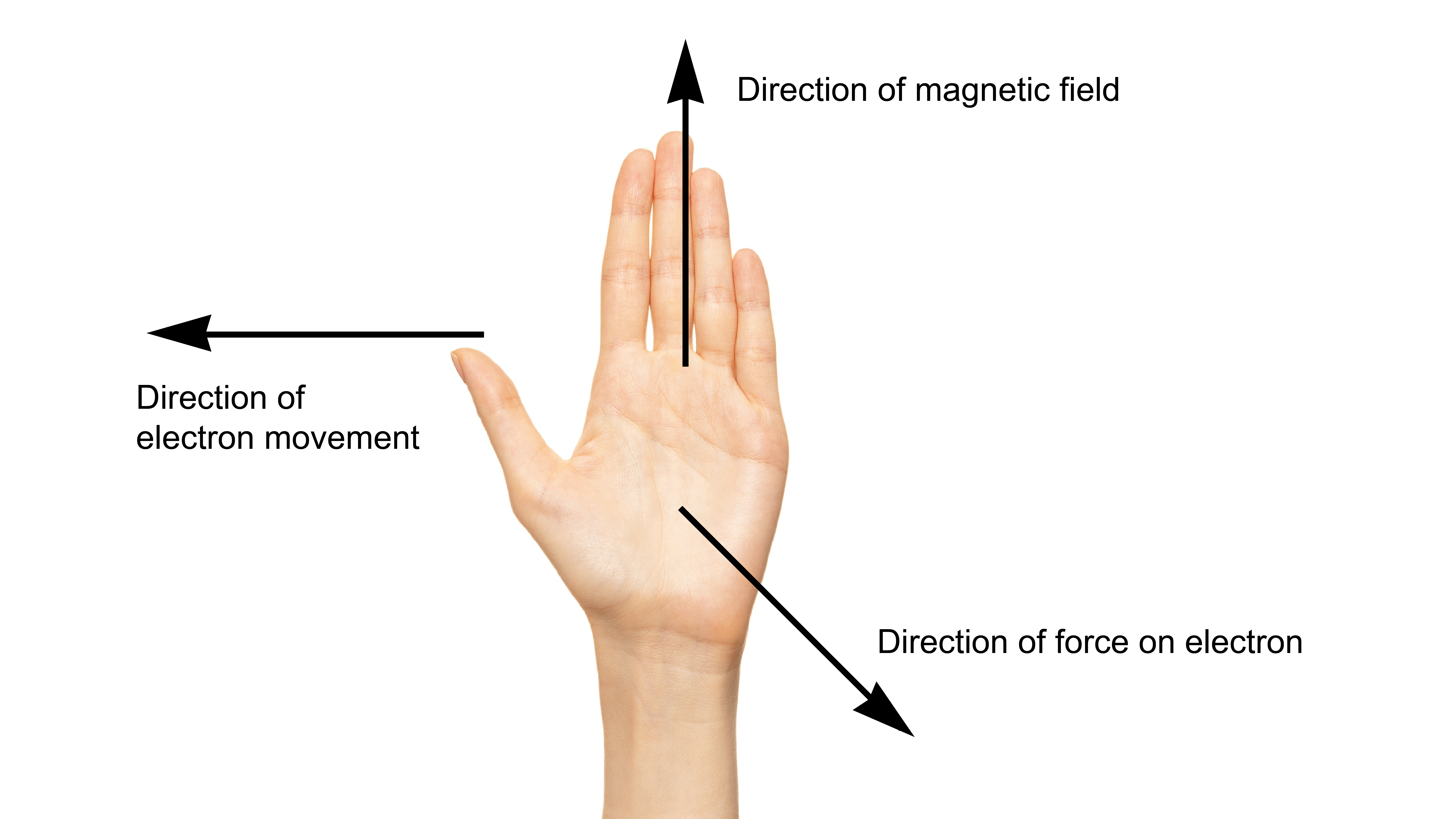
Which point, X, Y or Z would the electrons be expected to move towards? 1. Thinking: Based on right hand slap rule
2. As right hand slap rule is for a positive charge. When dealing with a negative charge either: Apply the right-hand palm rule and reverse the direction of the force. Solution: For a positive charge, velocity to right of page, magnetic field into page, resultant force would be up the page towards X. As it is a negative charge, reverse the direction of applied force, electron will travel downwards towards Z. |