
Comparing Einstein’s Relativity to Classical Physics
One of Einstein’s most famous quotes is “imagination is more important than knowledge”. This spirit of bold thinking led Einstein to bring together two powerful but seemingly conflicting ideas:
- Galileo’s Principle of Relativity, the idea that the laws of physics are the same in all inertial frames of reference.
- Maxwell's Equations, which predict that the speed of light is a constant regardless of the relative motion of the frame of reference.
Under classical (Newtonian) physics, these ideas appeared to contradict each other. Classical physics assumed that speeds should add together, that an observer moving toward a light source would measure light as travelling faster than someone moving away from it. But Maxwell’s theory said the speed of light was always the same. Einstein's theory of Special Relativity recognises that both ideas can be true, if we reconsider the nature of space and time. Space and time are relative to an observer’s motion, and together form a unified concept called spacetime.
Use this page to revise the following concepts within comparing Einstein’s Relativity to classical physics:
- Inertial Reference Frames
- The speed of light, c, is a constant
- Simultaneity and Spacetime in Special Relativity
Inertial Reference Frames
A frame of reference is a system used to describe the position, motion, and measurement of objects. It can be thought of as a coordinate grid attached to an observer, and motion can be described relative to that observer.
This is demonstrated in the image below, showing two people, one on the ground and one on a moving train, debating who is moving. The person on the ground argues that the person on the train is moving, which is true in their frame of reference. The person on the train argues that they are still, not moving. Their reference frame is moving with the train, but they are not moving relative to the train.
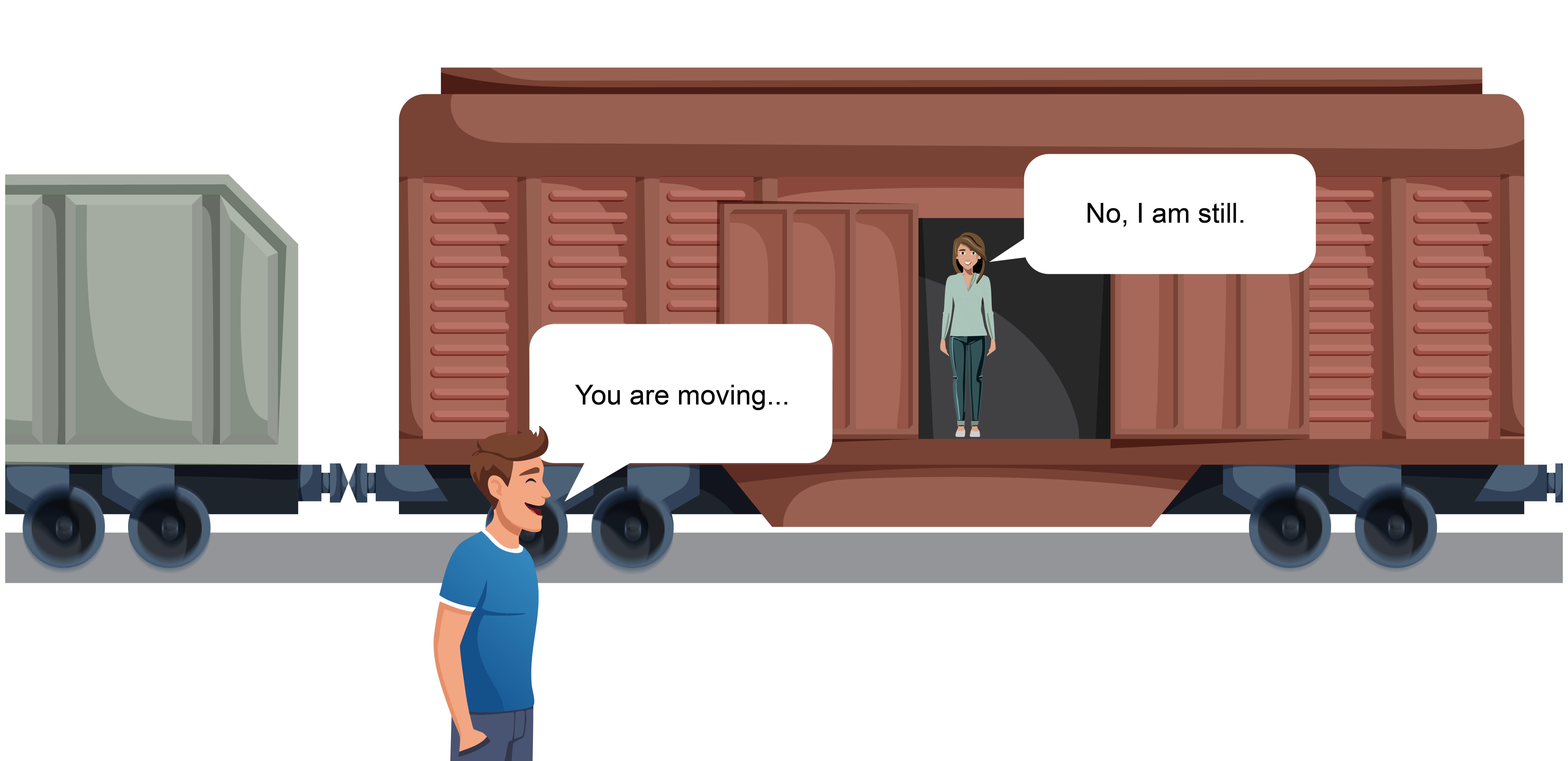
So who has the correct reference frame? Neither. Motion is always relative to the observer's frame of reference. There is no universal “stationary” reference point, instead all motion must be described relative to something else. That is, no frame of reference has an absolute zero velocity which means there is no correct frame of reference.
Returning to our example, the person on the ground may argue that are still while the person on the train is moving, and so suggest that their reference frame is more correct. However, an observer in space would see that the person on the ground is moving as the Earth rotates on its axis, orbits around the sun, and the solar system moves through space. Both individuals and reference frames in our scenario are moving, as is the observer in space. There is no absolute rest frame, instead the frame of reference defines how motion is observed and measured.
An inertial reference frame is one that is not accelerating. It moves at a constant velocity, or remains at rest. These frames are essential to understanding Special Relativity, which assumes that the laws of physics are the same in all inertial frames.
Worked Example
Suppose you are now in a train moving at \(50 \text{ ms}^{-1}\) and decide to run forward in the carriage at \(10 \text{ ms}^{-1}\). An observer on the platform would measure your speed as \(60 \text{ ms}^{-1}\).
In classical physics this is because: \(v_{\text{object in A}} = v_{\text{object in B}} + v_{\text{B in A}}\)
\[\begin{align*}
v_{\text{person on platform}} &= v_{\text{person on train}} + v_{\text{train}} \\
v &= 10\ \text{ms}^{-1} + 50\ \text{ms}^{-1} \\
v &= 60\ \text{ms}^{-1}
\end{align*}\]
Now consider the idea of a car moving forwards at \(60\text{ ms}^2\) and a ball is shot out the back of the car also at \(60\text{ ms}^2\). To an observer on the ground, what would you measure the speed of the ball to be, immediately after it is shot? Watch this video to see.
Check your understanding
View

The speed of light, c, is a constant
The speed of light in a vacuum is always the same, regardless of the motion of the observer or the light source. This challenged long-standing beliefs in classical physics and forced scientists to rethink the nature of space and time. This idea is central to Special Relativity.
Also challenging to classical physics was the observation that light can travel through empty space. The more familiar sound or water waves need a medium to travel through, and cannot travel through a vacuum. This raised questions in the 1800s about how light could do so.
Early scientists initially proposed the existence of an invisible medium called the aether , suggesting it was a weightless, frictionless medium that could carry light. However, no experimental evidence could detect existence. The most famous of these was the Michelson–Morley experiment, which found no change in the speed of light regardless of the Earth’s motion through space. Classical physics assumed that motion through a medium like the aether should affect measured speeds, so this famous null result was confounding.
Einstein considered Maxwell’s equations, which also showed light and all electromagnetic radiation to travel at a constant speed through a vacuum, to be so profound they must be true. Thus, Einstein worked to resolve the conflict between classical physics and light being a constant. To do so, he suggested that the aether does not exist and instead built the theory of Special Relativity.
Einstein’s Postulates
To resolve the apparent contradiction between the theories of Galileo and the inertial reference frames of classical physics and Maxwell's equations, Einstein instead proposed new foundational ideas regarding the nature of space and time.
Einstein’s two postulates of Special Relativity are:
- The laws of physics are the same in all inertial frames of reference. No inertial reference frame is more correct than another.
- The speed of light in a vacuum is constant for all observers regardless, of their motion or the motion of the source of light.
The only way both postulates can be true is if space and time are not fixed and absolute, as classical physics suggested, but are interconnected and relative. Einstein instead concluded that measurements of time and distance can vary depending on the observer’s frame of reference. This was initially controversial in the scientific community, but was supported by the results of the Michelson–Morley Null experiment.
Check your understanding
View
The Null Experiment
The famous Michelson–Morley experiment was designed to detect the presence of the aether, a hypothetical medium that scientists once believed carried light waves through space, just as air carries sound.
If the aether existed, the speed of light should appear different depending on how the Earth moved through this medium, just as the speed of sound waves differ to an observer based on motion. The expected result was that light moving in the direction of Earth’s motion would be measured at at a different speed compared to light moving at right angles to that motion.
To test this, Michelson and Morley used an interferometer, a device that splits a beam of light in two perpendicular directions using a half-transparent mirror. Each beam travels to a mirror, reflects back, and the two beams then recombine and are reflected to a recording device. One of the mirrors is adjustable in distance and therefore can be moved forward or back.
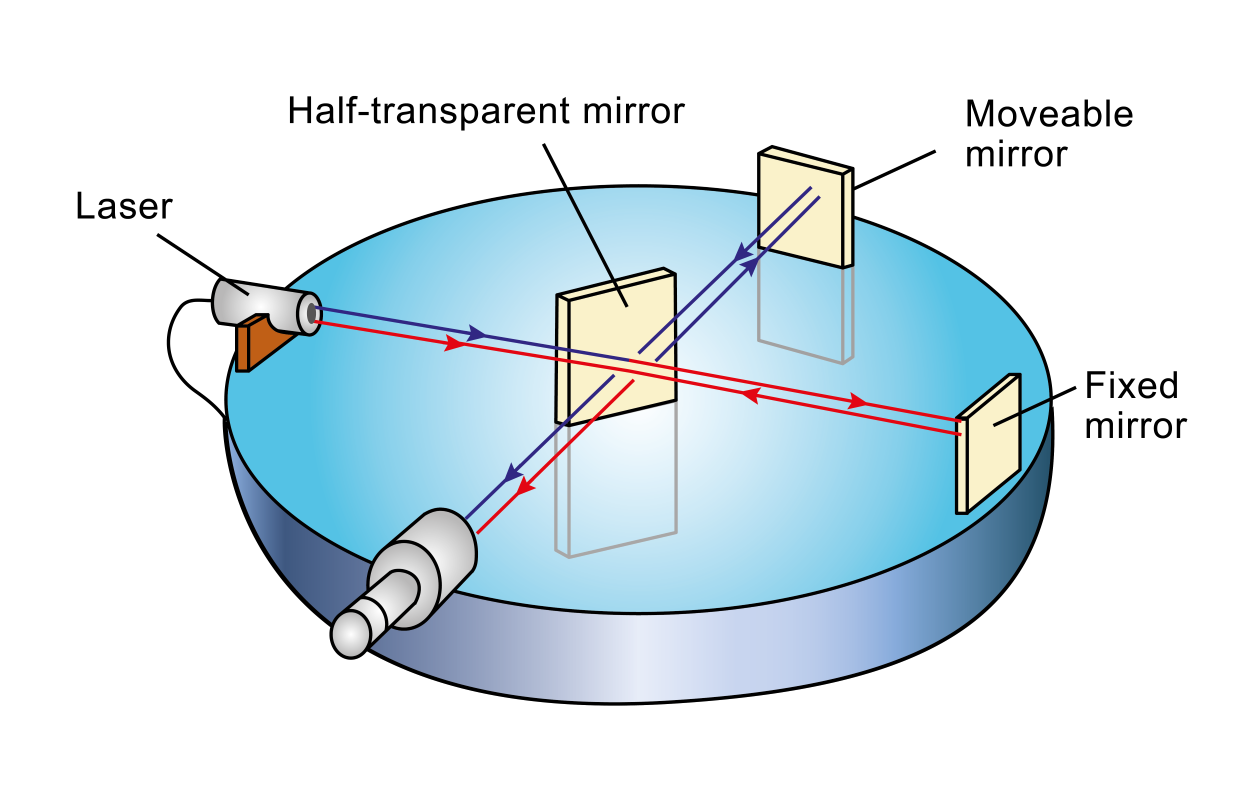
If an aether wind was present then the beams will travel with or against the aether wind as the interferometer was rotated. The different distances travelled by the beams would show as an interference pattern on the detector screen, that would shift with the direction of the Earth's motion through the aether. However, the experiment showed no detectable difference in the speed of light in any direction.
This raised serious doubts about the existence of aether. Einstein used this and similar results to draw the conclusion that Maxwell’s prediction was correct, and propose his theory of Special Relativity, that accepted that the speed of light is constant for all observers in an inertial reference frame.
Check your understanding
View
Simultaneity and Spacetime in Special Relativity
Einstein introduced a new understanding of time, where simultaneity (the idea that two events happen at the same time) is not absolute, but depends on the observer’s frame of reference. In classical physics, time was thought of as universal and was considered a fixed, one dimensional quality that was independent of three-dimensional space. But Special Relativity shows that time and space are interconnected, forming a four-dimensional system called spacetime . All relativistic effects like simultaneity, time dilation and length contraction are consequences of this spacetime structure.
Einstein was renowned as a theoretical physicist and most of his experiments were thought experiments. These imagined scenarios allow physicists to test the logical consequences of a theory without needing a physical experiment, and all measurements can be assumed to be perfectly accurate and free of uncertainty. We can use a thought experiment to explore simultaneity.
Imagine a train moving at a constant velocity \, \(v\), to the left. Inside the train are Rosie and Liz. Outside, standing still on the platform, is Joel.

Rosie and Liz each simultaneously roll two balls, one towards the front of a carriage and one towards the back. In their frame of reference (on the train), they are stationary, so they observe both balls hitting the ends of the carriage at the same time. This make sense, as the balls each travel an equal distance at equal speeds.
Joel, on the platform, observes that the ball moving toward the front of the train travels faster than the one moving toward the back. However, Joel also observes the balls hitting the front and back at the same time. The speed of each ball are different, but so are the distances. The ball moving to the front travels farther, while the one moving toward the back travels a shorter distance, relative to Joel as the train moves to the left.
This is an example of shared simultaneity . Everyone agrees on the timing of events, but may differ in their interpretation of speed and distance. This is an example where simultaneity is preserved across frames, consistent with classical physics. However when it comes to light something interesting occurs.
Imagine the same experiment, but instead of balls, a pulse of light from the centre of the carriage towards the front and back at the same time.

Rosie and Liz, inside the train, observe the light hitting the front and back of the train at the same time. They are stationary in their own frame, and the light travels at a constant speed in both directions, so the results are simultaneous.
Joel sees something different. From his point of view, the light pulse travelling to the back of the train moves toward a point that is approaching it, while the light pulse travelling to the front moves toward a point that is receding. As before, the train is moving with velocity, \(v\), however, the speed of light remains constant in all frames. Therefore, Joel sees the light reach the back of the train before it reaches the front.
This difference in observed outcomes is known as the relativity of simultaneity. Observers in different inertial frames (Rosie and Liz on the train, Joel on the platform) may disagree about whether two events occurred at the same time. This is not due to measurement error or illusion, but a direct consequence of accepting Einstein’s two postulates, especially the constancy of the speed of light. Since the speed of light cannot vary between frames, the timing of events must vary. This led Einstein to reject the classical idea of time as separate and universal. Instead, time and space are understood as part of a single, four-dimensional structure called spacetime, where measurements of distance and time both depend on the observer’s frame of reference.