
Effects of electric fields
Electric charges produce electric fields, and these fields determine how other charges would respond within this region of space. For more information on these fields click here.
Use this page to revise the following concepts within effects of electric fields:
Coulomb’s Law
Electric field s are produced by charged objects, including point charges and charged plates.

The magnitude and direction of the force can be calculated, as well as the work done on a charge in an electric field.
The electric force between two point charge s can be calculated using Coulomb’s Law
Coulomb's Law
\[ F = \frac{k|q_1q_2|}{r^2} \]
Where:
- \(F\) = magnitude of the force \((\mathrm{N})\)
- \(k\) = Coulomb’s constant \((9.0 \times 10^9 \mathrm{~Nm}^2\mathrm{~C}^{-2})\)
- \(|q_1|\) and \(|q_2|\) = magnitudes of charge \(1\) and charge \(2\) \((\mathrm{C})\)
- \(r\) = distance between the two charges \((\mathrm{m})\)
To determine the direction of the force :
- Calculate \(F\) while including the sign on the charges \(q_1\) and \(q_2\)
- Determine the direction by looking at the charges: If they are like, it will be repulsion; if they are different, it will be attraction. You can then determine the magnitude of the force while ignoring the sign on \(q_1\) and \(q_2\).
Worked Example
A helium nucleus and an electron are \(5 \mathrm{~nm}\) apart.
\(q_1 = 3.2 \times 10^{-19} \mathrm{~C}\)
\(q_2 = -1.6 \times 10^{-19} \mathrm{~C}\)
\(r = 5 \times 10^{-9} \mathrm{~m}\)
Hence:
\[ F = \frac{kq_1q_2}{r^2} = \frac{(9 \times 10^9)(3.2 \times 10^{-19})(-1.6 \times 10^{-19})}{(5 \times 10^{-9})^2} = -1.8432 \times 10^{-11} \mathrm{~N} \]
So, the magnitude of the force is \(1.8 \times 10^{-11} \mathrm{~N}\), and the force is attractive.
Try the example below:
 Check your understanding
View
Check your understanding
View

Alternatively, you may consider the electric field one point charge creates and then determine the force that it exerts on any other charge. This is useful if you need to determine the force by one charge on multiple charges.
The electric field of a point charge is given by:
\[ E = \frac{k|q_1|}{r^2} \]
Where:
- \(E\) = magnitude of the electric field strength \((\mathrm{NC}^{-1}\text{ or }\mathrm{Vm}^{-1})\)
- \(k\) = Coulomb’s constant \((\mathrm{Nm}^2\mathrm{C}^{-2})\)
- \(|q_1|\) = magnitude of the charge creating the field \((\mathrm{C})\)
- \(r\) = distance from the point charge \((\mathrm{m})\)
The force on any other charge is then given by:
\[ F = |q_2|E \]
Where:
- \(F\) = magnitude of the force on the charge \((\mathrm{~N})\)
- \(|q_2|\) = magnitude of the charge in the field \((\mathrm{~C})\)
Worked Example
Reconsider the example of the helium nucleus and the electron. Consider the electric field created by the helium nucleus:
\[ E = \frac{kq_1}{r^2} = \frac{(9 \times 10^9)(3.2 \times 10^{-19})}{(5 \times 10^{-9})^2} = 1.152 \times 10^8 \mathrm{~NC}^{-1} \]
The force on the electron is then given by:
\[ F = q_2E = (-1.6 \times 10^{-19})(1.152 \times 10^8) = -1.8432 \times 10^{-11} \mathrm{~N} \]
So, the magnitude of the force is \(1.8 \times 10^{-11} \mathrm{~N}\), and the force is attractive.
Check your understanding
View
Fields between charged plates
Electric fields can be created between two charged plates by applying a potential difference between them. Adjusting this potential difference alters the uniform field between the plates.
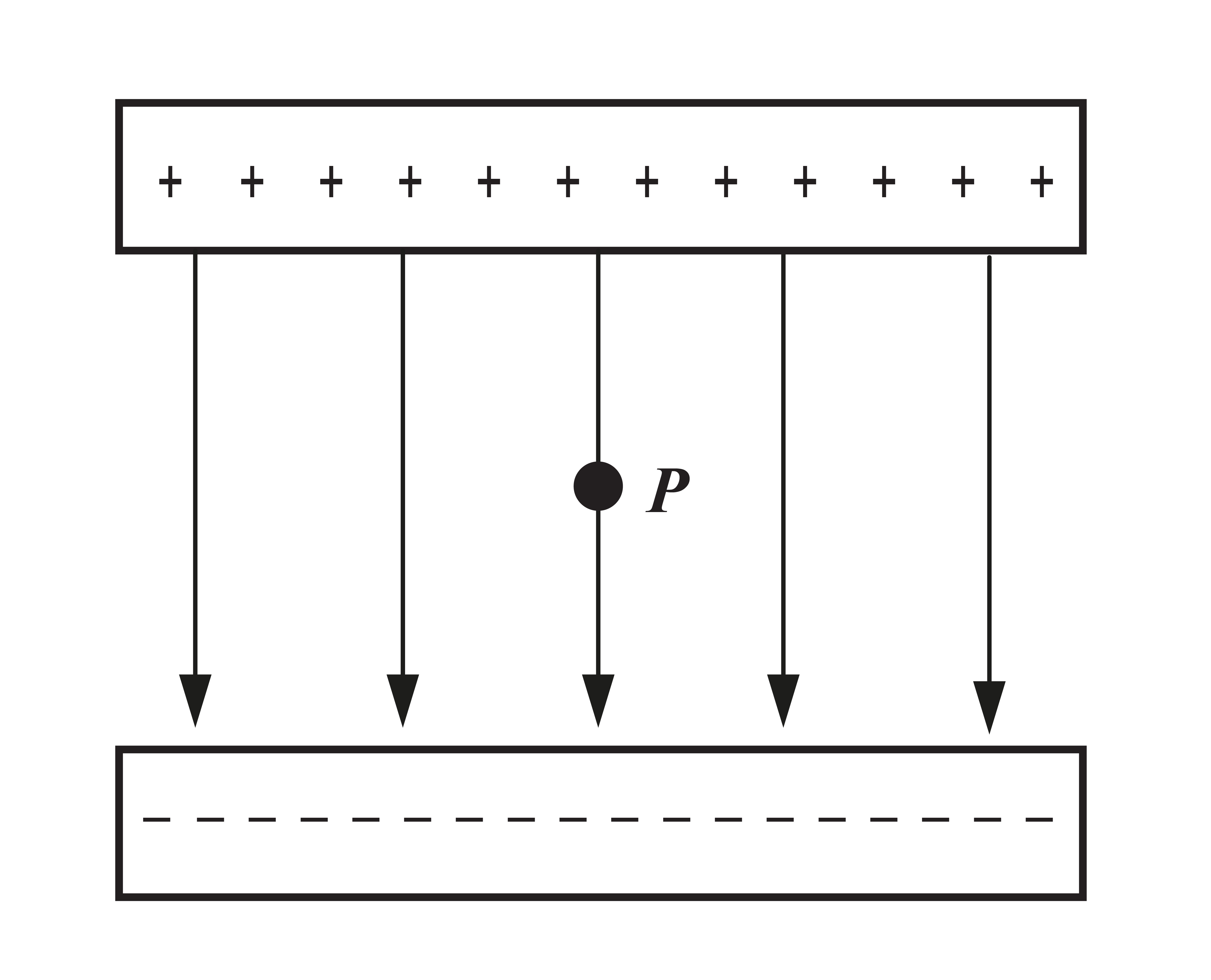
Consider two parallel plates as shown in the diagram above. If the potential difference \((V)\) between the plates and the separation distance of the plates are known, the uniform electric field between two plates and the work done on a point charge in this field can be calculated:
\[ E = \frac{V}{d} \]
and
\[ W = qV \]
Therefore:
\[ W = qEd \]
Where:
- \(E\) = electric field strength \((\mathrm{~Vm}^{-1})\)
- \(V\) = potential difference \((\mathrm{~V})\)
- \(d\) = distance separating the plates \((\mathrm{~m})\)
- \(W\) = work done on a point charge in the field \((\mathrm{~J})\)
- \(q\) = charge of the point charge in the field \((\mathrm{~C})\)
Worked Example
Consider two plates \(20 \mathrm{~cm}\) apart, with a potential difference of \(12 \mathrm{~V}\). What is the work done to move an electron \(5 \mathrm{~cm}\) to the positive plate?
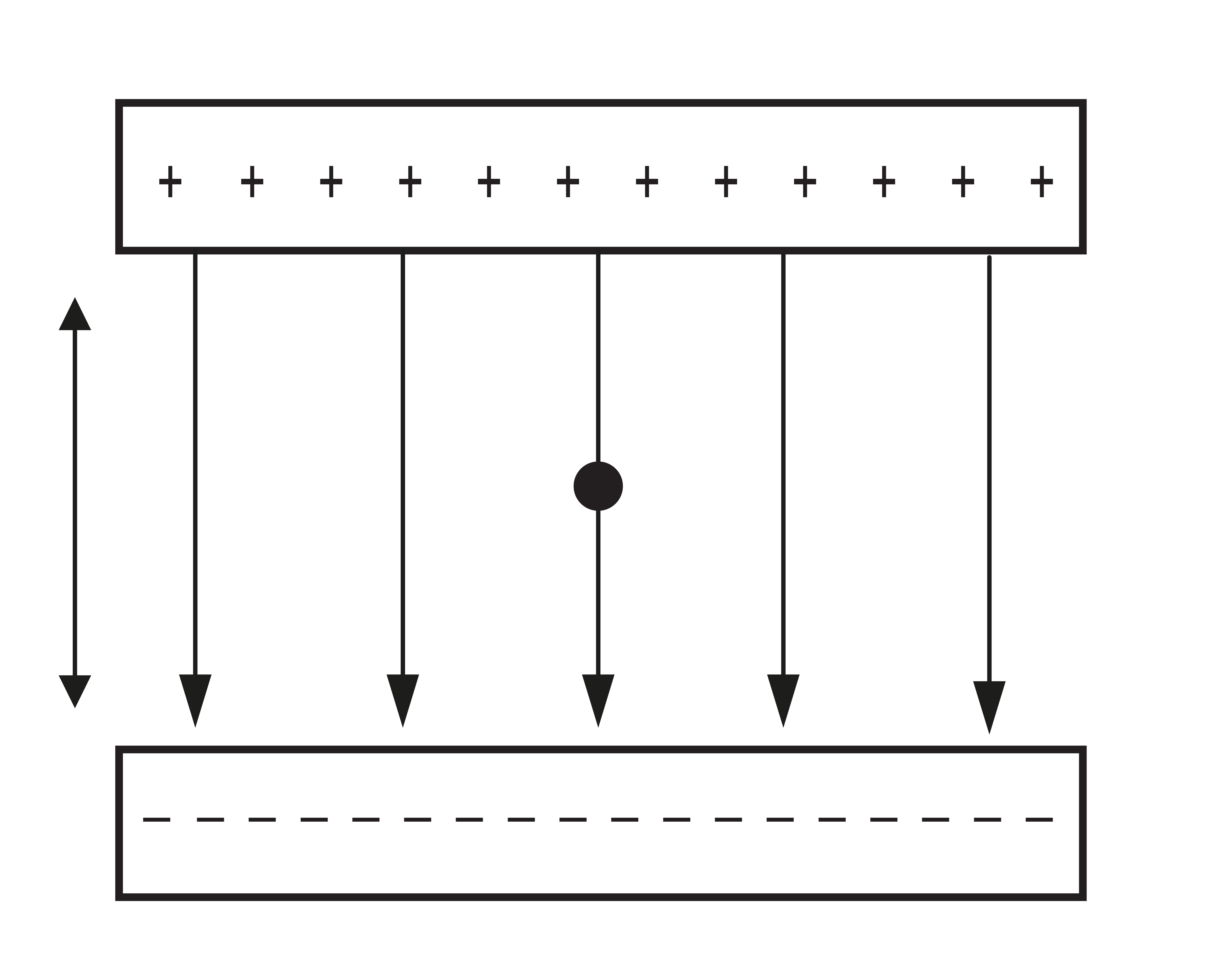
The electric field between the plates is given by:
\[ E = \frac{V}{d} = \frac{12}{0.20} = 60 \mathrm{~Vm}^{-1} \]
If an electron moves \(5 \mathrm{~cm}\) towards the positive plate, then the magnitude of the work done by the electric field on the electron is found by:
\[ W = qEd = (1.6 \times 10^{-19})(60)(0.05) = 4.8 \times 10^{-19} \mathrm{~J} \]
Check your understanding
View
Millikan oil drop experiment
Robert Millikan conducted this experiment in 1909 to determine the charge of an electron.

- Oppositely charged plates arranged vertically contain a vertical electric field that can be manipulated to create an upwards force on a charged particle
- Oil drops that have been charged with electrons are sprayed into the field
- Once the field is altered such that the drops become stationary, the gravitational force and the electric force on the drops is balanced.
Equating these forces:
\[
\begin{aligned}
F_E &= F_G \\
\frac{qV}{d} &= mg \\
q &= \frac{mgd}{V}
\end{aligned}
\]
the charge of the oil drop can be found.
- This charge must be an integer multiple of the charge of a single electron.
- Performing multiple trials (with different unknown number of electrons on each drop) the size of the charge of one electron can be found.