Light as a wave
Light exhibits many behaviours that are characteristic of waves. This is evident in the formation of rainbows is a result of the refraction and dispersion of light through water droplets in the atmosphere. Light can also be polarised, and can undergo diffraction, similar to the way water waves bend as they pass through a narrow opening. These observations provide strong evidence for the wave model of light.
Use this page to revise the following concepts within light as a wave:
Types of Waves
Waves can be categorised as longitudinal or transverse, depending on the orientation of their oscillations relative to the direction of energy transfer.
A longitudinal wave has oscillations that travel parallel to the direction of wave propagation and energy transfer. These waves consist of alternating compressions (regions where particles are close together) and rarefactions (regions where particles are spread apart). Sound waves in air are a common example.
A transverse wave has oscillations that travel perpendicular to the direction of wave propagation and energy transfer. Light is an example of a transverse wave, and this is the type that will be the focus of this section.

Waves in strings and water waves are examples of mechanical waves, which are waves that require a medium to travel through. Their oscillations are due to physical displacement of matter.
In contrast, light does not require a medium. It is a part of the electromagnetic spectrum, whichconsists of transverse waves of electric and magnetic fields that propagate through space. The wave model of light was supported by the work of James Clerk Maxwell, who demonstrated that oscillating electric and magnetic fields could sustain one another, allowing light to travel through a vacuum as a wave.
Check your understanding
View

Properties of a wave
A wave can be described in terms of the properties of its amplitude, wavelength, period and frequency. Click on the diagram below for definitions of each of these properties
NotePeriod is a measurement of time, while wavelength is a measurement of distance. |
Check your understanding
View
The Wave Equation
The speed in which an object travels is determined by the distance travelled and the time taken. This idea also applies to waves.
The speed of a wave, \(v\), is given by the wave equation:
\[ v = \frac{\lambda}{T} \]
Where
- \(v\) is the wave speed in metres per second \(ms^{-1}\)
- \(λ\) is the wavelength in metres, \(m\)
- \(T\) is the period in seconds, \(s\)
The period of a wave, \(T\), is inversely related to its frequency, \(f\), which is measured in Hertz (\(Hz\)):
\[T=\frac{1}{f}\]
Substituting this into the wave equation, we get the more commonly used form:
\[v = \lambda f\]
Where
- \(v\) is the wave speed in metres per second, \(ms^{-1}\)
- \(λ\) is the wavelength in metres, "\(m\)"
- \(f\) is the frequency, in "\(Hz\)"
This means that when frequency increases, the period decreases, and vice versa. The two quantities are reciprocals. They are mathematically and conceptually linked.
Worked Example
The diagram below depicts a wave which has wavelength of 2.80m. The point P takes 0.5s to travel from crest to trough, that is, maximum displacement to the minimum displacement. Calculate the speed the wave?
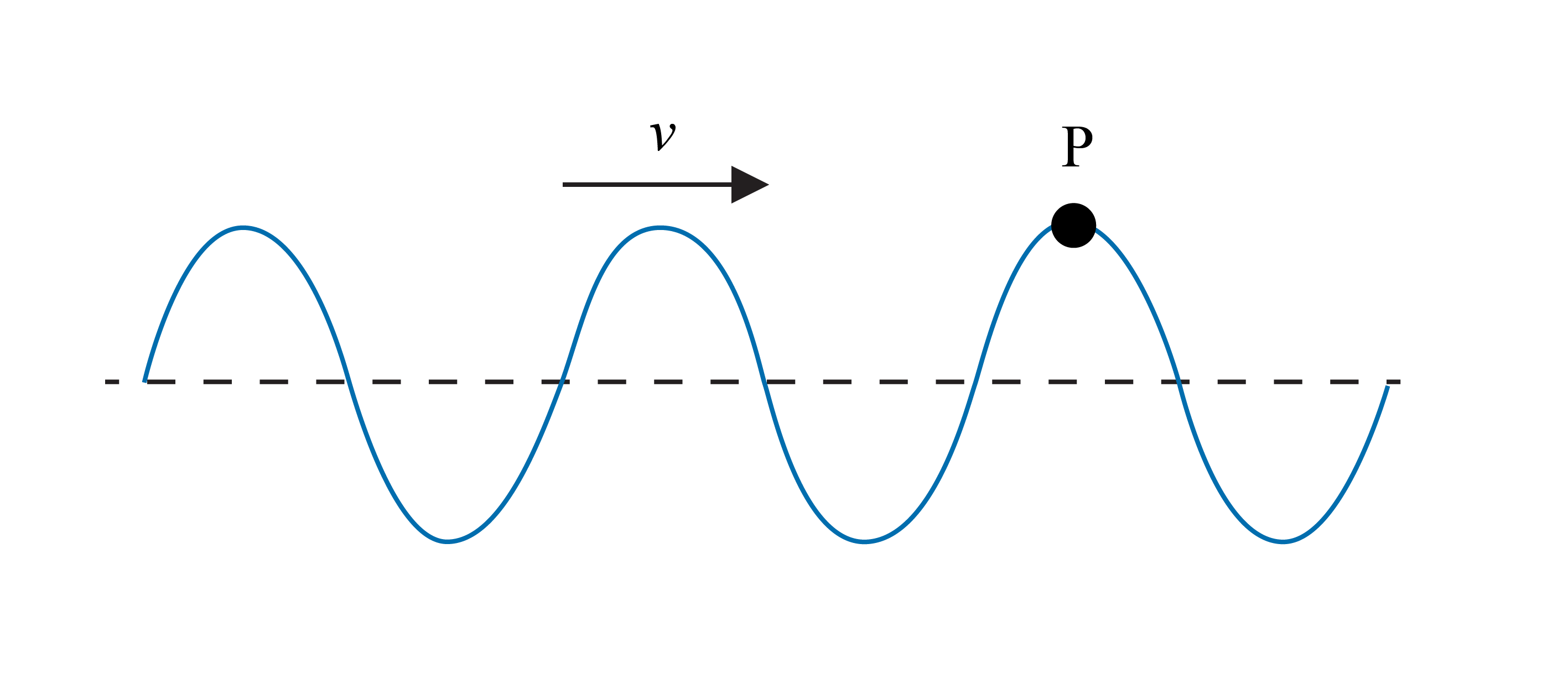
Using the wave equation: \[v = \frac{\lambda}{T}\] \[\quad \lambda = 2.80\,\text{m}\]
The time taken to go from maximum to minimum is \(0.5 \text{ s}\) so the period \(T\), which is one full cycle of the wave must be \(1.0 \text{ s}\)
\begin{align*} v &= \frac{\lambda}{T} \\ &= \frac{2.80}{1} \\ &= 2.80\,\text{ms}^{-1} \end{align*}
Check your understanding
View
Light waves in a vacuum
When applying the wave equation to light, something interesting occurs. James Clerk Maxwell demonstrated that light travels at a constant speed in a vacuum, \(c = 3 \times 10^{8} \text{ ms}^{-1}\). Therefore, the velocity of the wave equation for light travelling through a vacuum is always \(c\). This can be written as:
\[c=\lambda f\]
Where
- \(c\) is the speed of light, \(3 \times 10^{8} \text{ ms}^{-1}\)
- \(λ\) is the wavelength in metres, \(m\)
- \(f\) is the frequency in Hertz, \(\text{ Hz}\)
This equation allows us to determine the frequency or wavelength of any electromagnetic wave, including visible light, radio waves, and x-rays, as long as they are travelling in a vacuum.
Electromagnetic Spectrum
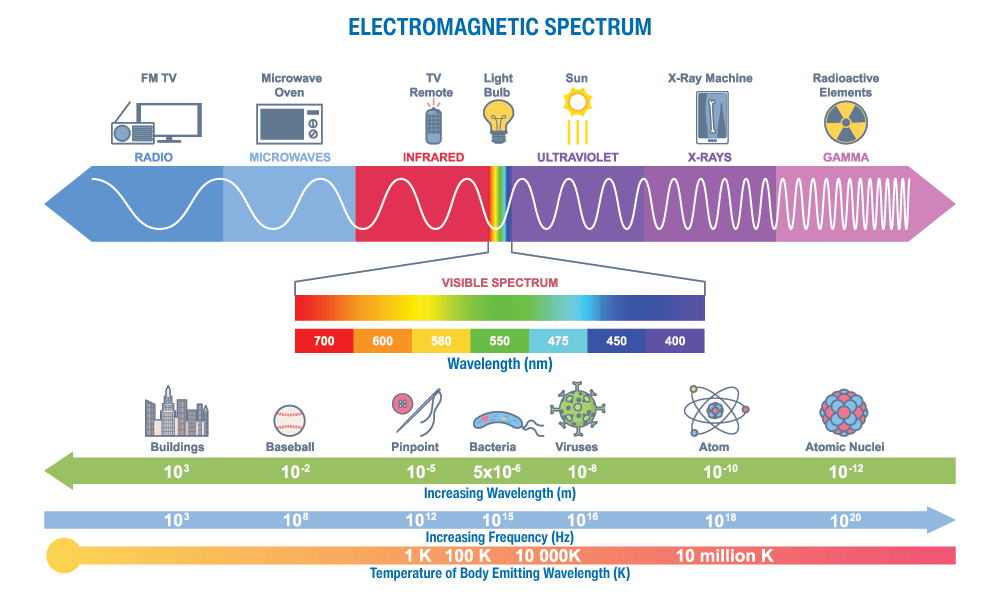
The electromagnetic spectrum represents the full range of electromagnetic radiation (EMR), a form of energy that travels through space as oscillating electric and magnetic fields.
The concept of EMR was first proposed by James Clerk Maxwell in 1865. He theorised that an accelerating charged particle that moves back and forth would generate a changing magnetic field. This changing magnetic field would, in turn, induce a changing electric field . These alternating fields regenerate each other, forming a self-propagating wave that can travel through a vacuum.
You can read more about this concept on the LearnHQ page on Magnetic flux and Faraday’s law
As illustrated in the diagram below, electromagnetic waves consist of two components:
- An electric field oscillating in one plane
- A magnetic field oscillating in a perpendicular plane
As shown in the diagram below, for EMR the electric and magnetic fields oscillate at the Both fields oscillate at the same frequency, and together they create a self-sustaining, transverse wave that travels at the speed of light, \(c = 3 \times 10^{8} \text{ ms}^{-1}\) in a vacuum.

The frequency of oscillation of the electric and magnetic fields determines the frequency of the electromagnetic radiation. Different frequencies of EMR have different properties and applications. Depending on its frequency, EMR can be used for a wide range of purposes, including communication, medical imaging, and heating.