
Mass-Energy Theorem
Mass and Energy are not the same thing but they are equivalent in the sense that mass can be transformed into energy and energy can be transformed into mass providing the total energy is conserved. Mass-energy transformations provide answers to how Nuclear Energy, Nuclear Weapons and the Sun being able to provide extreme amounts of energy. Einstein’s infamous equation \(E = mc^2\) is explored in this section too.
Use this page to revise the following concepts within mass-energy theorem:
Relativistic Momentum and Energy
In classical physics, momentum and kinetic energy are defined in simple ways that work well at everyday speeds. But when objects move close to the speed of light, these classical definitions no longer match experimental results. Special Relativity provides new expressions for momentum and energy that remain valid at all speeds, from walking pace to near light speed.
Relativistic Momentum
Imagine a rocket travelling at \(99%\) the speed of light \((0.99\text{ c})\). If it continues to accelerate, will it ever reach or exceed the speed of light? According to classical physics, applying a constant force should keep increasing the rocket’s speed without limit. However, Einstein showed that this is not what happens.
As an object’s speed approaches \(c\), increases more rapidly than predicted by classical physics. Instead of the simple formula \(p=mv\), relativistic momentum is given by:
\[p=\gamma mv\] Where:
- \(p\) is the relativistic momentum
- \(m\) is the mass of the object \((\text{kg})\)
- \(v\) is the velocity of the object \((\text{ms}^{-1})\)
- \(\gamma\) is the Lorentz factor
This equation shows that as \(v\) increases, \(\gamma\) increases, and therefore momentum grows much faster than in classical physics.
We can also see how relativistic momentum arises by starting from the classical definition of momentum change. In classical physics, the change in momentum\((\Delta p)\) is given by:
\[F \Delta t_0 = m \Delta v\] Where:
- \(t_0\) is the proper time \((\text{s)}\)
- \(m\Delta v\) is the change in momentum of classical physics \((\text{ms}^{-1})\)
- \(F\) is the force applied \((\text{N})\)
However, in a stationary observer’s frame, the elapsed time is not \(\Delta t_0\), but the dilated time
\[\Delta t = \gamma \Delta t_0\]
Substituting this into the momentum equation gives:
\[F \Delta t = \gamma m \Delta v\]
This illustrates that the observed change in momentum is larger by a factor of \(\gamma\) compared to the classical prediction. That is:
\[\Delta p = \gamma \Delta v = \gamma p_0\]
Where \(p_0\) is the momentum in classical physics and \(p\) is the relativistic momentum. This demonstrates that the classical formula for momentum transforms into the relativistic one once you take time dilation into account. The Lorentz factor \((\gamma)\) corrects for time dilation and ensures momentum grows correctly at speeds close to \(c\)
Cosmic Speed Limit
Classical physics suggested that momentum increases linearly with velocity, so an object could, in theory, be accelerated beyond the speed of light. Special Relativity shows this is not possible.
As an object’s velocity approaches \(c\), the Lorentz factor \((\gamma)\) increases sharply. Since relativistic momentum is given by \(p=\gamma mv\), the momentum of an object approaches infinity as its velocity gets closer to \(c\), as shown in the following graph.
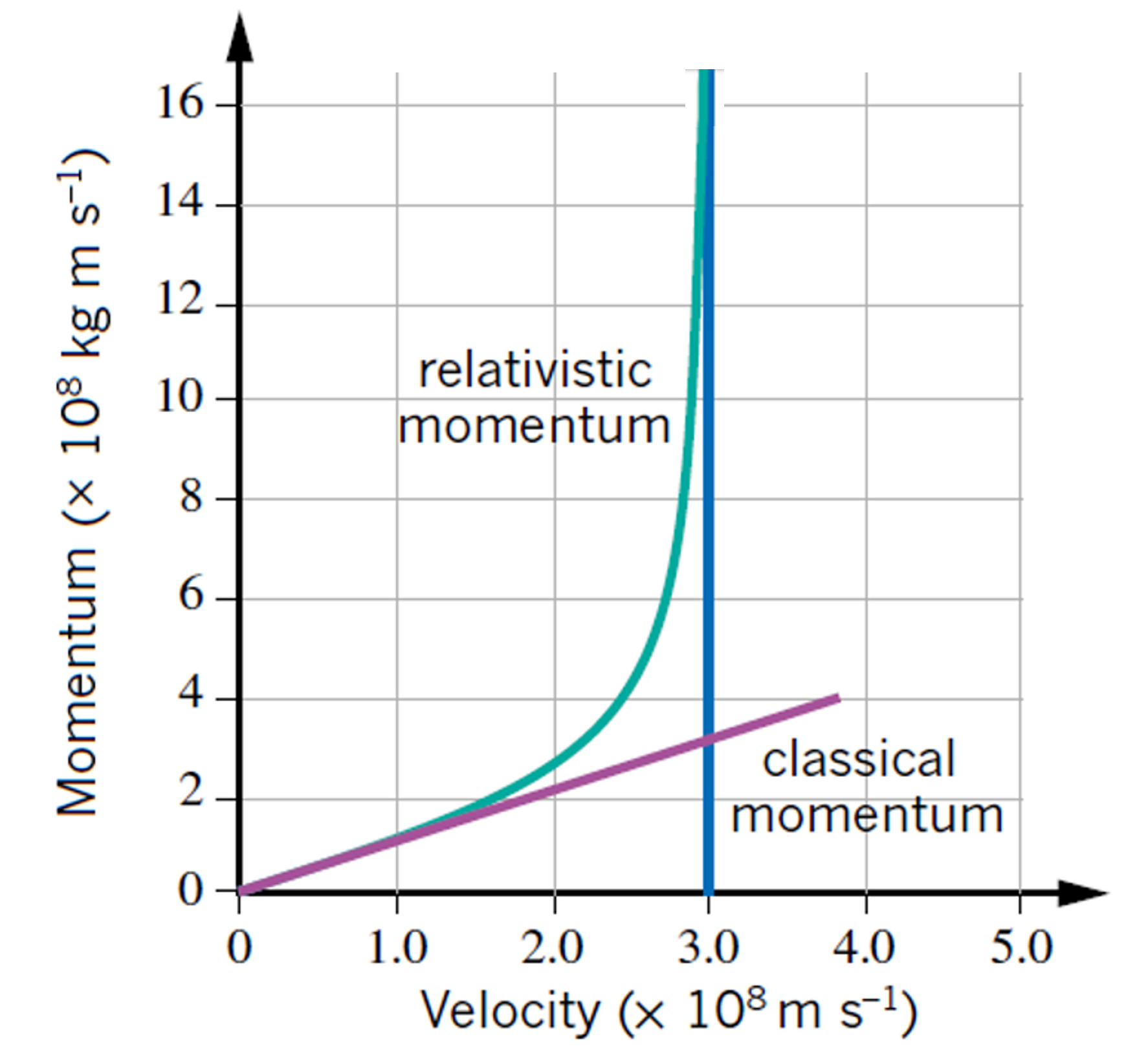
This means that applying a force cannot accelerate an object with mass to the speed of light.To reach \(c\) would require an infinite amount of momentum, and therefore an infinite amount of energy, as \(F \Delta t = \gamma \Delta v\). The result is a cosmic speed limit: material objects can get arbitrarily close to \(c\), but never reach it. Only massless particles, such as photons, always move at the speed of light.
Check your understanding
View

Relativistic Kinetic Energy
As an object gains momentum it also gains kinetic energy. In classical physics, the kinetic energy of an object is:
Where:
- \(E_k\) is the kinetic energy \((\text{J})\)
- \(m\) is the mass of the object \((\text{kg})\)
- \(v\) is the velocity \((\text{ms}^{-1})\)
This is accurate at low speeds but fails to account for observed phenomena at velocities close to the speed of light. From relativistic momentum, Einstein derived relativistic kinetic energy as:
Where:
- \(\gamma\) is the Lorentz factor
- \(c\) is the speed of light \((\text{ms}^{-1})\)
At low speeds, this expression very closely approximates the classical \(\frac{1}{2}mv^2\). At relativistic speeds, however, it predicts much larger energies, consistent with experimental results.
Total Energy and Rest Energy
The expression for relativistic kinetic energy also reveals that an object has energy even when it is at rest, called its rest energy. We can demonstrate this algebraically, by expanding the equation:
\[\begin{align*}
E_k &= (\gamma - 1)mc^2 \\
E_k &= \gamma mc^2 - mc^2 \\
\end{align*}\]
Rearranging this gives us:
\[ mc^2 +E_k = \gamma mc^2\]
From this, Einstein defined the the total energy of an object:
\[E_{total}=\gamma mc^2\]
Further, the energy when an object is at rest, that is when \(v=0\) and therefore \(\gamma=1\), this becomes
\[E_0=mc^2\]
As, \(E_{total}=\gamma mc^2=mc^2 +E_k\), we see there must be two contributions to an object's energy, both the kinetic energy, \(E_k\), and the rest energy, \(E_0\), so that the total energy can also be written as
\[E_{total}= E_0+E_k\]
That is, relativistic kinetic energy not only explains why objects require more and more energy to accelerate to near the speed of light, but that mass itself is a source of energy, even without motion.
Check your understanding
View
Worked Example 1: Calculating relativistic momentum
Calculate the relativistic momentum of a rocket with a rest mass of \(10000 \text{ kg}\) moving at \(0.9 \text{c}\), as measured by an observer at rest.
Step 1: Identify key variables
\(m=10000\text{ kg}\)
\(v= 0.9 \text{c}\)
This equates to a Lorentz factor of \[\begin{align*} \gamma&=\frac{1}{\sqrt{1-\left(\frac{v}{c}\right)^2}}\\ &=\frac{1}{\sqrt{1-(0.90)^2}}=\frac{1}{\sqrt{1-0.81}}\\ &=\frac{1}{\sqrt{0.19}}=2.29 \end{align*}\]
Step 2: Substitute into equation and solve
\[\begin{align*} p &= \gamma mv \\ &= 2.29 \times 10000 \times 0.90 \times 3.00 \times 10^8 \\ &= 6.18 \times 10^{12}\ \text{kg ms}^{-1} \end{align*}\]
Worked Example 2: Calculating total energy
Calculate the total energy of a very fast Lime scooter, if its rest mass is \(100 \text{ kg}\) and it is travelling at a speed of \(2.60 \times 10^8 \text{ ms}^{-1}\).
Step 1: Identify key variables
\(m=100\text{ kg}\)
\(v=2.60\times 10^8 \text{ ms}^{-1}\)
This equates to a Lorentz factor of \[\begin{align*} \gamma&=\frac{1}{\sqrt{1-\frac{\left(2.60\times10^{8}\right)^2}{\left(3.00\times10^{8}\right)^2}}}\\ &=\frac{1}{\sqrt{1-(0.8667)^{2}}}\\ &=\frac{1}{\sqrt{0.249}} \approx 2.00 \end{align*}\]
Step 2: Substitute into equation and solve
\[\begin{align*} E_{\text{total}} &= \gamma mc^2 \\ &= 2.00 \times 100 \times (3.00 \times 10^8)^2 \\ &= 1.8 \times 10^{19}\ \text{J} \end{align*} \]
Check your understanding
View
Conservation of Mass-Energy and \(E = mc^2\)
Through Special Relativity, Einstein showed that mass and energy are different forms of the same thing. Mass can be converted into energy, and energy can be converted into mass, provided the total mass–energy of a system is conserved.
Classical physics suggested that in any process, the total mass of a system must remain constant. Relativity refined this idea: it is the combined mass–energy that is conserved, not mass alone. If mass appears to “disappear,” it has in fact been converted into energy. This difference in mass before and after a reaction is called the mass defect.
This relationship is expressed in Einstein’s famous equation:
\[\Delta E = \Delta mc^2\]
Where:
- \(\Delta E\) is the energy released \((\text{J})\)
- \(\Delta m\) is the mass defect \((\text{kg})\)
Fusion and Fission Reactions
Fusion and fission reactions are practical examples of mass–energy conservation, where small differences in mass appear as large amounts of released energy. These nuclear processes demonstrate Einstein’s principle that mass can be converted into energy while the total mass–energy of the system remains conserved.
Fusion occurs when two light nuclei combine to form a heavier nucleus. In practice, this requires extremely high temperatures and pressures so the positively charged nuclei can overcome their electrostatic repulsion and get close enough for the strong nuclear force to bind them. This is the process that powers the Sun.
Fission occurs when a heavy nucleus splits into two or more smaller nuclei, often triggered by neutron bombardment. Fission reactions release large amounts of energy and are used in atomic weapons, first developed in 1945.
In both fusion and fission, the products have slightly less mass than the reactants. The resulting mass defect appears as released energy, ensuring that the total mass–energy remains conserved. Even though there is only a small loss of mass, this results in a very large release of energy because it is multiplied by the factor \(c^2\) in Einstein’s equation.
Worked Example
Calculate the energy produced by the Sun each second if \(4.00\) million tonnes of matter are converted into energy every second.
Step 1: Identity known variables in
\[\Delta E = \Delta mc^2\]
\(Δm=4.00 \text{ million tonnes} = 4.00 \times 10^6 \times 1000 \text{ kg/tonne} = 4 \times 10^9 \text{ kg}\)
Step 2: Substitute and solve
\[\begin{align*} \Delta E &= \Delta m c^2 \\ &= (4 \times 10^9 \text{ kg})(3 \times 10^8\text{ms}^{-1})^2 \\ &= 3.6 \times 10^{26}\ \text{J} \end{align*} \]