
What is a field?
Use this page to revise the following concepts within what is a field?:
A field is a representation of what is going on in a region of space. It’s defined as a function that takes a point in space and returns either a scalar (a number) or a vector (a number and a direction).
Fields that are functions that return scalars are called scalar fields. You can see an example of a scalar field when you open a weather app and look at a map showing the temperatures in different locations.
Fields that are functions that return vectors are called vector fields. Gravitational, electric, and magnetic fields are all examples of vector fields. We often call them just fields for short, as we care about vector fields more often than scalar fields in introductory physics. These fields can show us regions of space in which a mass or a charge within this space experiences a non-contact force. We can represent a field using vectors in a field diagram, and in the case of gravitational, electric, and magnetic fields, we can use fields to figure out forces on objects.
To model the different effects of fields, a field diagram can be drawn. A field diagram of a bar magnet is shown below.

Field diagrams are represented with the following properties:
- Field lines are vectors as they have both magnitude and direction. The direction is indicated by an arrowhead. The magnitude of the field is indicated by the spacing of the field lines: closer field lines represent a stronger field, while further-apart field lines indicate a weaker field.
- Field lines do not cross, as field lines are vectors. To have them intersecting would suggest the field at that point could have two different directions.
Always remember that these drawings are two-dimensional representations of a three-dimensional field. This can be seen in the photo below of a bar magnet surrounded by iron fillings. The iron fillings show the magnetic field lines curving outward from the North pole to the South pole, and are densest near the North and South poles of the bar magnet, where the magnetic field is strongest.

 Check your understanding
View
Check your understanding
View

Types of fields
Fields can be described as uniform or non-uniform, and as static or changing. This is dependent on the object(s) producing the field.
Uniform & Non-Uniform Fields
A uniform field is a field where the field strength is the same at all points within the field.
An example is the electric field between two charged plates. The field is the same strength at all points within the field. This is depicted in the field diagram below. The gaps between the field lines are equal and the direction of the field always points from positive to negative (the direction a positive charge would go if placed within the field).

A non-uniform field is characterised by variations in field strength or direction at different points within the field. The spacing between field lines in a diagram of a non-uniform field isn’t be consistent, indicating areas of stronger or weaker field strength.
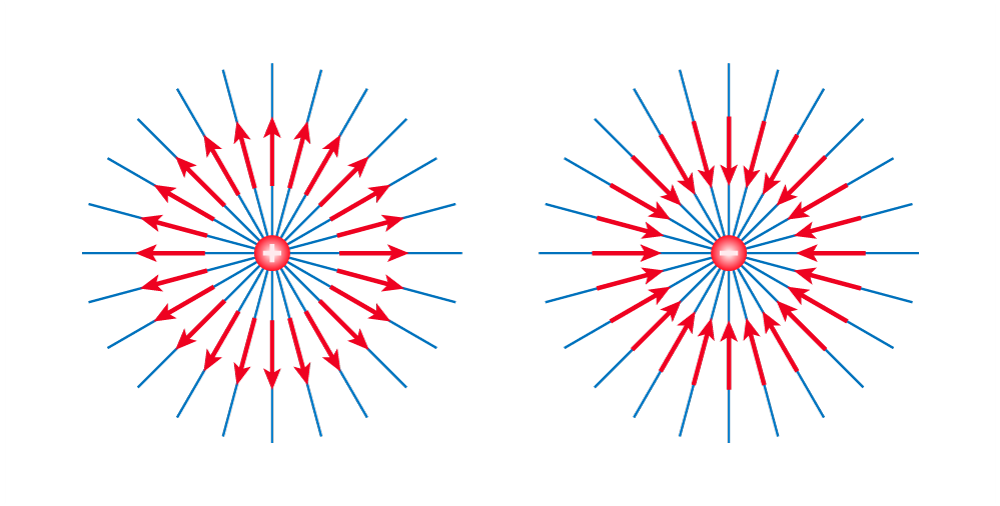
An example is the field strength around a point charge . The further away you go from the point charge, the weaker the field strength. This is indicated by the field lines extending away from each other the further away you get from the charge, showing that the field is non-uniform.
At the surface of the Earth, gravity is considered a uniform field as we take an accepted value of \(g = 9.8 m s^{-2}\)

However, the reality is that the further away you go from the Earth, the weaker the field strength. This can be seen in the field diagram, where the gravitational field is shown to be non-uniform as the field lines spread further apart the farther they extend from the Earth.
Static Fields
A static field is a field that will not change over time. An example of this is a permanent magnet if it is stationary. That is to say that the field strength of the bar magnet below will continue to have the same field strength as long as it remains stationary.
It might appear that the field lines of a magnet extend out in all directions; however the poles only represent regions where the field lines exit or enter the magnet. The field lines form complete loops which will flow back into the magnet itself.
Changing field
Changing fields are dynamic, meaning their strength and/or direction change with time. This variation can be caused by moving charges or changing magnetic fields, leading to a range of effects and interactions in the environment around them. You can find out more about changing fields in application of field concepts.
Monopoles and Dipoles
The interaction of a field also depends on if it is considered to be a monopole or dipole.
A monopole is considered to be a ‘one way only’ field and this occurs for all interactions of gravitational field s and also a point charge. For gravity the direction of the field lines will always point inwards to the mass of the object, and for point charges this varies depending on the type of charge – positive outwards and negative inwards.
A dipole is considered a two way field This occurs when field lines ‘connect’ or ‘bridge’ between two unlike charges or a closed loop, such as is seen within magnets. For this reason, there are no magnetic monopoles.
Gravitational Monopoles, Electric Monopoles and Dipoles
Magnetic Dipoles
A magnet is a dipole, as it will always have a north pole and a south pole. Breaking/cutting it in half will result in two smaller magnets. Evidence of a magnetic monopole has not yet been found.
