
Electric Fields
Use this page to revise the following concepts within electric fields:
- Electric Field of Point Charges
- Calculating Field Strength
- Inverse Square Law
- Electric Fields Between Charged Plates
- Work Done on a particle moving through an electric field
Electric Field of Point Charges
Electric charges produce electric fields. These fields determine how other charges respond within this region of space. A field diagram can be used to describe the field within the proximity of point charges.
A point charge is considered to be a small charged sphere in which the field lines radiate like spokes on a wheel. Point charges can be either negative or positive.
Field lines show the size and direction of a field. They indicate the direction that a positive point charge would experience if it was placed in the field .
For an isolated charge the lines extend to infinity. The field lines point away from a positive charge - the direction another positive charge would move if placed in the field - and towards a negative charge. This reflects the fact that a positive point charge would be pushed away from the positive charge but attracted to the negative charge.
 For two or more opposite charges, we represent the lines as beginning from a positive charge and ending on a negative charge.

Like charges repel, so on an electric field diagram, their field lines diverge away from each other. The lines will not cross and will curve outward, indicating the repulsive force between the charges.
You can also understand the field lines from multiple charges as adding up the fields from individual charges. For the oppositely charged charges above, consider the middle point between them. For the positive charge, the field points right, away from the positive charge. For the negative charge, the field points right as well, as this is towards the negative charge. Therefore, the sum of the fields is a strong field to the right, as reflected in the image.
With two charges of the same sign, as shown below, the opposite happens: the field cancels out, and we see no field lines at all at the midpoint between the two charges.

Check your understanding by answering the following questions.
 Check your understanding
View
Check your understanding
View

Calculating Field Strength
To calculate the field strength of a point charge , it is easiest to first consider the most common examples of charged particles, a proton \((+)\) and an electron \((-)\). These have equal and opposite charges of \(e = 1.6\times10^{-19} C\), where \(e\) represents the elementary charge.
The formula for calculating field strength is
\[ E = \frac{k|q|}{r^2} \]
Where:
- \(E\) = electric field strength \((\mathrm{NC}^{-1}\text{ or }\mathrm{Vm}^{-1})\)
- \(k\) = Coulomb’s constant \((8.99 \times 10^9 \mathrm{Nm}^2\mathrm{C}^{-2})\)
- \(|q|\) = magnitude of the electric charge generating the field \((\mathrm{C})\)
- \(r\) = distance from the point charge \((\mathrm{m})\)
Inverse Square Law
The inverse square law represents how the field decreases over an increasing distance . The strength of an electric field decreases with the square of the distance from the source, written as \(E \propto \frac{1}{r^2}\) , similar to how the gravitational field strength diminishes with distance.

Worked Example
The electric field strength determines the magnitude of the force experienced by a charge within the field:
\[ F = |q|E \]
Where:
- \(F\) = magnitude of the electric force \((\mathrm{~N})\)
- \(|q|\) = magnitude of the charge within the field \((\mathrm{~C})\), not the charge creating the field
- \(E\) = electric field strength \((\mathrm{~NC}^{-1}\text{ or }\mathrm{~Vm}^{-1})\)
Coulomb’s law, which calculates the force acting between two point charges, is derived as follows:
\[ E = \frac{k|q_1|}{r^2} \]
\[ F = |q_2|E \]
\[ F = \frac{k|q_1q_2|}{r^2} \]
Note: This equation gives the magnitude of the force. Like charges repel, and opposite charges attract.
Check your understanding by answering the following question.
Check your understanding
View
Electric Fields Between Charged Plates
In the region between parallel charged plates, the electric field \(E\) is uniform. The strength of the field depends on the potential difference between the plates and the distance between the plates.
The electric field strength of a uniform electric field is given by
\[ E = \frac{V}{d} \]
Where:
- \(E\) = electric field strength \((\mathrm{NC}^{-1}\text{ or }\mathrm{Vm}^{-1})\)
- \(V\) = accelerating voltage or potential difference across the two plates \((\mathrm{V})\)
- \(d\) = distance between the two plates \((\mathrm{m})\)
For a uniform electric field, strength \(E\) is constant at all points between the plates. If \(E\) is constant and \(d\) is a constant due to being a fixed distance then the magnitude of the force experienced of a charge within the field will also be constant.
Check your understanding by answering the following questions.
Check your understanding
View
Work Done on a particle moving through an electric field
Work is the change in energy of an object caused by a force . The work done on an object by a constant force is given by
\[ W = Fs \]
Where:
- \(W\) = work done \((\mathrm{J})\)
- \(F\) = force \((\mathrm{N})\)
- \(s\) = displacement in the direction of the force \((\mathrm{m})\)
Through algebraic manipulation, it can be shown that:
\[ W = qV = qEd \]
From \(F = qE\), and since \(E = \frac{V}{d}\), it follows that:
\[ F = q\frac{V}{d} \]
Therefore:
\[ Fd = qV \]
Since \(W = Fd\), it follows that:
\[ W = qEd = qV \]
As a charged particle is accelerated through a potential difference, it loses electric potential energy if it moves in the direction of the electric force. This loss of electric potential energy is converted into kinetic energy. The equation that describes this is also known as the electron gun equation.
\[ qV = \frac{1}{2}mv^2 \]
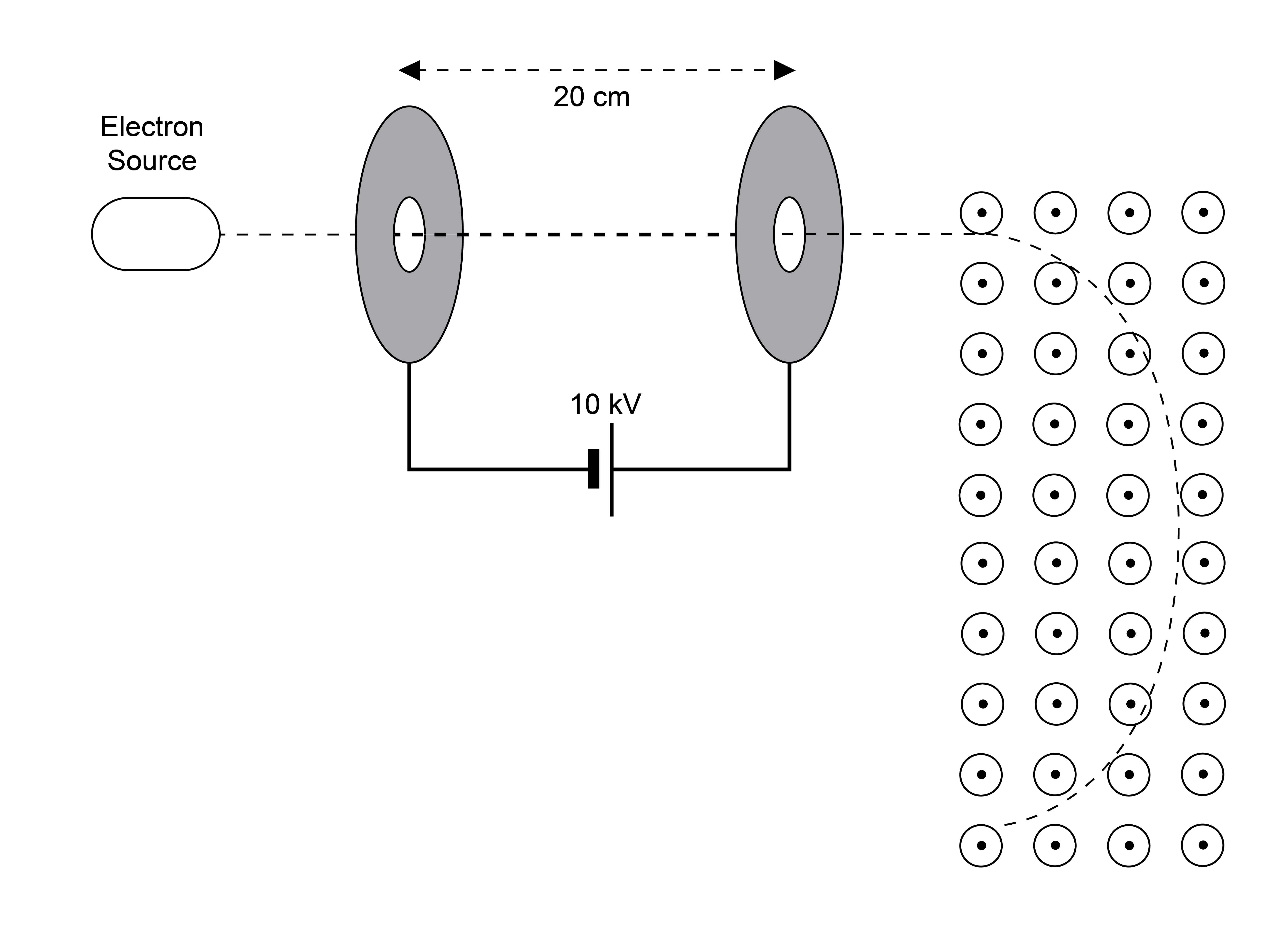
An electric field accelerates an electron between two plates as shown below.
| Mass of Electron | \(9.11\times10^{-31}kg\) |
| Charge of Electron | \(1.60\times10^{-19} C\) |
Worked Example
Calculate the strength of the electric field between the plates. In the above diagram, the plates are \(20 \mathrm{~cm}\) apart, with a potential difference of \(10 \mathrm{~kV}\).
The electric field between the plates is given by:
\[ E = \frac{V}{d} = \frac{10000}{0.20} = 50000 \mathrm{~Vm}^{-1} \]
Calculate the speed of the electron as it exits the electric field.
Note: The work done in accelerating the electron between the charged plates is converted entirely into kinetic energy. Therefore:
\[ W = qEd = (1.6 \times 10^{-19})(50000)(0.20) = 1.6 \times 10^{-15} \mathrm{~J} \]
\[ qEd = \frac{1}{2}mv^2 \]
\[ 1.6 \times 10^{-15} = 0.5 \times 9.1 \times 10^{-31} \times v^2 \]
Rearranging to solve for \(v\), we obtain:
\[ v = \sqrt{\frac{1.6 \times 10^{-15}}{0.5 \times 9.1 \times 10^{-31}}} \approx 5.9 \times 10^7 \mathrm{~ms}^{-1} \]