
Light as a particle
Not all light phenomena can be explained using the wave model. The photoelectric effect is a phenomenon that only occurs under certain conditions. The wave model of light would not predict these conditions, in fact it would predict the opposite.
Light can therefore be said to exhibit particle-like properties, and further investigation beyond wave mechanics is required in order to understand these properties.
Use this page to revise the following concepts within Light as a particle:
- The Planck equation
- The electron volt
- The photoelectric effect
- The work function
- Wave-like nature of particles
- Electron standing waves
- The Heisenberg uncertainty principle
The Planck equation
Max Planck was a German physicist who studied the light spectra emitted by hot objects. He discovered that not all aspects of their spectra could be explained by the wave model.
He explained his observations using the assumption that light was emitted in discrete packets, or photons, and developed an equation quantifying their energy:
\[E = hf \text{ or } E = \frac{hc}{\lambda}\]
Where
- \(E\) is the energy of a quantum of light (\(\text{J}\))
- \(f\) is the frequency of light (\(\text{Hz}\))
- \(h\) is Planck’s constant (\(6.63\times 10^{-34} \text{ J s}\))
- \(c\) is the speed of light (\(3.00 \times 10^{8} \text{ m/s}\))
- \(λ\) is the wavelength of light (\(\text{m}\))
Check your understanding
View

Worked Example
Determine the energy of a photon with a frequency of \(5.2 \times 10^{14} \text{ Hz}\)
Solution
\[\begin{align*} E &= hf = 6.63 \times 10^{-34} \times 5.2 \times 10^{14} \\ &= 3.45 \times 10^{-19} J \end{align*}\]
Check your understanding
View
The electron volt
Why don’t we measure TV screen sizes in kilometres? Because the sizes would be around 0.002km.
In the same way that the kilometre is too large of a unit for small distances, the joule is too large of a unit on the electron-scale.
For convenience we employ the use of a different unit for energy; the electron volt (\(\text{eV}\)).
Defined simply to be the amount of energy an electron gains when accelerated by a potential difference of \(1V\), \(1eV = 1.6 \times 10^{-19}J\).
NoteTo convert from joules to electron volts, divide by \(1.6 \times 10^{-19}\) To convert from electron volts to joules, multiply by \(1.6 \times 10^{-19}\) |
When performing calculations involving Planck’s equation and electron volts, there are two options:
- Perform the calculation with standard units and then convert joules to electron volts
- Use an alternate value of Planck’s constant, \(h=4.14 \times 10^{-15} eV s\)
Worked Example
Determine the energy, in electron volts, of a photon with a wavelength of \(4.7 \times 10^{-7} \text{ m}\)
Method 1: Perform calculation then convert at the end.
\[\begin{align*} E &= \frac{hc}{\lambda} \\ &= \frac{(6.63 \times 10^{-34}) \times (3.00 \times 10^8)}{4.7 \times 10^{-7}} \\ &= 4.23 \times 10^{-19}\ \text{J} \\ &= \frac{4.23 \times 10^{-19}}{1.6 \times 10^{-19}}\ \text{eV} \\ &= 2.64\ \text{eV} \end{align*} \]
Method 2: Use the alternate value of Planck’s constant.
\[\begin{align*} E &= \frac{hc}{\lambda} \\ &= \frac{(4.14 \times 10^{-15}) \times (3.00 \times 10^8)}{4.7 \times 10^{-7}} \\ &= 4.23\ \text{eV} \end{align*} \]
Check your understanding
View
The photoelectric effect
When electromagnetic radiation is incident on a piece of metal, the metal becomes positively charged, due to electrons being ejected from its surface.
Known as photoelectrons, these are ejected due to the electromagnetic radiation imparting enough energy to them that they are able to overcome the attractive forces of the metal cation lattice.
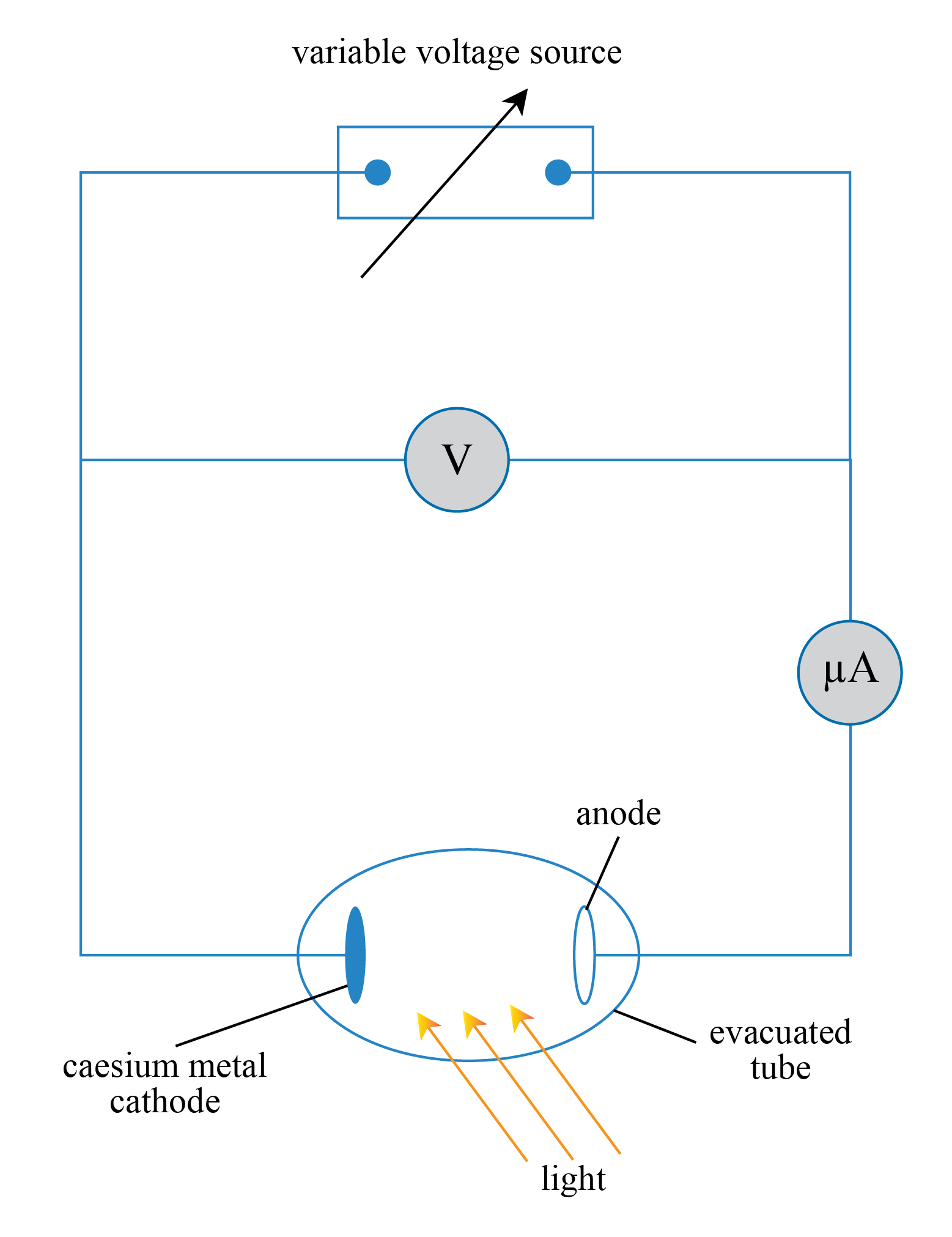
A number of key observations around this phenomenon were noted:
- For any particular metal there was a threshold frequency \(f_0\), a minimum frequency of light required to be incident on the metal before any photoelectrons were emitted and a photocurrent (current due to the photoelectric effect ) was observed. \(f > f_0\)
- For any given metal there was a voltage that could be applied in opposition to the photocurrent to stop the photocurrent, called the stopping voltage. This was the same voltage for the metal, regardless of the intensity of the light incident upon it.
- When a voltage was applied aid the photocurrent due to a light source with frequency \(f >f_0\), only a small voltage was required, any further increase did not further increase the size of the photocurrent.
- A higher intensity of light resulted in a higher photocurrent.

- For a given metal, two light sources of the same intensity by different frequencies resulted in the same maximum photocurrent. However, the higher frequency light source required a larger stopping voltage.
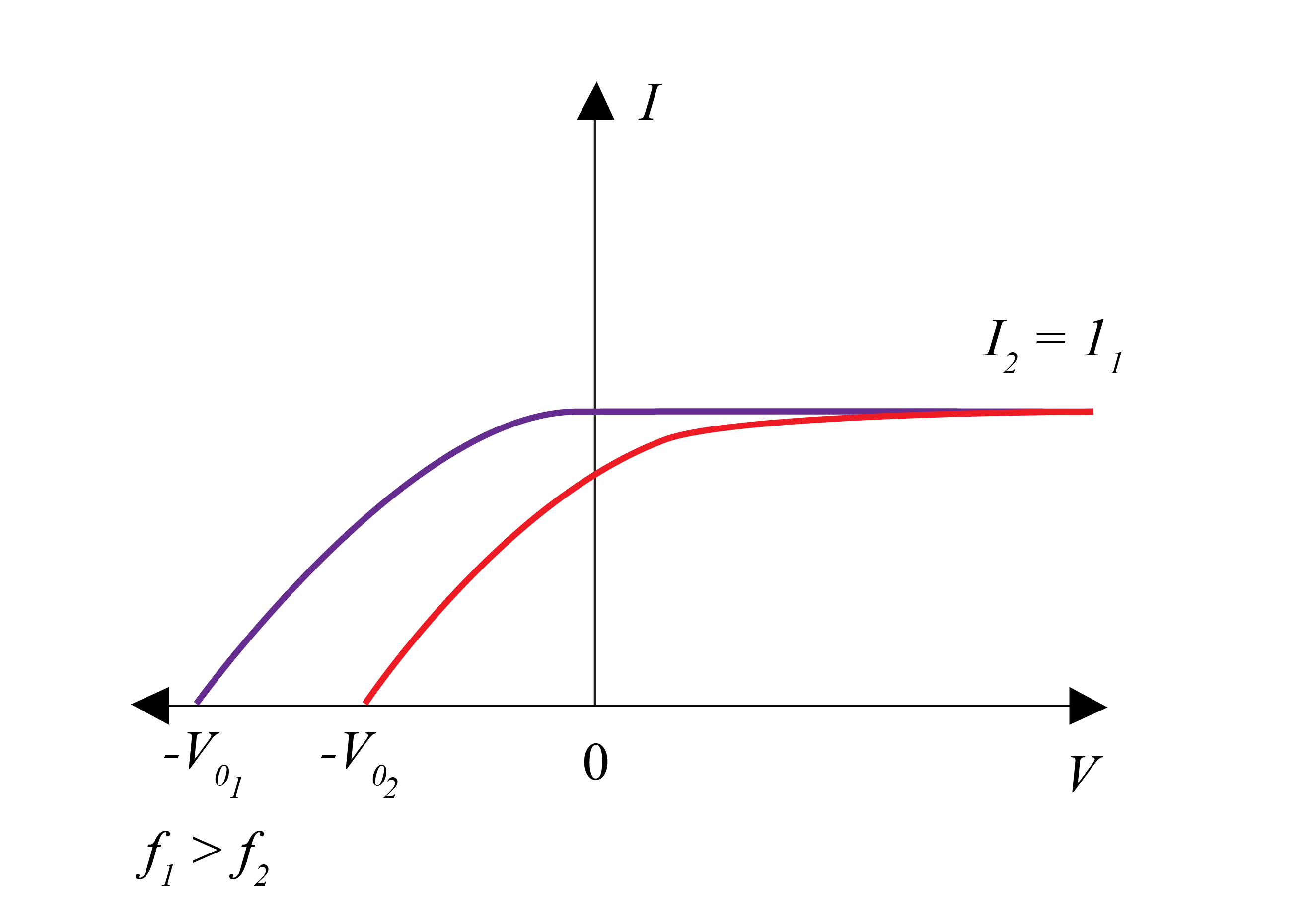
The conclusion based on these observations is that light is exhibiting particle-like nature. These light particles required a minimum energy, and therefore a minimum frequency, to emit photoelectrons.
The wave model of light could not explain these observations:
- Threshold frequency : If a light source didn’t have enough energy to cause a photocurrent, it’s intensity (amplitude of its wave) could be increased so that it did. Or the light source could be incident on the metal for a longer period of time until it built up enough energy to release a photocurrent. There would be a time delay.
- Different stopping voltages for different frequencies but same intensity. This should be independent as frequency doesn’t equate to energy of light. If intensity is the same then the stopping voltage should be too.
- Same stopping voltage for different intensities and same frequency. These should be different, with a higher intensity light requiring a larger stopping voltage.
The work function
The work function is a property of the metal itself. In order for electrons to be ejected from a metal, they required enough kinetic energy to escape from the metal (called the work function) and the remaining energy left over is the kinetic energy they would leave the metal with.
The maximum kinetic energy of a photoelectron is equal to the energy of the incident light minus the energy required to leave the metal. It is the maximum kinetic energy as this is only the case when the conversion energy from photon to electron is 100%.
\[E_{k \, max} = hf - hf_0 \text{ or } E_{k \, max} = hf - ϕ \]
Where
- \(E_{K \, max}\) is the maximum kinetic energy of the photoelectrons \((\text{J}\) or \(\text{eV}\))
- \(h\) is Planck’s constant (\(text{J s}\) or \(\text{eV s}\))
- \(f\) is the frequency of the incident light (\(\text{Hz}\))
- \(f_0\) is the threshold frequency for the metal (\(\text{Hz}\))
- \(ϕ\) is the work function of the metal (\(\text{J}\) or \(\text{eV}\))
Worked Example
A particular metal has a work function of \(2.1\text{ eV}\). What is the maximum kinetic energy, in eV, of photoelectrons ejected from this metal if light of frequency \(1.45 \times 10^{15} \text{ Hz}\) is incident upon it?
Solution
Write the equation
\[E_{k \, max} = hf - ϕ\]
As all energies are in \(\text{eV}\), use \(h=4.14 \times 10^{-15} \text{ eV s}\)
\[E_{k \, max} = (4.14 \times 10^{-15})(1.45 \times 10^{15}) -2.1 = 6.003 - 2.1 = 3.9003\]
So the maximum kinetic energy of the photoelectrons is \(3.9\text{ eV}\)
Check your understanding
View
This energy can be plotted against the frequency of light and some key observation about the graph can be made.
Check your understanding
View
Wave-like nature of particles
In 1924, the French physicist Louis de Broglie hypothesised that if light can exhibit particle-like properties, then perhaps matter could exhibit wave-like properties.
He quantified this with the following equation:
\[\lambda = \frac{h}{p} = \frac{h}{mv}\]
Where
- \(λ\) is the de Broglie wavelength of the particle (\(\text{m}\))
- \(h\) is Planck’s constant (\(\text{J s}\))
- \(p\) is the momentum of the particle (\(\text{kg m/s}\))
- \(m\) is the mass of the particle (\(\text{kg}\))
- \(v\) is the velocity of the particle (\(\text{m/s}\))
In 1927 de Broglie’s hypothesis was found to be correct with the famous Davission-Germer experiment.
In this experiment electrons produced a diffraction pattern when bombarded a nickel plate.
The experimental set up is below.

It yielded the following results:

Clearly the electrons are exhibiting a diffraction pattern, a wave-like phenomena.
The question could be asked – “If matter exhibits wave-like properties, why don’t humans exhibit wake-like phenomena such as diffraction?”
The answer to this lies in the de Broglie wavelength.
Consider a person weighing 80kg and moving at a speed of \(1.4\text{ m/s}\). Their de Broglie wavelength would be calculated as:
\[\begin{align*}
m &= 80\ \text{kg}, \quad v = 1.4\ \text{m/s} \\
\lambda &= \frac{h}{mv} \\
&= \frac{6.63 \times 10^{-34}}{80 \times 1.4} \\
&= 5.9 \times 10^{-32}\ \text{m}
\end{align*}\]
Recall that for significant diffraction to occur \(\frac{λ}{w}>1\) where w is the width of the gap to be passed through.
It can be seen that the de Broglie wavelength of a person is small. So small, in fact, that it is too small for us to exhibit any noticeable wavelike properties.
Check your understanding
View
Electron standing waves
Electrons orbit around a nucleus and only discrete allowable distances from the nucleus. This is because electrons travel in waves around the nucleus and stable orbits only exist if the circumference of the orbit is an integer multiple of the de Broglie wavelength of the electron. They orbit in standing waves. These orbits have associated energies, higher energy electrons orbit at larger distances from the nucleus.

Electrons can be excited, given energy by a photon, in order to move to a higher energy orbit. However, because only orbits that form standing waves are allowable, only certain distances from the nucleus are allowable.
This means that electrons require specific energies that correlate to these orbits, in order to become excited.
Once in this excited state, electrons can release energy in the form of a photon, and return to their ground state (original orbit).
These allowable orbits can be presented in a diagram, called an energy level diagram.
Consider the energy level diagram for mercury below:
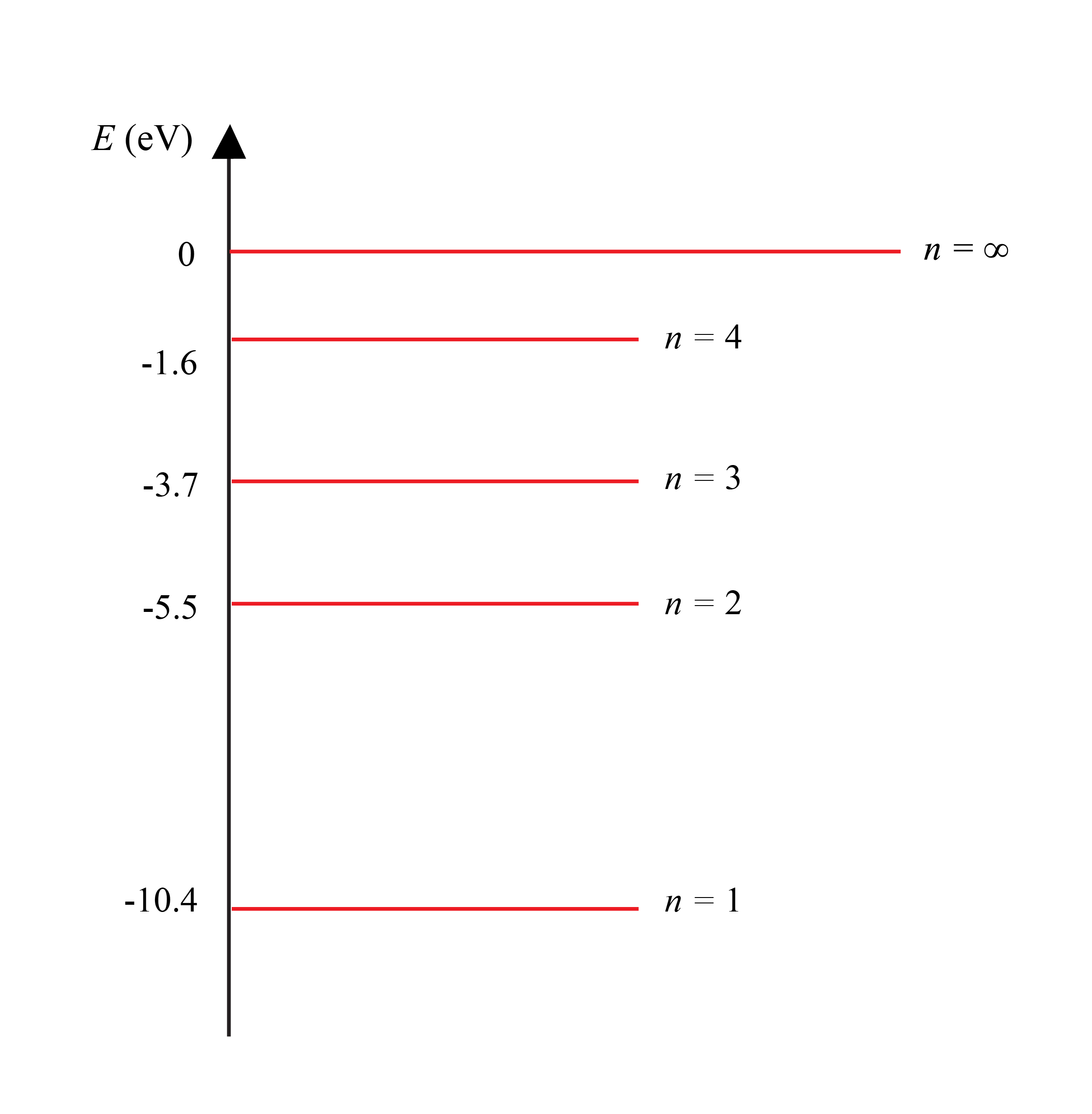
The ground state an electron is at \(n=1\). If this electron were provided with \(6.7 \text{ eV}\), it would be excited to the \(n=3\) state.
It can move to any one ground state to any other provided it gains or emits the energy difference between those two states.
For instance if the electron were excited to the \(n=3\) state. It could emit a \(6.7 \text{ eV}\) photon and return to the ground state, or it could release a \(1.3 \text{ eV}\) photon and fall to the \(n=2\) state, and then a \(4.9 \text{ eV}\) photon and fall back to the ground state.
Note: \(n =∞\) is the ionisation level. The energy required to create an ion, by providing the electron with enough energy to leave the orbit of the mercury atom.
Check your understanding
View
The Heisenberg uncertainty principle
The dual nature of light and matter on the quantum scale, demonstrates that light and matter behave very differently on a small scale, when compared to everyday life.
One follow-on from this is the Heisenberg uncertainty principle. In essence it states that any measurement taken of a system will always come with a degree of uncertainty.
Consider wanting to know the temperature of a glass of water. In order to do so you might place a thermometer in the water. However, in doing so the thermometer will ever so slightly alter the temperature of the water and hence the measured temperature will not be precisely what it was before the measurement was taken.
More formally the Heisenberg uncertainty principle is written thusly:
\[ ΔxΔp ≥ \frac{h}{4 \pi} \]
Where
- \(Δx\) is the uncertainty in the position of a sub-atomic particle
- \(Δp\) is the uncertainty in the momentum of a sub-atomic particle
- \(h\) is Planck’s constant
According to this principal, the more precisely a particles position is known (and therefore the smaller Δx is), the less precisely its momentum is known (and therefore the larger \(Δp\) is)
Consider the diffraction pattern exhibited by light passing through a narrow slit:
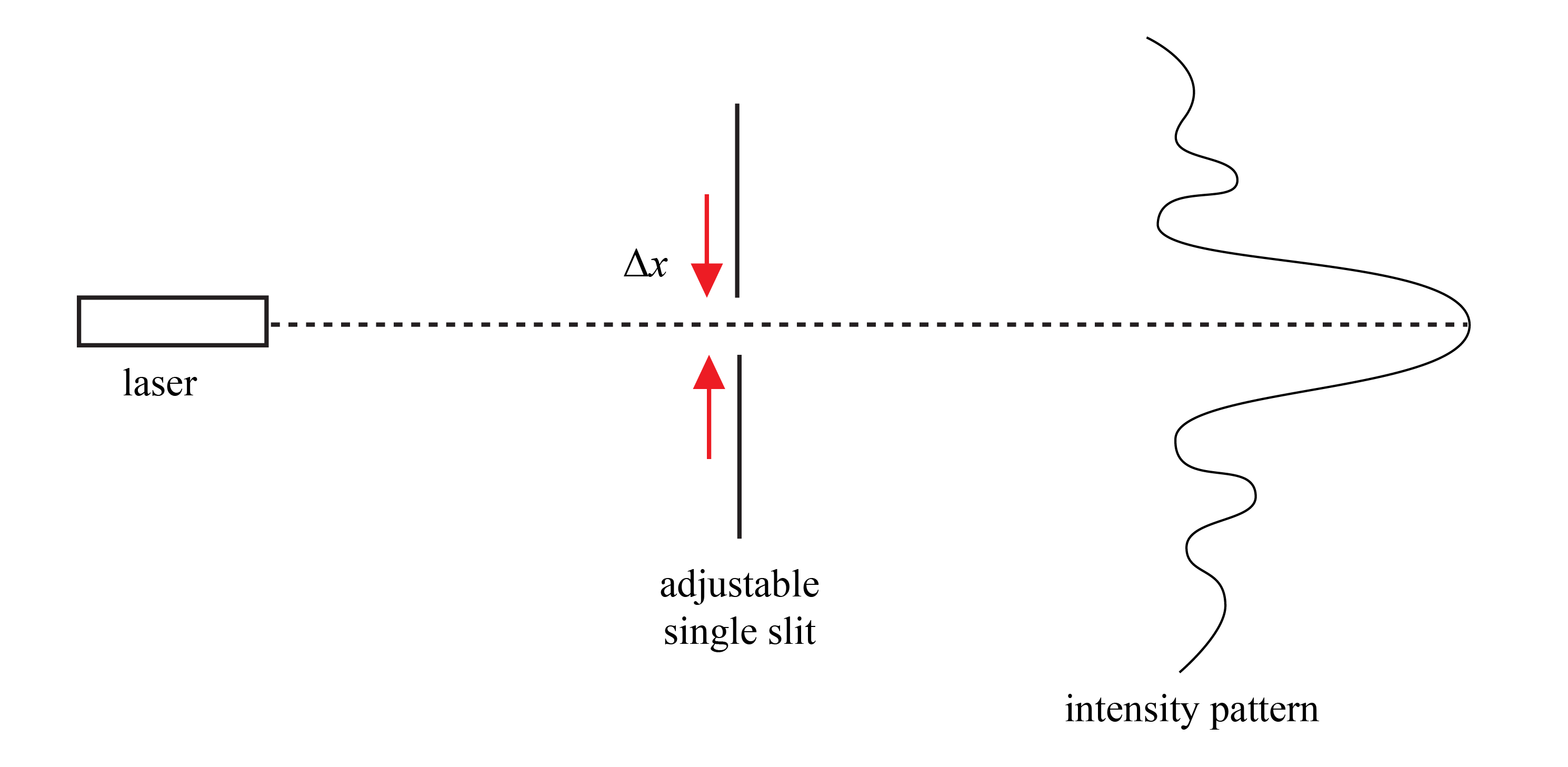
This pattern can be explained by \(\frac{λ}{w}>1\). The ratio of the wavelength of the light wave passing through the slit is equal to, or larger than the slit width, and hence diffraction is observed.
However, it could also be explained using the Heisenberg uncertainty principle.
Because the light is known to pass through the slit, its position is quite precisely known, hence \(Δx\) is small. Due to the Heisenberg uncertainty principle, this means that \(Δp\) is large. The momentum, specifically its direction, is less precisely known. Hence the direction of the path the light takes after the slit is less precisely known and a diffraction pattern is observed.
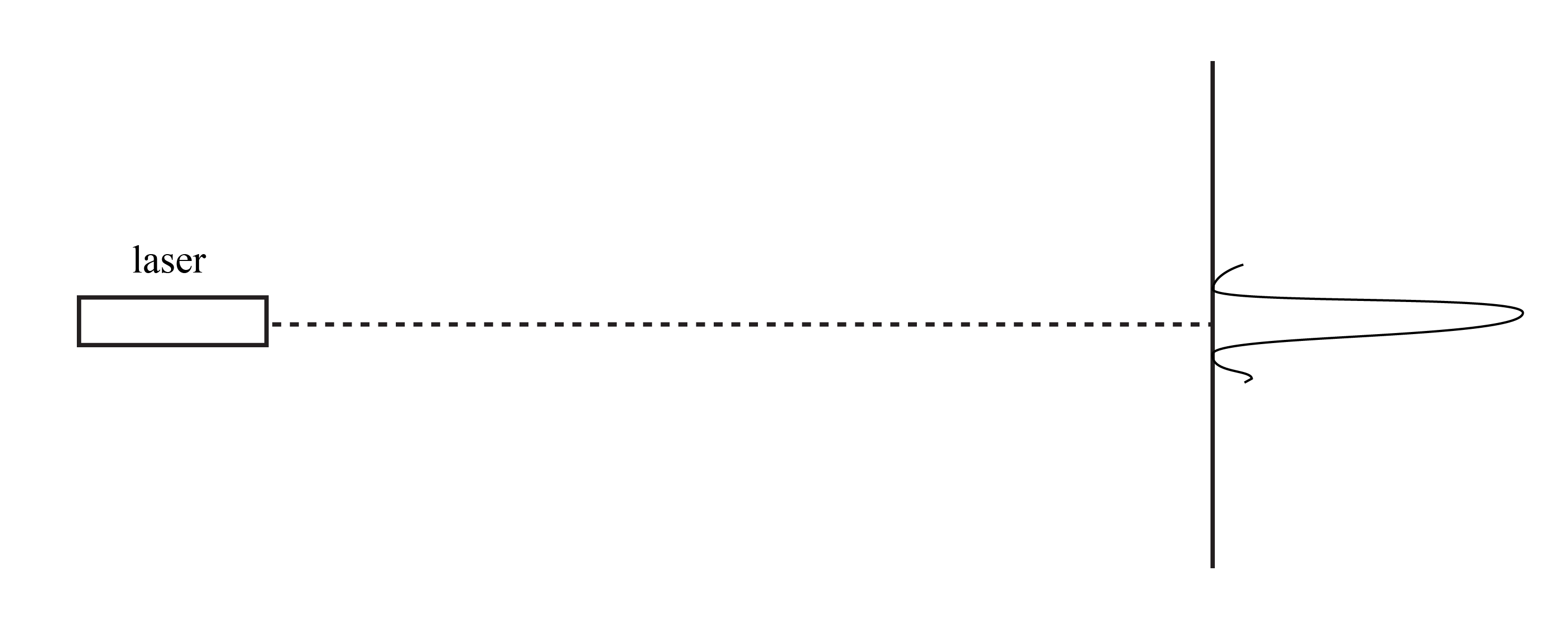
By removing the wall with the slit, the position in the middle is less precisely known, hence \(Δx\) is larger. Due to the Heisenberg uncertainty principle, this means that \(Δp\) is smaller. Therefore, the direction the light is travelling is more precisely known, it does not deviate, and a diffraction pattern is not observed.