
Time Dilation and Length Contraction
Einstein’s theory of Special Relativity postulates that if the speed of light is constant for all observers, then space and time cannot be fixed and absolute. For the speed of light to remain constant in all inertial reference frames, space and time must change depending on the observer’s reference frame. This leads to two key effects that distinguish relativity from classical physics: time dilation and length contraction.
Time dilation is the effect where a moving clock is measured to run more slowly by an outside observer in another frame of reference. In other words, time passes differently for observers in relative motion. Length contraction is the effect where an object moving relative to an observer will appear shortened in the direction of its motion. These effects are central to modern physics and technology, most notably in GPS, which depends on accurate time corrections.
Use this page to revise the following concepts within time dilation and length contraction:
Lorentz Factor
In Special Relativity, the Lorentz factor \((\gamma)\) is used to calculate how much time, length, and momentum are affected when objects are moving at close to the speed of light. It provides the link between classical physics, which can very closely approximate these measurements at everyday speeds, and relativistic physics, which becomes necessary at very high speeds.
The Lorentz factor is a dimensionless quantity which determines the magnitude of change in time, space or momentum of objects moving at relativistic speeds.
- \(\gamma\) is the Lorentz Factor, a dimensionless quantity
- \(v\) is velocity of the object \((\text{ms}^{-1})\)
- \(c\) is the speed of light \((\text{ms}^{-1})\)
If two reference frames are at rest relative to one another, then \(v=0\) and \(\gamma=1\). This means relativistic effects disappear and classical physics is sufficient. As an object’s velocity approaches the speed of light, however, the denominator of the fraction approaches zero and the Lorentz factor approaches infinity, showing that relativistic effects become extremely large.
Check your understanding
View

Time Dilation
Time dilation explains why two observers moving at high relative speeds measure different time intervals for the same event. An event is something that happens at a specific place and time, such as a ball bouncing, a car collision, or a pulse of light being emitted.
When comparing the time between two events, two different intervals can be measured:
- Proper time \((t_0)\): the time measured by an observer who sees both events occur at the same location in space i.e they are at rest with the frame of reference of the event.
- Dilated time \((t)\): the time measured by an observer who sees the two events occur at different locations in space, i.e. the time recorded in any other reference frame.
The relationship between proper time and dilated time is:
Where: \(t\) is the dilated time
- \(t\) is the dilated time
- \(t_0\) is the proper time
- \(\gamma\) is the lorentz factor
As \(\gamma >1\) for all non-zero velocities, the dilated time will always be greater than the proper time. In other words, this means that a moving clock records less time between events than one at rest in an observer’s frame.
Worked Example
An astronaut travels to Proxima Centauri at a speed of \(0.90c\). Observers on Earth measure the journey time as \(t=4.71 years\). If \((\gamma=2.29)\), how long does the astronaut experience the trip to take?
Step one: Identify proper and dilated time.
Proper time of an event is measured by an observer in the same location in space i.e they are at rest in the frame of reference with the event. Therefore, the astronaut measures proper time \((t_0)\).
Dilated time refers to the time recorded in any other reference frame. The observers on Earth therefore measure dilated time \((t)\).
Step two: Identify known variables and use the time dilation formula
\[\begin{align*} t &= t_0 \gamma \\ t &= 4.71 \text{years}, \quad \gamma = 2.29 \\ t_0 &= \frac{t}{\gamma} = \frac{4.71}{2.29} = 2.06\ \text{years} \end{align*} \]
Check your understanding
View
Length Contraction
Length Contraction explains why two observers moving at relativistic speeds will measure different lengths for the same object. In classical physics, length is absolute. In Special Relativity, however, length depends on the relative motion between the observer and the object.
- The proper length \((L_0)\) is the length of the object as measured in the frame where the object is at rest.
- The contracted length \((L)\) is the length measured in any other reference frame, by an observer moving relative to the object.
NoteLength contraction only occurs along the direction of motion. Dimensions that are perpendicular to the motion are unchanged. |
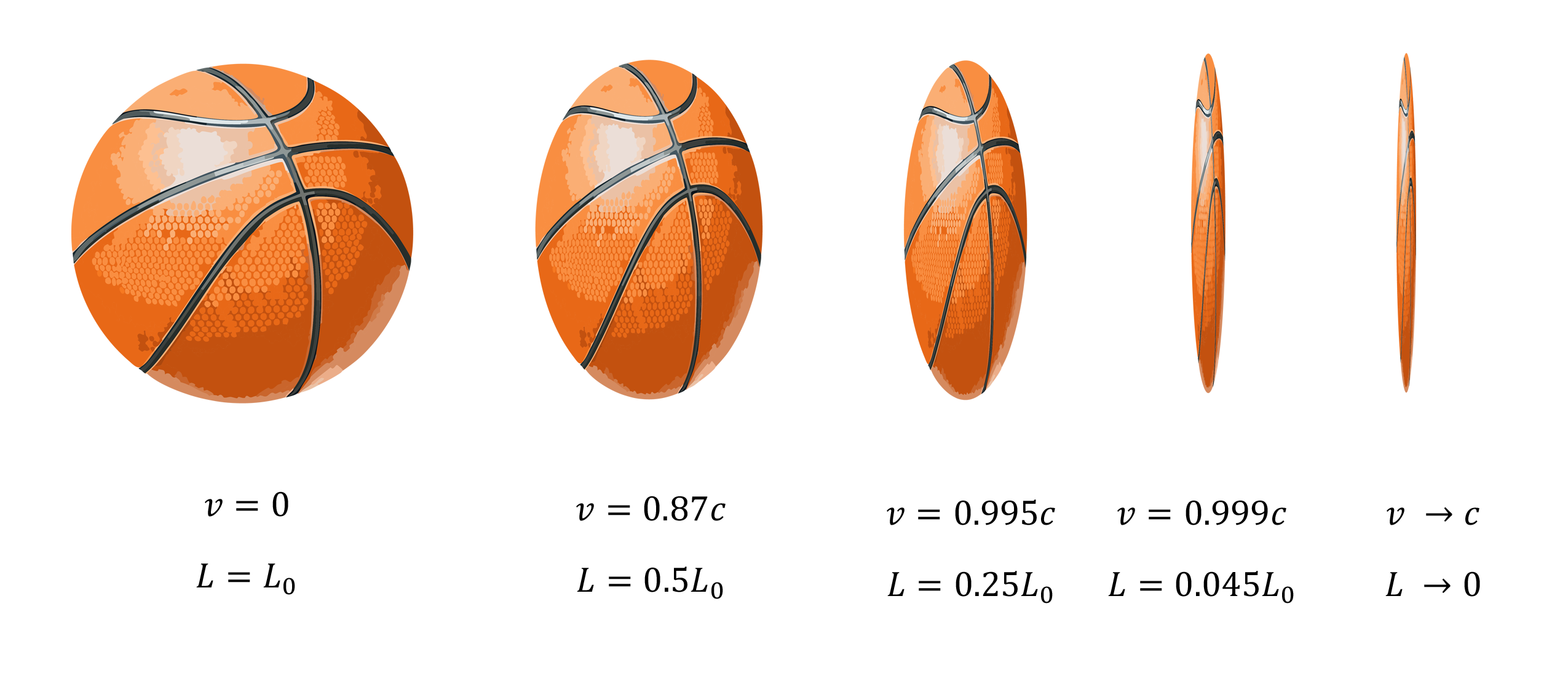
The formula that connects proper length and the contracted length is:
\[ L = \frac{L_0}{\gamma} \]
Where :
- \(L\) is the contracted length (\(\text{m}\))
- \(L_0\) is the proper length (\(\text{m}\))
- \(\gamma\) is the Lorentz factor
Since \(\gamma >1\) for all non-zero velocities, the contracted length is always shorter than the proper length.