
Magnetic Fields
Use this page to revise the following concepts within magnetic fields:
- Magnetic Fields of Bar Magnets
- Static and Changing Magnetic Fields
- Drawing Magnetic Fields
- Magnetic Field around a current carrying wire
Magnetic Fields of Bar Magnets
A magnetic field is the effect we can see from the movement of charges or the spin of electrons. The fields themselves can be static or changing. A field diagram can be used to show the interactions of magnets and you will see this is similar to gravitational and electrical fields.
Regardless of the type of magnetic field, static or changing each will always point from \(N\) to \(S\) form a closed loop. For this reason magnetic fields are always dipoles. If you cut a magnet in half you will simply get two smaller magnets.
Check your understanding by answering the following questions.
 Check your understanding
View
Check your understanding
View

Check your understanding
View
Static and Changing Magnetic Fields
Magnetic fields can be described as static or changing.
| Static | Changing | |
|---|---|---|
Permanent magnet | If the magnet is stationary. (e.g. A permanent magnet that is stationary; the movement of charges within the magnet create fields that align. As fields are vectors the field lines add up and point in the same direction/loop.) | If the magnet is in motion. (e.g Permanent magnets that are in motion; this motion can cause a change in the magnetic field.) |
Electromagnet
| If the current is constant and the electromagnet is stationary. (e.g. Electromagnets are created by charge flowing through a loop or multiple loops of wire. When the current is constant, the fields will align creating a static magnetic field.) | If the current is changing or the electromagnet is in motion. (e.g. Electromagnets with an alternating current or the electromagnet is in motion can also cause a change in the magnetic field.) |

Drawing Magnetic Fields
Magnetic, gravitational and electrical fields are all 2D representations of a 3D world. For this reason particular conventions are agreed upon within the physics world. When the directions go beyond simple "up" or "down" on the page, the terms "into the page" and "out of the page" can be used to represent the third dimension.
When drawing magnetic field lines it is important to remember the following:
- Form a closed loop that flow from North to South
- Field lines do not cross
- Field lines are vectors and describe direction and magnitude, the closer the lines the stronger the magnetic field
- To draw a field into the page you use x and for out of the page ●
Investigate the tabs below for examples of illustrating magnetic fields.


Magnetic Field around a current carrying wire
Oersted’s law states that an electric current induces a magnetic field. It was observed that current-carrying wires created a circular magnetic field around them. The convention of the right hand grip rule allows physicists to determine the direction of the magnetic field around a wire.
To use the right hand grip rule, point your thumb in the direction of the electric current, and curl your fingers around the wire; the direction your fingers curl shows the direction of the magnetic field lines.

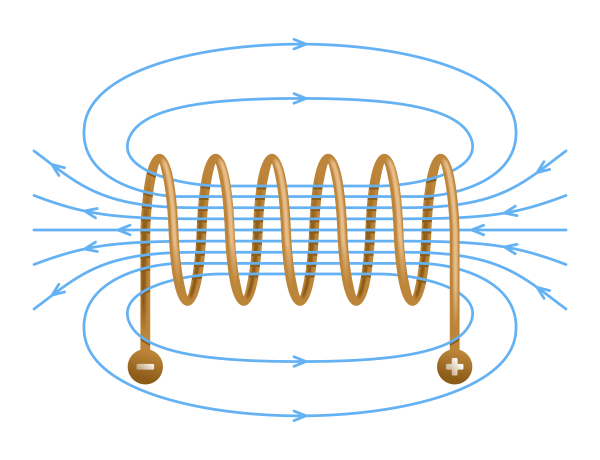
Oersted’s law can then be applied to a closed loop of wire. As magnetic fields are vectors, they are able to be added together to show a stronger magnetic field through the loop.
A solenoid is a collection of current carrying loops of wire, arranged to form a cylinder. The magnetic field that is created combines as you add more loops, strengthening the magnetic field along the length of the axis through the loop of wire. The direction of the magnetic field is found by applying the right hand grip rule.
