
Understanding emerging opioid-related harms through improved surveillance, drug checking and information sharing systems
In Australia, between 2012 and 2016 unintentional heroin deaths increased by more than 107%, far outstripping other opioid deaths that increased 20% over the same time period. Increased overdoses at Supervised Injecting Facilities were observed in recent years. Yet, it is not clear what is driving changes in opioid-related harms.
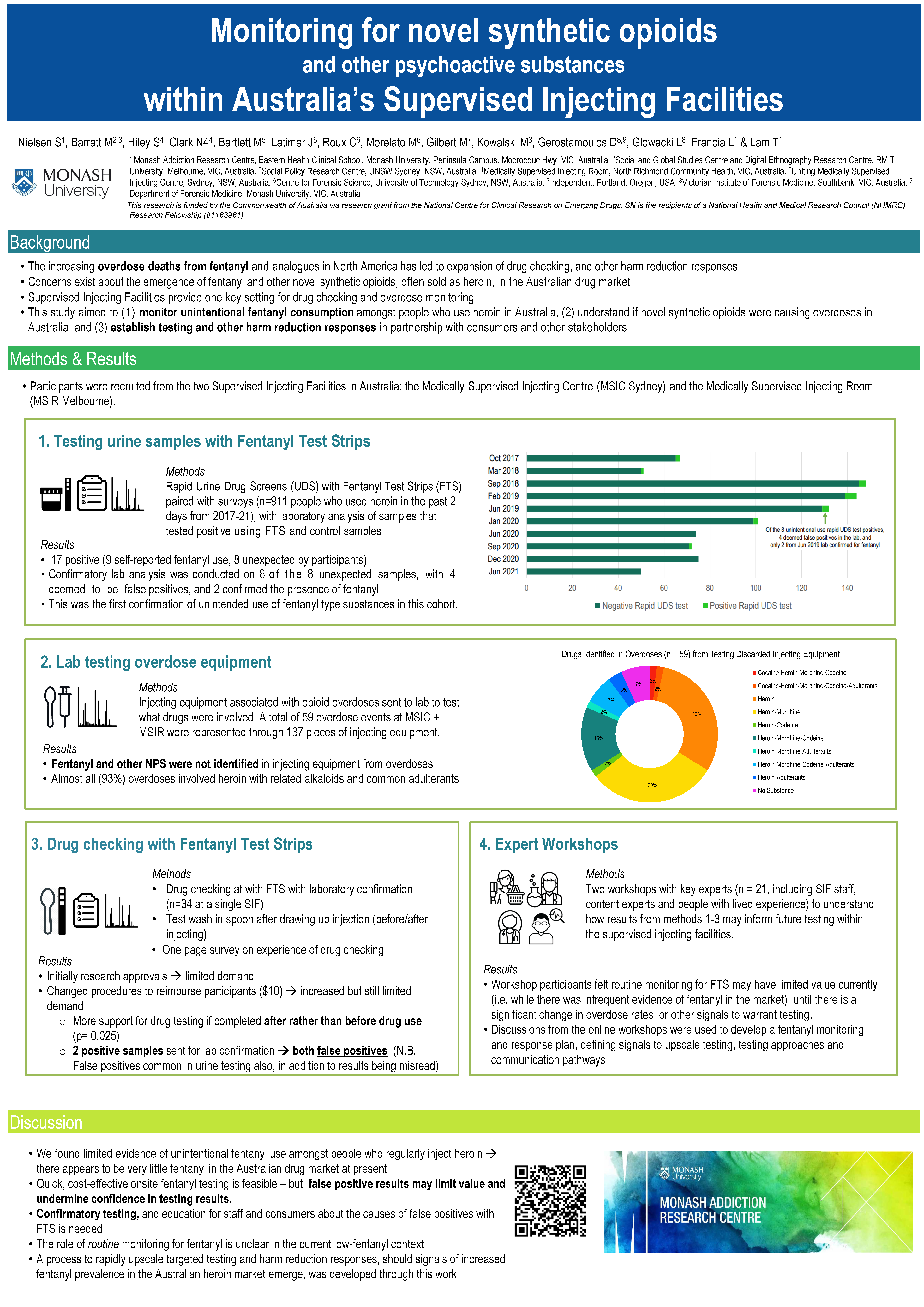
To understand rising opioid-related harms, there is a need for systems to gather timely information on changing opioid overdose patterns and risk factors, including the involvement of emerging drugs. This project will establish fixed-site drug checking and data monitoring to inform responses to emerging novel synthetic opioids or other changing drug patterns.
Methods:
The study will extend our current established fentanyl surveillance activities to:
- Co-design and embed procedures for monitoring for emerging substances into routine practice at supervised injecting facilities (SIFs)
- Extend existing urine monitoring to include laboratory confirmation for 234 novel psychoactive substances
- Conduct novel analysis to identify novel psychoactive substance implicated in overdoses from testing injecting equipment
- Combine these data sources to feed into a co-designed protocol for rapid responses
Research questions :
- How can SIFs implement drug checking and contribute to early warning systems?
- Are there specific opioids and/or other emerging drugs that are contributing to overdoses, and if so, which?
Benefits:
The study will establish and test approaches for monitoring for fentanyl and novel psychoactive drugs in partnership with clinicians and consumers.
Publications
Lam, T, Barratt, MJ, Bartlett, M, Latimer, J, Jauncey, M, Hiley, S, Clark, N, Gerostamoulos, G, Glowacki, L, Roux, C, Morelato, M, & Nielsen, S (2022). Infrequent detection of unintentional fentanyl use via urinalysis among people who regularly inject opioids in Sydney and Melbourne, Australia. Addiction, 117, 2331– 2337. https://doi.org/10.1111/add.15832
Nielsen, S, Barratt, M, Hiley, S, Bartlett, M, Latimer, J, Jauncey, M, Roux, C, Morelato, M, Clark, N, Kowalski, M, Gilbert, M, Francia, L, Shipton, A, Gerostamoulos, D, Glowacki, L, & Lam, T. (2023). Monitoring for fentanyl within Australian supervised injecting facilities: Findings from feasibility testing of novel methods and collaborative workshops. International Journal of Drug Policy, 115. https://doi.org/10.1016/j.drugpo.2023.104015
Project Funder
National Centre for Clinical Research on Emerging Drugs (NCCRED) Seed Funding
Project Partners
Medically Supervised Injecting Room, Uniting Medically Supervised Injecting Centre, University of New South Wales (UNSW), University of Technology Sydney (UTS), Victorian Institue of Forensic Medicine (VIFM)
Project staff
Professor Suzanne Nielsen, Monash University
Sarah Hiley, North Richmond Community Health
Julie Latimer, Uniting Medically Supervised Injecting Centre
Dr Nico Clark, North Richmond Community Health
Marianne Jauncey, Uniting Medically Supervised Injecting Centre
Dr Monica Barratt, Social and Global Studies Centre, RMIT University
Dr Emma Tay, Western Sydney Local Health District
Associate Professor Dimitri Gerostamoulos, Victorian Institute of Forensic Medicine (VIFM)
Linda Glowacki, Victorian Institute of Forensic Medicine (VIFM)
Professor Claude Roux, University of Technology Sydney
Dr Marie Morelato, University of Technology Sydney (UTS)
Elodie Lefrançois, University of Lausanne, Switzerland
Dr Tina Lam, Monash University
Michael Gilbert, Independent consultant