Upscaling a pharmacist-prescriber collaborative model of care for Medication Assisted Treatment for Opioid Dependence (EPIC-MATOD)
Investigators: Professor Suzanne Nielsen, Professor Lisa Nissen, Dr John Jackson, Dr Bosco
Rowland, Dr Dennis Petrie, Dr Ali Cheetham.
MATOD is the gold-standard treatment for opioid dependence; however, there is an
urgent need for innovations to expand access to MATOD in Australia, particularly in
regional areas where prescriber shortages are amplified.
To address these barriers, the Enhancing Pharmacist Involvement in Care (EPIC-
MATOD) project has co-designed a collaborative care model that engages
community pharmacists working to their full scope of practice, in partnership with
prescribers, as an innovative approach to improving treatment access. In a
collaborative care model, clinical tasks such as reviews and dose adjustments are
delegated to the pharmacist, who provides care within an individualised treatment
plan developed by the prescriber.
The model has been successfully implemented in an pilot study in Melbourne's
South Eastern suburbs. Results supported the hypothesis that pharmacist-led
collaborative care would provide comparable clinical outcomes to usual care (with
97.2% of collaborative care patients retained in treatment compared to 89.8% in the
comparison arm), and was associated with significant increases in treatment
satisfaction and quality adjusted life years (QALYs).
Interviews with pharmacists, prescribers and patients supported that collaborative
care was feasible and acceptable, with high levels of support from all three groups. A
health economics assessment found the model was cost-effective compared to
treatment as usual.
The current project aims to expand the EPIC-MATOD model across three regions in
Australia, setting the stage for a national rollout.
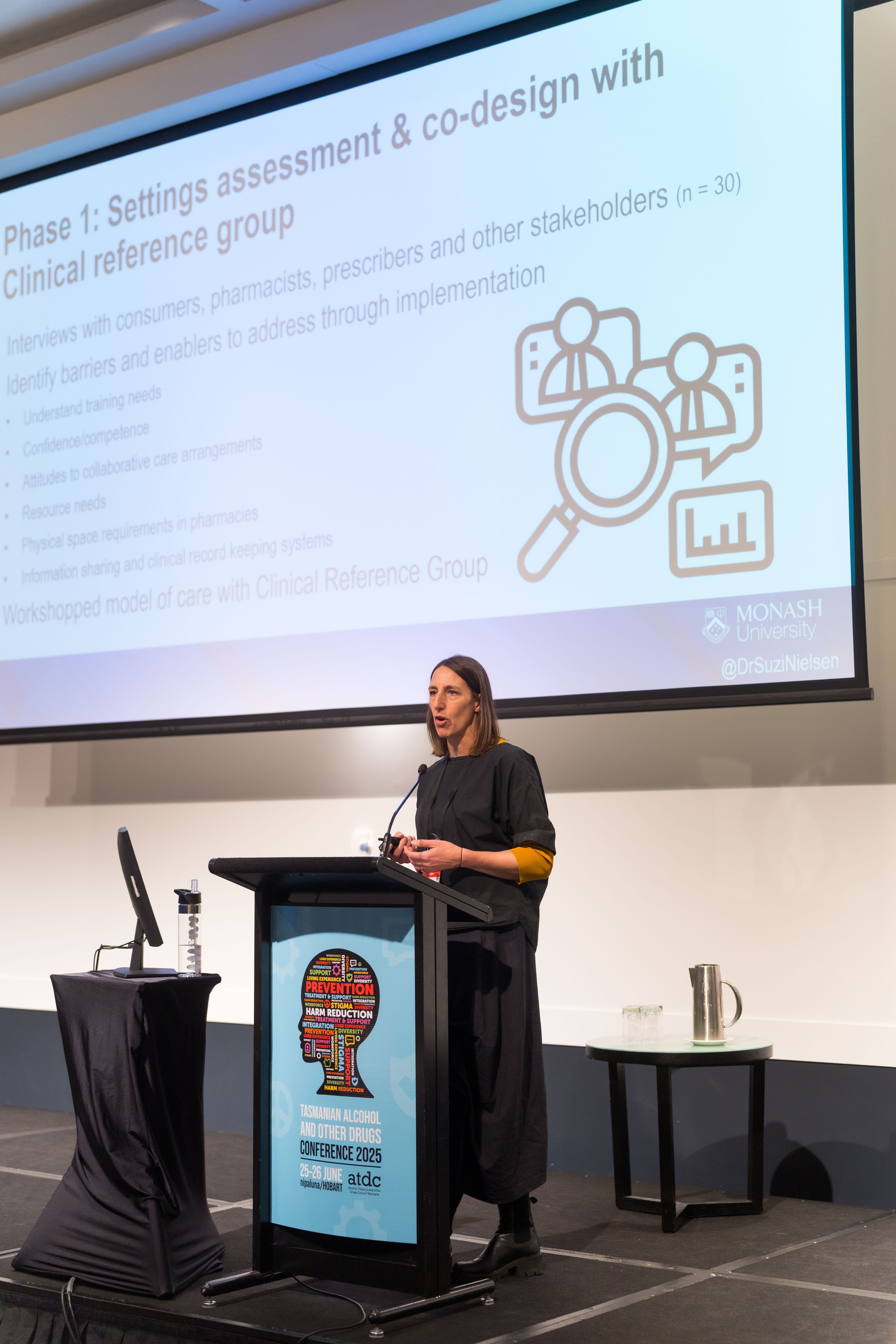
The study will be conducted in two phases: the first phase will involve co-designing
the implementation strategies with pharmacists and prescribers; the second phase
will test the effectiveness of these strategies in a hybrid effectiveness-implementation
trial. The primary outcome will be the number of patients receiving collaborative care
six months post-randomization. Secondary outcomes include intervention fidelity,
clinical outcomes and patient satisfaction. By embedding the EPIC-MATOD model
into local health networks and providing targeted support, this project aims to ensure
the sustainability and scalability of the model, ultimately improving access to opioid
dependence treatment across Australia.
Project funder: HCF Foundation
Contact: If you would like more information, please contact Prof Suzanne Nielsen
(Suzanne.Nielsen@monash.edu)