
Publications and resources
Browse our latest reports and publications below, or click the links below to skip to the relevant section. For more information, please contact us at med-HWLRGroup@monash.edu
Research examining pathways to secondary psychological injury
Mental health and psychological injury have become a growing priority for Australian workplaces. Workers’ compensation claims for primary mental health conditions last significantly longer than claims for physical conditions and have increased significantly in recent years.
Concerns have also been raised about the impact of secondary psychological injury on worker recovery and return to work, claims costs and compensation scheme sustainability. However, while some of the features of secondary psychological injury are understood, there has been no commonly accepted working definition that allows consistent understanding of secondary psychological injury.
A new report produced by researchers from the Healthy Working Lives Research Group and funded by Safe Work Australia provides a critical step forward.
This research brings together evidence from literature reviews, industry stakeholder consultations, injured worker surveys, and workers’ compensation claims data to develop a nationally consistent working definition of secondary psychological injury.
Importantly, the report also identifies:
- Key drivers of secondary psychological injury
- When and how these injuries tend to develop
- Practical recommendations for policy, practice, and future research
As mental health continues to shape the future of work and compensation systems, this report offers an evidence-based foundation to improve prevention, early identification, and system responses for injured workers.
Read the full report here.
Workforce Health in Australia
Report (PDF)
Pain and psychological distress are common in Australian workers.
This report shows that 39 percent of workers reported pain interfering with their work, and 40 per cent reported psychological distress in 2020-21.
The study also shows that 43 per cent of workers reported that their job was very demanding, and 12 per cent had a disability or long term condition affecting their work. Poor mental health led to 42 million days of lost work per annum in 2020 to 2022.
Design for Care
This research aims to understand and improve workplace mental health and well-being in Australia’s Healthcare and Social Assistance (H&SA) industry by developing evidence-based work design interventions to prevent psychological injury, which include but not limited to burnout and sustained work stress
At the heart of Design for Care is the prevention of psychological injury through good work design.
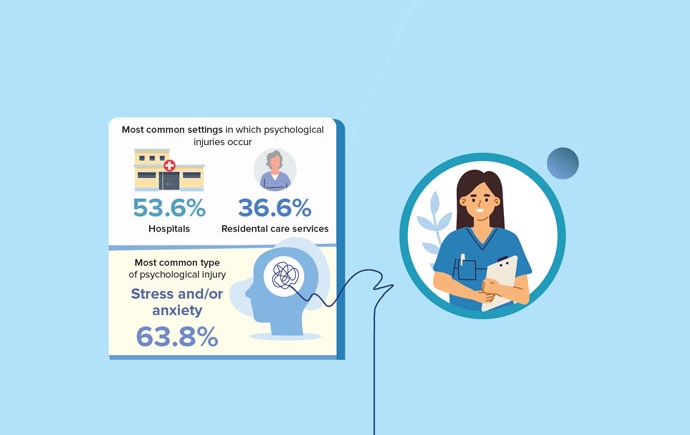
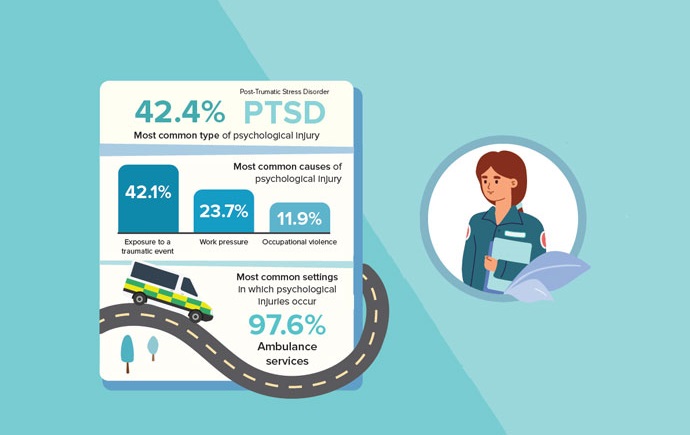
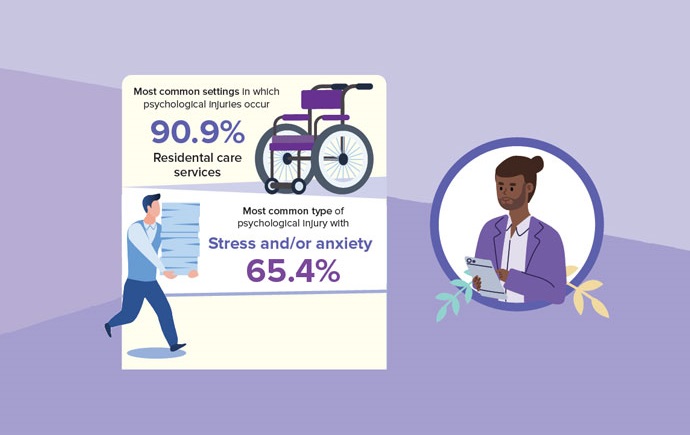
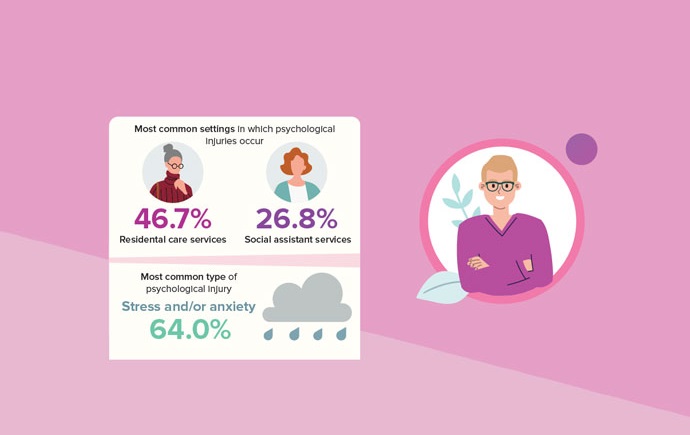
Reports (PDF)
- Report #1: Risk factors associated with psychological injury among Healthcare and Social Assistance
workers in non-hospital settings: Systematic scoping review (June 2022) - Report #2: Psychological injury in the New South Wales Healthcare and Social Assistance industry: A retrospective cohort study (August 2022)
- Report #3: How work design shapes mental health in the Healthcare and Social Assistance industry
(July 2023) - Report #4: Changing work design to improve mental health in the Healthcare and Social Assistance
industry (April 2024)
Driving Health
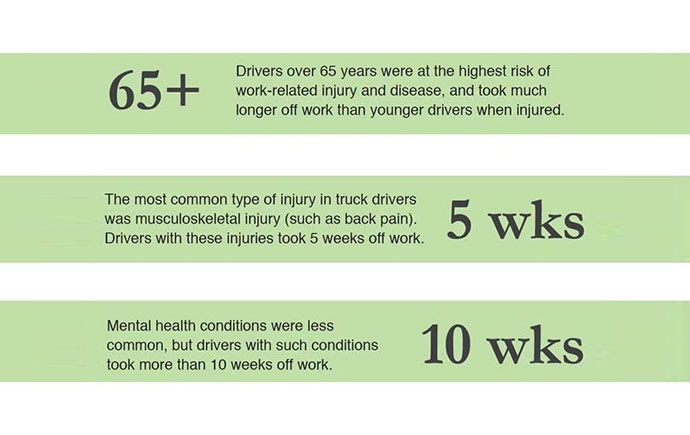
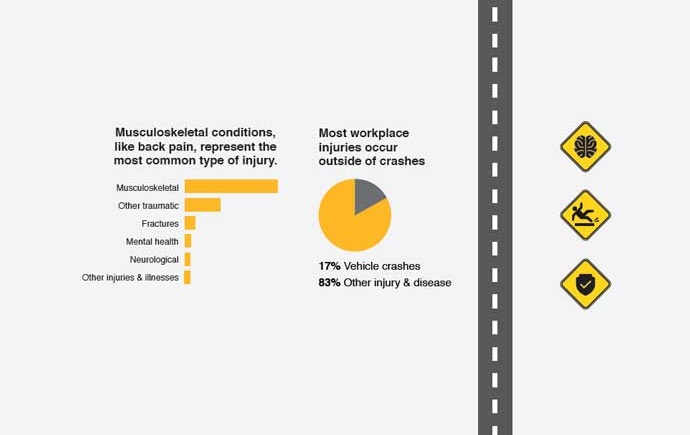
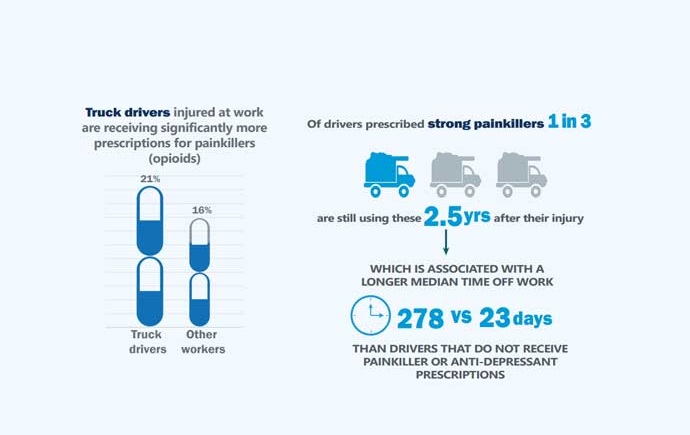
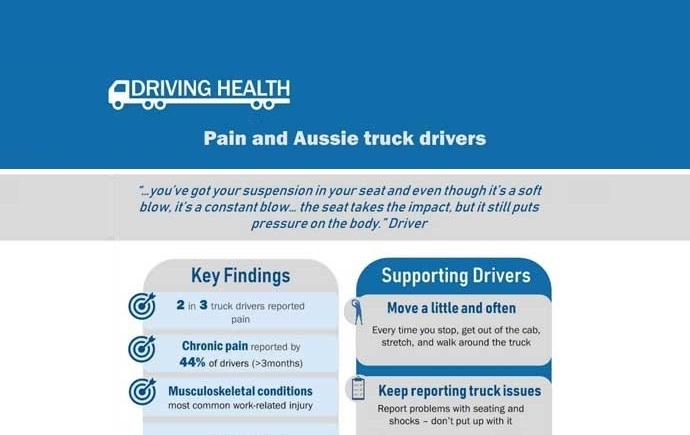
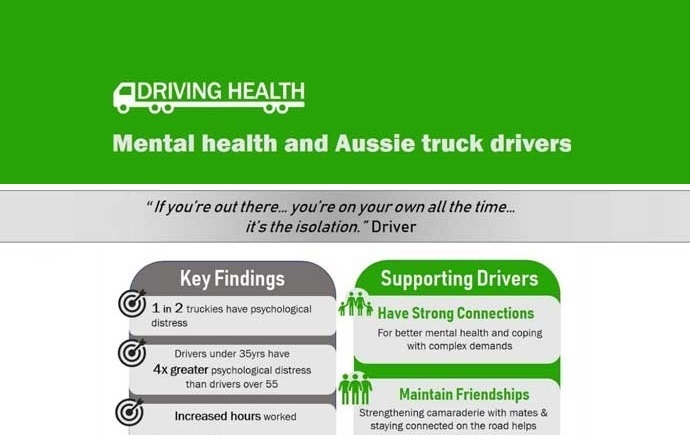
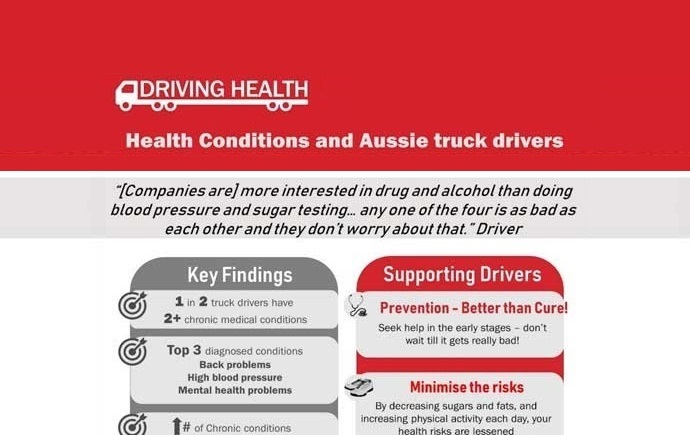
The Driving Health project aims to develop evidence-based strategies to improve the health of the Australian Truck Driver. Visit the Driving Health website to find out more.
Reports (PDF)
- Report #1: Work-Related Injury and Disease in Australian Transport Sector Workers
- Report #2: Profile of Work-Related Injury and Disease in Australian Truck Drivers
- Report #3: Health Service Use Following Work-Related Injury and Illness in Truck Drivers
- Report #4: Use of Medications Following Work-related Injury and Illness in Truck Drivers
- Report #5: Analysis of Life Insurance claims data
- Report #9: Direct managers influencing truck driver health – Driving Health Allocator Training (DHAT) Program
COMPARE Project
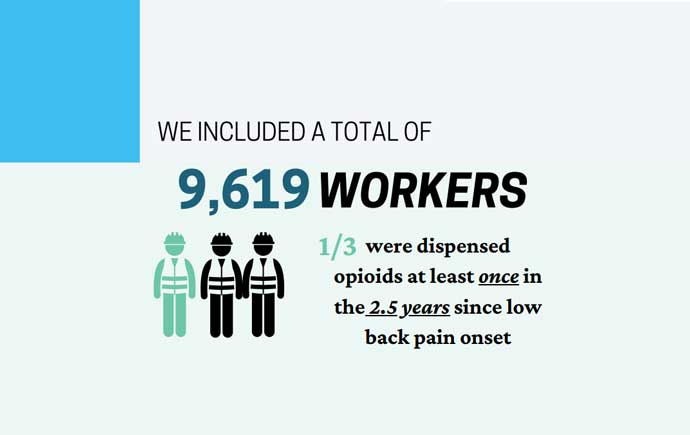
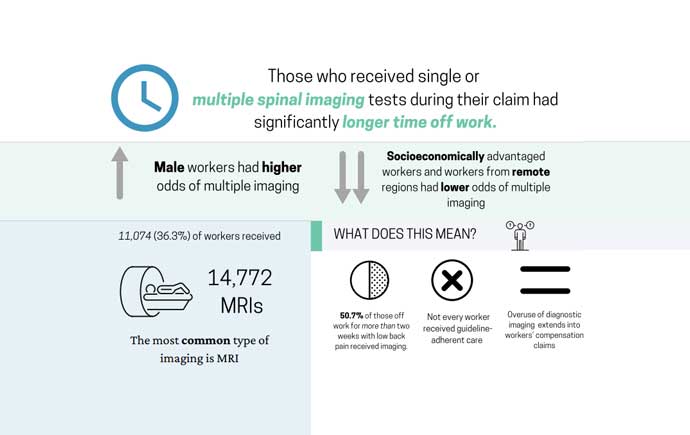
The COMpensation Policy And Return to work Effectiveness (COMPARE) project was established to develop an evidence base that can support development and implementation of effective return to work policy in Australia. Find out more here.
Reports (PDF)
- Claims Experience in Injured Australian Workers: Overview and Association with Return to Work
- Employer Support for Making a Workers' Compensation Claim: Overview and Association with Return to Work
- Employer Support for Injured Australian Workers: Overview and Association with Return to Work
- Return to Work Plans for Injured Australian Workers: Overview and Association with Return to Work
- Long-Term Workers' Compensation Claims in Australia
- Determining the Association Between Workers' Compensation Claim Processing Times and Duration of Compensated Time Loss
- Workers' Compensation Claims in Government Employees
- Comparison of Return to Work Practices and Outcomes in Self-Insured and Scheme-Insured Organisations
- Evaluating the impact of the 2012 legislative amendments to the NSW workers' compensation scheme
- Benefit Generosity, Claiming, and Disability Duration
Transitions Study
Reports (PDF)

Report (PDF)
- Risk Factor Identification for Delayed Return to Work – Best Practice Statement – An outline of the key concepts underpinning best practice in risk factor identification for delayed return to work based on available evidence and knowledge of current practice in workers' compensation case management. April 2018.
The DSP Study
The DSP Study aims to build an evidence base on the health and experiences of people receiving the Disability Support Pension, and on the impact of government policy changes on access to Centrelink payments. Visit the Study website to find out more.
Report (PDF)
- The Health of Disability Support Pension and Newstart Allowance Recipients – Analysis of national health survey data – This report uses National Health Survey data to compare the health and health service use of people receiving the Disability Support Pension or the Newstart Allowance with other working age Australians. September 2019.
National Work Health and Safety Leading Indicator Survey
Reports (PDF)
- National Work Health and Safety Leading Indicator Survey Summary Report – The relationship between three validated leading indicator measures and lagging indicators of workplace health and safety, in a large and diverse sample of Australian workers. May 2017.
- Developing a leading indicators questionnaire to identify Victorian workers at increased risk of work-related harm – Summary report, 9 November 2023.
Below are some of our key publications that have demonstrably influenced policy or opinion in Australia and around the world. For more of our publications, visit the Monash University Research Portal profiles for Prof Alex Collie, Dr Shannon Gray, Dr Michael Di Donato and Dr Samineh Sanatkar.
2025
Early high-risk opioid prescribing and persistent opioid use in Australian workers with workers' compensation claims for back and neck musculoskeletal disorders or injuries: A retrospective cohort study.
Tefera YG, Gray S, Nielsen S, Di Donato M, Collie A.
CNS Drugs. 2025 May;39(5):499-512. doi: 10.1007/s40263-025-01169-5.
This study is the first to measure the extent of early high-risk prescribing patterns in Australia’s workers’ compensation system. Researchers analysed data from 30,590 workers with back and neck injuries.
Changes in Pregabalin Dispensing to Australians with Workers’ Compensation Claims for Low Back Pain Following the Listing of Pregabalin on the Pharmaceutical Benefits Scheme.
Di Donato MF, Abdel Shaheed C, Collie A, Maher CG, Mathieson S.
Journal of Occupational Rehabilitation. 2025 Feb 12. doi: 10.1007/s10926-025-10276-5. Epub ahead of print.
Adding pregabalin to the pharmaceutical benefits scheme in 2013 saw increases in the prevalence and number of dispenses and decreases in the costs of dispenses, to Victorians with workers' compensation time loss claims for low back pain.
Trends in opioid dispensing to injured workers following codeine scheduling changes in Australia: a retrospective cohort study.
Di Donato MF, Mathieson S, Ferreira GE, Xia T, Tefera YG, Abdel Shaheed C, Maher C, Collie A.
BMJ Open. 2025 Mar 12;15(3):e092651. doi: 10.1136/bmjopen-2024-092651.
Up-scheduling low-dose codeine in 2018 does not appear to have changed the supply to Australians with workers' compensation time loss claims for low back pain. Temporary increases in high-dose codeine, the mean dose of other opioids, and prevalence of other pain medicines appear to indicate a shift to alternative analgesics.
Effect of working hours and shift work on preterm birth among Australian women in paid work during pregnancy: Prospective cohort study.
Adane HA, Iles R, Boyle JA, Sheehan LR, Collie A.
Public Health. 2025 May;242:352-358. doi: 10.1016/j.puhe.2025.03.021.
In Australia, the rate of preterm births increased from 8.3 % in 2010 to 8.7 % in 2021, posing risks not only during pregnancy and the neonatal period but also for long-term offspring development.
2024
The burden of working time lost to compensable occupational injury and disease in Australia, 2012-17: a retrospective population-based study.
Collie A, Sheehan L.
Medical Journal of Australia. 2024 Jun 17;220(11):573-578. doi: 10.5694/mja2.52309.
To determine the national burden of working time lost to occupational injury and disease in Australia compensable by workers’ compensation schemes; to characterise the distribution of time lost by age, sex, and injury and disease type.
Effects of psychosocial work factors on preterm birth: systematic review and meta-analysis.
Adane HA, Iles R, Boyle JA, Gelaw A, Collie A.
Public Health. 2024 Mar;228:65-72. doi: 10.1016/j.puhe.2023.12.002.
Preterm birth is one of the global public health issues that result in high rates of infant mortality and long-term health complications. We sought to explore the association between psychosocial work factors and preterm birth.
Patterns of mental health service use in Australian workers with low back pain: A retrospective cohort study.
Gray SE, Di Donato M, Sheehan LR, Iles R, Collie A.
Journal of Occupational Rehabilitation. 2024 Feb 24. doi: 10.1007/s10926-024-10180-4.
We describe the volume, frequency and timing of psychologist, psychiatrist and social work services for people with low back pain claims, in four Australian workers' compensation jurisdictions: Victoria, Queensland, Western Australia and South Australia, between 2010 and 2015.
Patterns of physiotherapy attendance in compensated Australian workers with low back pain: a retrospective cohort study.
Di Donato M, Sheehan LR, Iles R, Gray S, Buchbinder R, Collie A.
Pain. 2024 Apr 2. doi: 10.1097/j.pain.0000000000003228.
Most people with workers' compensation claims for low back pain attend physiotherapy. Trajectory modelling indicates some attend numerous times over a long period.
How much physiotherapy, chiropractic, and osteopathy care do compensated Australian workers with low back pain receive? A retrospective cohort study.
Di Donato M, Gray S, Sheehan LR, Buchbinder R, Iles R, Collie A.
Journal of Occupational Rehabilitation. 2024 May 18. doi: 10.1007/s10926-024-10202-1.
To identify the prevalence and frequency of physiotherapy, chiropractic, and/or osteopathy care in Australians with workers’ compensation claims for low back pain (LBP).
2023
Factors associated with fatigued driving among Australian truck drivers: A cross-sectional study.
Ren X, Pritchard E, van Vreden C, Newnam S, Iles R, Xia T.
International Journal of Environmental Research and Public Health. 2023 Feb 3;20(3):2732. doi: 10.3390/ijerph20032732.
This cross-sectional study examines the role of demographic, occupational, lifestyle, and other health risk factors associated with fatigue among Australian truck drivers.
The prevalence of mental health service use in Australian workers with accepted workers' compensation claims for low back pain: A retrospective cohort study.
Gray SE, Di Donato M, Sheehan LR, Iles R, Collie A.
Journal of Occupational Rehabilitation. 2023 Sep;33(3):602-609. doi: 10.1007/s10926-023-10098-3.
This study determines the prevalence of funded mental health services for workers with compensated lower back pain.
Impact of work and coping factors on mental health: Australian truck drivers' perspective.
Pritchard E, van Vreden C, Xia T, Newnam S, Collie A, Lubman DI, de Almeida Neto A, Iles R.
BMC Public Health. 2023 Jun 6;23(1):1090. doi: 10.1186/s12889-023-15877-4.
The aim of this study was to explore the impact of work and coping factors on mental health of Australian truck drivers from their perspective.
Injured worker outcomes after compensation system overhaul: an interrupted time series study.
Lane TJ, Di Donato MF, Collie A.
Journal of Epidemiology & Community Health. 2023 Aug;77(8):515-520. doi: 10.1136/jech-2023-220387.
In 2015, South Australia replaced its workers’ compensation system with the aim of improving return to work rates. We examined whether this was achieved by focusing on the duration of time off work, as well as claim processing times and claim volumes to understand how this may have been achieved.
Maternal occupational risk factors and preterm birth: A systematic review and meta-analysis
Adane HA, Iles R, Boyle JA, Gelaw A, Collie A.
Public Health Reviews. 23 October 2023. doi: 10.3389/phrs.2023.1606085.
This systematic review and meta-analysis aimed to summarise the evidence on the relationship between physical occupational risks and preterm birth.
Exploring the health and economic burden among truck drivers in Australia: A health economic modelling study.
Peter Lee, Ting Xia, Ella Zomer, Caryn van Vreden, Elizabeth Pritchard, Sharon Newnam, Alex Collie, Ross Iles, Zanfina Ademi.
Journal of Occupational Rehabilitation. 2023 Jun;33(2):389-398. doi: 10.1007/s10926-022-10081-4. Epub 2022 Nov 10.
A Driving Health study on the health and economic consequences of poor truck driver health and the estimated work-related mortality burden among truck drivers over a 10-year period.
2022
The physical and mental health of Australian truck drivers: a national cross-sectional study.
Caryn van Vreden, Ting Xia, Alex Collie, Elizabeth Pritchard, Sharon Newnam, Dan I Lubman, Abilio de Almeida Neto, Ross Iles.
BMC Public Health. 2022 Mar 8;22(1):464. doi: 10.1186/s12889-022-12850-5.
The aims of this study were to characterise the physical and mental health of Australian truck drivers overall, and to identify any differences in factors influencing the health profile of long-haul compared to short-haul drivers.
Changes in work and health of Australians during the COVID-19 pandemic: a longitudinal cohort study.
Daniel Griffiths, Luke Sheehan, Caryn van Vreden, Dennis Petrie, Peter Whiteford, Malcolm R Sim, Alex Collie.
BMC Public Health. 2022 Mar 12;22(1):487. doi: 10.1186/s12889-022-12897-4.
A study on work and health during the COVID-19 pandemic and changes in mental and physical health following experiences of work loss and return to work.
The health impacts of a 4-month long community-wide COVID-19 lockdown: Findings from a prospective longitudinal study in the state of Victoria, Australia.
Daniel Griffiths, Luke Sheehan, Dennis Petrie, Caryn van Vreden, Peter Whiteford, Alex Collie.
PLoS One. 2022 Apr 7;17(4):e0266650. doi: 10.1371/journal.pone.0266650. eCollection 2022.
A study to determine health impacts during, and following, an extended community lockdown and COVID-19 outbreak in the Australian state of Victoria, compared with the rest of Australia.
Work-related injuries in the Australian education sector: A retrospective cohort study.
Fatimah M Al Afreed, Tyler J Lane, Shannon E Gray.
Injury. 2022 Dec;53(12):3962-3969. doi: 10.1016/j.injury.2022.09.046.
An Australian-first study of workplace injury amongst the nation’s teachers and teacher’s aides suggests educators are at higher risk of assault injuries than other workers, and that the risk is higher still among special educators and education aides. Educators were also at elevated risk of mental health conditions, particularly in secondary education and special education.
The relationship between work disability and subsequent suicide or self-harm: A scoping review
Alex Collie, Shannon E Gray.
PLOS Global Public Health. 2022 Dec 7;2(12): e0000922. doi: 10.1371/journal.pgph.0000922.
This study closely examined the relationship between a disabling work injury or illness, and later suicide or self-harm.
2021
Returning to the workplace during the COVID-19 pandemic: The concerns of Australian workers.
Daniel Griffiths, Luke Sheehan, Caryn van Vreden, Peter Whiteford, Alex Collie.
Journal of Occupational Rehabilitation. 2021 Dec;31(4):711-720. doi: 10.1007/s10926-021-09990-7.
Publication from our landmark COVID-19 Work and Health study that identifies the concerns Australian workers hold regarding workplace reopening after periods of lockdown.
Timing of health service use among truck drivers after a work-related injury or illness.
Ting Xia, Alex Collie, Sharon Newnam, Dan Lubman, Ross Iles.
Journal of Occupational Rehabilitation. 2021 Dec;31(4):744-753. doi: 10.1007/s10926-021-10001-y.
A publication from the Driving Health study that describes when truck drivers access health services, including services for mental health.
Changes in access to Australian disability support benefits during a period of social welfare reform.
Alex Collie, Luke Sheehan, Tyler Lane.
Journal of Social Policy. 2021, 1-23. doi: 10.1017/S0047279420000732.
This study describes how reforms to the Disability Support Pension eligibility and administrative processes led to a significant reduction in DSP grants and differentially affected people based on the nature of their medical condition or disability.
Prevalence, predictors and wage replacement duration associated with diagnostic imaging in Australian workers with accepted claims for low back pain: a retrospective cohort study.
Michael Di Donato, Ross Iles, Rachelle Buchbinder, Ting Xia, Alex Collie.
Journal of Occupational Rehabilitation. 2021 Apr 28. doi: 10.1007/s10926-021-09981-8.
This study identified the prevalence of diagnostic spinal imaging for compensated Australian workers with low back pain and its association with wage replacement duration.
2020
Development and pilot assessment of the PACE Tool: Helping case managers identify and respond to risk factors in workers’ compensation case management.
Ross Iles, Luke Sheehan, Karen Munk, Cameron Gosling.
Journal of Occupational Rehabilitation. 2020 Jun;30(2):167-182. doi: 10.1007/s10926-019-09858-x.
A comprehensive description of a tool to identify injured workers at risk of delayed return to work, including the results of applying the tool with more than 500 injured workers.
Impact of legislative reform on benefit access and disability duration in workers’ compensation: an interrupted time series study.
Alex Collie, Dianne Beck, Shannon Elise Gray, Tyler Jeremiah Lane.
Occupational and Environmental Medicine. 2020 Jan;77(1):32-39. doi: 10.1136/oemed-2019-106063.
Population based evaluation of a workers’ compensation policy change using sophisticated quasi-experimental analysis.
Psychological distress in workers’ compensation claimants: prevalence, predictors and mental health service use.
Alex Collie, Luke Sheehan, Tyler Lane, Ross Iles.
Journal of Occupational Rehabilitation. 2020 Jun;30(2):194-202. doi: 10.1007/s10926-019-09862-1.
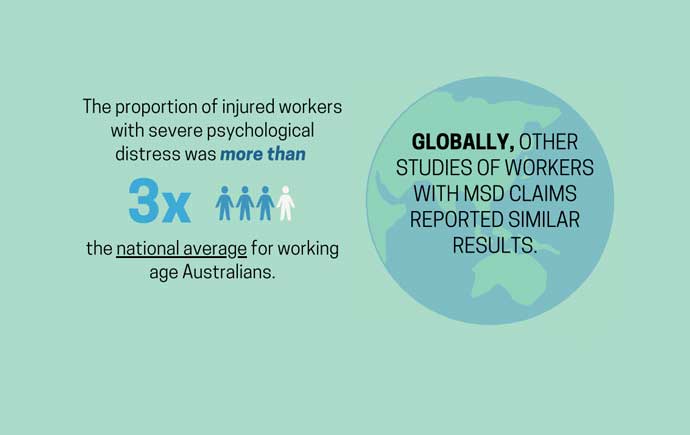
Describes a high prevalence of psychological distress among workers with musculoskeletal disorder claims, and that most such workers in distress do not receive specialist mental health care.
The impact of income support systems on healthcare quality and functional capacity in workers with low back pain: a realist review.
Michael Di Donato, Ross Iles, Tyler Lane, Rachelle Buchbinder, Alex Collie.
Pain. 2020 Dec;161(12):2690-2709. doi: 10.1097/j.pain.0000000000001978.
This realist review revealed the impact of intersecting healthcare and social systems on healthcare quality and functional capacity in workers suffering low back pain.
The impact of income sources on financial stress in workers’ compensation claimants.
Luke Sheehan, Tyler Lane, Alex Collie.
Journal of Occupational Rehabilitation. 2020 Dec;30(4):679-688. doi: 10.1007/s10926-020-09883-1.
Using data from the National Return to Work Survey, this study shows that injured workers receiving workers’ compensation report greater financial stress than those back at work or those who were receiving the aged pension or superannuation.
2019
Individual recovery expectations and prognosis of outcomes in non-specific low back pain: prognostic factor review.
Jill Hayden, Maria Wilson, Richard Riley, Ross Iles, Tamar Pincus, Rachel Ogilvie.
Cochrane Database of Systematic Reviews. 2019 Nov 25;2019(11):CD011284. doi: 10.1002/14651858.CD011284.pub2.
This is a comprehensive review of the ability of recovery expectations to predict outcomes for people with low back pain, spanning 60 studies and more than 30,000 people with back pain.
Factors associated with employer support for injured workers during a workers’ compensation claim.
Luke Sheehan, Tyler Lane, Shannon Gray, Alex Collie.
Journal of Occupational Rehabilitation. 2019 Dec;29(4):718-727. doi: 10.1007/s10926-019-09834-5.
This study identified characteristics of injured workers who are more or less likely to feel supported by their employers and receive support in the form of a return to work plan.
Work disability in Australia: an overview of prevalence, expenditure, support systems and services.
Alex Collie, Michael Di Donato, Ross Iles.
Journal of Occupational Rehabilitation. 2019 Sep;29(3):526-539. doi: 10.1007/s10926-018-9816-4..
Landmark study that describes prevalence of work disability across Australia’s “system of systems” including workers compensation, social security, life insurance, sickness absence.
Patterns and predictors of return to work after major trauma: a prospective, population-based registry study.
Alex Collie, Pamela M Simpson, Peter A Cameron, Shanthi Ameratunga, Jennie Ponsford, Ronan A Lyons, Sandra Braaf, Andrew Nunn, James E Harrison, Belinda J Gabbe.
Annals of Surgery. 2019 May;269(5):972-978. doi: 10.1097/SLA.0000000000002666.
Identifies distinct patterns of return to work after major trauma, from analysis of population based longitudinal trauma registry data.
Evaluating the success of legislative amendments designed to reduce work disability.
Shannon Gray, Tyler Lane, Behrooz Hassani-Mahmooei, Alex Collie.
Policy Design and Practice. 2019; 3: 291-304, doi: 10.1080/25741292.2019.1610147.
Examined the effect of a major change to a workers’ compensation system, finding minimal evidence for intended effects and likely unintended consequences due to antagonistic components in the legislation.
We value media engagement as an important way to share our knowledge and findings directly with the community. The Healthy Working Lives Research Group is happy to provide expert comment to journalists and can be contacted via media@monash.edu.
Here are some of the highlights of our recent media activity:
More media about the Driving Health study can be found here.
.

Workers' Voice Information Session
Presented by Prof Alex Collie (Head of the Healthy Working Lives Research Group, this session is for any worker who has made a compensation claim in Australia, and their family or friends who supported them during the claim, or for anyone who works with workers who have made a claim.
2022 HEALTHY WORKING LIVES SEMINAR SERIES (PREVENTION THEME)
Health impacts of regulations in the transport industry
Driving Health lead researcher Associate Professor Ross Iles discusses the health impacts of regulations in the transport industry. With special guests Greg Fill (National Heavy Vehicle Regulator) and Rod Hannifey (OzHelp ambassador and truck driver).

How the job gets done – You've gotta do what you gotta do
Driving Health lead researcher Associate Professor Ross Iles discusses the ins and outs of how truck drivers 'get the job done' and the health implications associated with it. With special guests Naomi Frauenfelder (Healthy Heads in Trucks & Sheds) and Sharon Newnam (Monash University Accident Research Centre).
Everyone deserves to be safe at work – how the big players are leading the way
Driving Health Research Fellow Dr Elizabeth Pritchard is joined by Chris Wilks – Group Manager, Safety, Health and Wellbeing, Linfox – to discuss Healthy Fox, Linfox's dedicated program to support the health and wellbeing of team members.

What does a healthy truck driver look like?
Associate Professor Ross Iles discusses the findings from the Driving Health study around the health and lifestyle risks truck drivers face on a daily basis. A diverse panel of experts sheds some light on the truths behind what it's really like to be an Australian truck driver and the health challenges they face.
2022 HEALTHY WORKING LIVES SEMINAR SERIES (RECOVERY THEME)
The (un)holy trinity? Opioids, imaging and surgery in workers with low pack pain
Dr Michael Di Donato and Professor Ian Harris describe a series of studies that have examined the prevalence and impacts of opioids, spinal imaging and spinal surgery in Australian workers with low back pain.
What do we know about secondary psychological conditions in workers' compensation?
Professor Alex Collie and Dr Dielle Felman present data on the prevalence and impacts of secondary psychological conditions, and explore how worker’s compensation systems are identifying and supporting workers with these conditions.
The critical role of insurance case managers in return to work
Associate Professor Ross Iles and Matt Bannan (Head of Stakeholder Engagement, WorkCover Queensland) describe some of the practical learnings from introducing change to case management in multiple workers' compensation jurisdictions.

New insights into healthcare use in Australian workers’ compensation schemes
This seminar presents new insights into the two most common types of health services in workers comp: General practice and physiotherapy. Presented by Professor Alex Collie and Dr Mary Wyatt (Occupational Physician).

What happens to workers with long duration compensation claims?
In this seminar Dr Daniel Griffiths and Luke Sheehan describe how common long duration claims are, differences between jurisdictions, and present findings from a new study describing what happens when workers compensation payments stop.
How do workplaces support return to work?
This seminar presents a series of studies in which workers provide unique insights into what helped with return to work, including emotional and practical support, return to work planning and workplace contact. Presented by Dr Shannon Gray and Andrew McGarity (Fire & Rescue NSW).
2022 HEALTHY WORKING LIVES SEMINAR SERIES (SYSTEMS THEME)
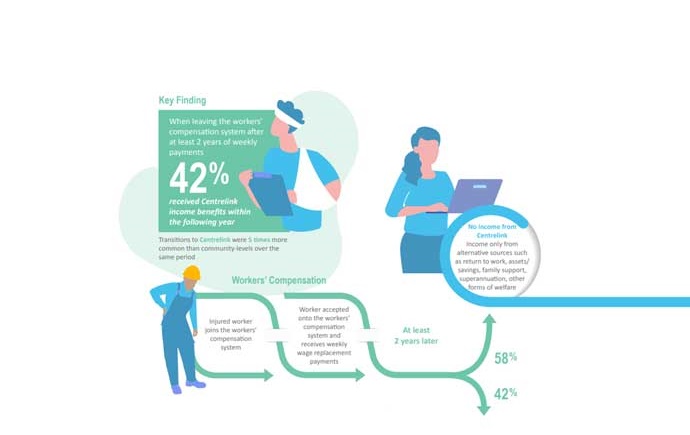
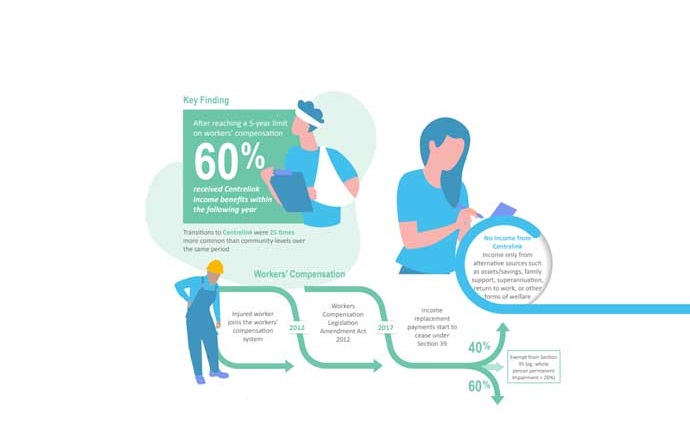
Transitions to Centrelink after long workers' compensation claims
In this seminar, Professor Alex Collie and Dr Daniel Griffiths present the first Australian study to describe transitions to Centrelink after workers’ compensation benefits stop.
Hospital admissions after long-duration workers’ compensation claims
The end of a compensation claim can be stressful period of adjustment – does the hospital system pick up the pieces? Presented by Dr Daniel Griffiths and Professor Alex Collie.
What healthcare do people receive when workers' compensation ends?
In this seminar Dr Michael Di Donato presents the findings from Report #3 of the Transitions Study, the first Australian study to examine hospitalisations towards the end of long workers’ compensation claims, and afterwards.
OUR RESEARCH

What is the Driving Health study?
Driving Health lead researcher Associate Professor Ross Iles introduces the 3-year Driving Health study, which aims to develop evidence-based strategies to improve the health and wellbeing of Australian truck drivers.
What is the Driving Health Allocator Training?
Associate Professor Ross Iles explains how the Driving Health Allocator Training has an impact on improving the health and wellbeing of Aussie truck drivers.
An introduction to the COMPARE project
Director of the Healthy Working Lives Research Group Professor Alex Collie introduces the COMPARE project.

What is qualitative data?
Have you ever wondering what it means when researchers refer to qualitative data? Dr Elizabeth Pritchard explains what exactly it means.