Production of Hydrogen
One of the big challenges in chemistry is developing alternatives to fossil fuels, which produce \(CO_2\) emissions and contribute to the enhanced greenhouse effect. A fuel that is a credible alternative to fossil fuels is hydrogen.
Hydrogen has a reasonably high energy density (282 \(\text{kJ mol}^{-1}\), compared to, for example, 890 \(\text{kJ mol}^{-1}\) for methane) and is readily abundant on Earth (mostly found in water). When it undergoes combustion it only produces water.
However, as fuel it has some limitations:
- It requires energy to produce.
- It requires a large amount of energy to convert into a liquid fuel, or very high pressures to store as a gas.
- It is also explosively flammable and requires careful handling and storage.
This makes it difficult to transport as either liquid or gas.
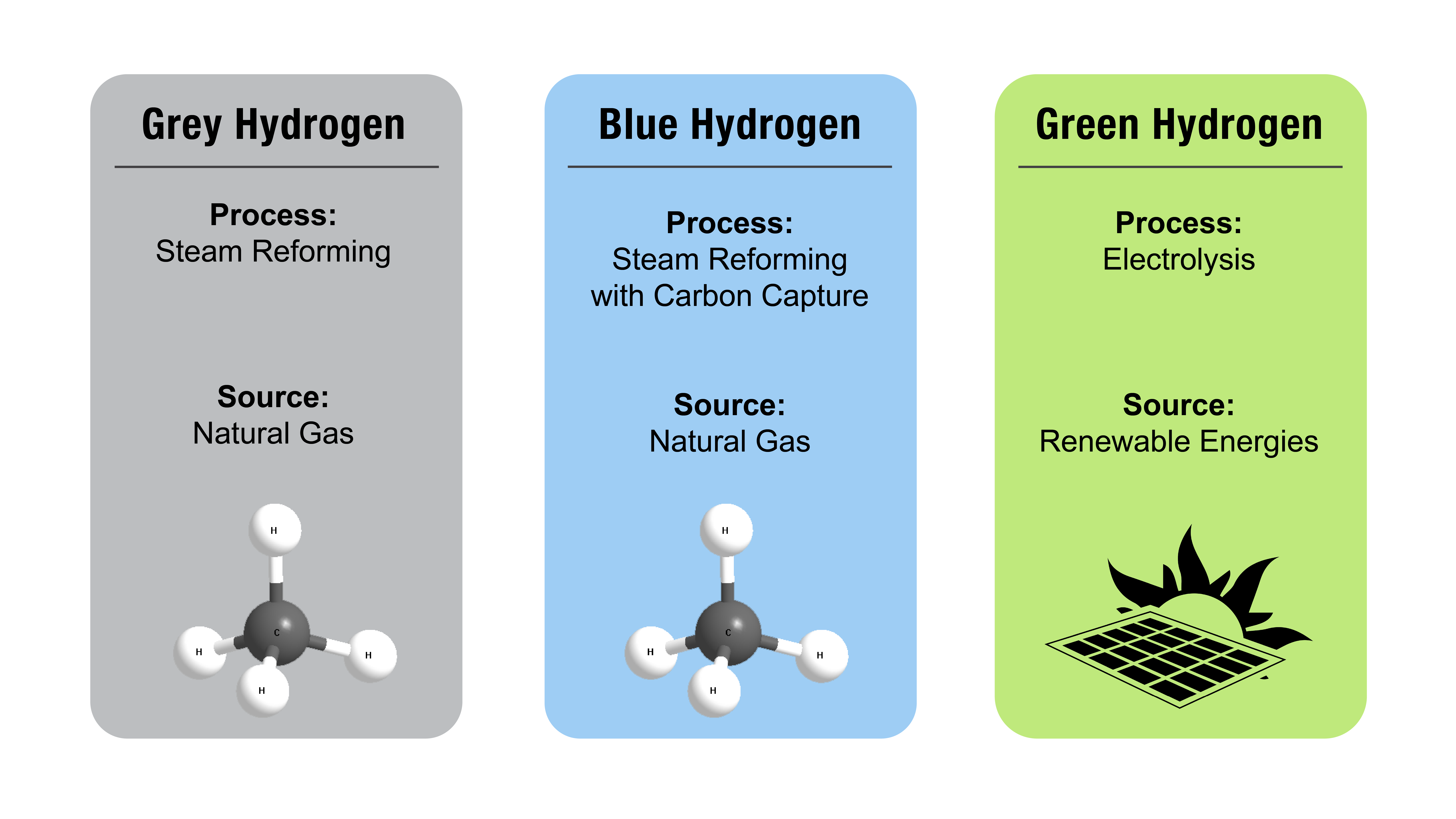
Hydrogen is currently able to be produced in a range of ways, mostly commonly through steam reforming and electrolysis. Depending on the process used to produce hydrogen, the hydrogen is labelled as different colours. The three most common are shown below.
Steam reforming
Grey hydrogen is currently the most common, and the cheapest, form of hydrogen production. When it is used as a fuel, it doesn't generate greenhouse gas emissions itself, but its production process does.
Grey hydrogen is created from natural gas using steam reforming, which separates the hydrogen from the natural gas according to the reaction:
\[CH_4(g)+H_2O(g)\leftrightharpoons CO(g) = 3H_2(g) \Delta{H} = +206kJ\]
Carbon emissions are created during the process, which are released into the atmosphere.
Blue hydrogen is also extracted using the steam reforming process, but the carbon emissions released are captured and stored.
Electrolysis of water
Green hydrogen doesn’t generate carbon emissions as it uses renewable energies in the production process, providing emission free energy.
It is made by electrolysing water using electricity created from renewable energy from wind and solar power. The reaction is:
\[2H_2O(l) \rightarrow 2H_2(g) + O_2(g)\]
Electrolysis of water can be conducted in the laboratory using an acidic or alkaline electrolyte. However, at an industrial level other processes are preferred.
Polymer electrolyte membrane (PEM) electrolyser
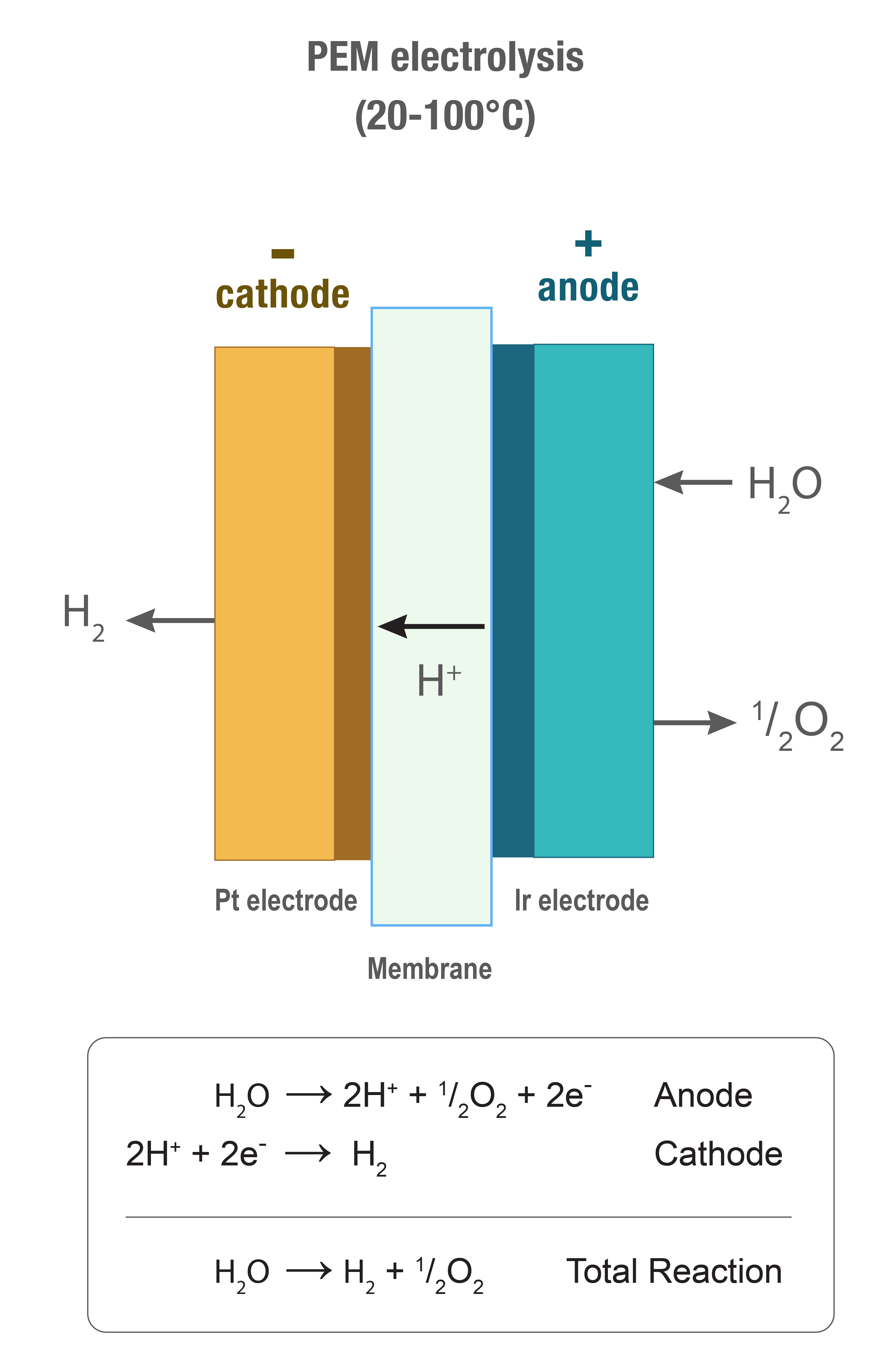
A polymer electrolyte membrane (PEM) electrolyser uses a solid electrolyte in place of acidic or alkaline electrolyte solution. This is alternatively known as a proton exchange membrane (as protons can flow through to complete the circuit). The electrodes are made from metals such as ruthenium or iridium and are porous to allow for the passage of gases.
Water is oxidised at the anode to produce oxygen gas and hydrogen ions. The hydrogen ions migrate across the electrolyser and are reduced to hydrogen gas. Some designs produce compressed hydrogen, eliminating one of the limitations of hydrogen use. Multiple electrolysers can be placed together, called an electrolyser stack, producing enough hydrogen to fuel nearby industrial use.
Artificial photosynthesis
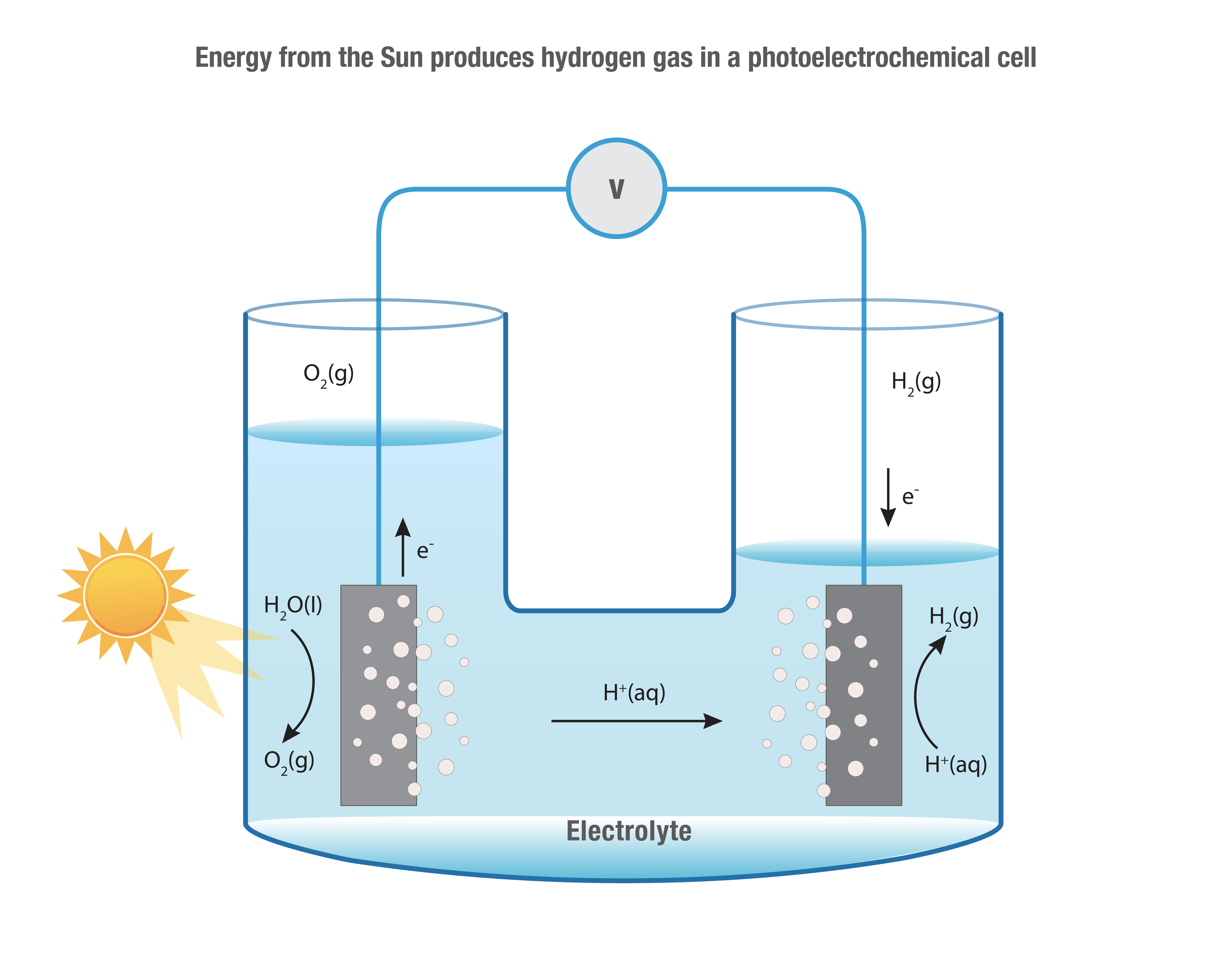
Another way to produce green hydrogen is through the process of artificial photosynthesis . This process uses a photoelectrochemical cell, where sunlight directly hits the anode, enabling oxidation of water into hydrogen ions and oxygen. The hydrogen ions are then reduced after moving to the cathode. The equations for artificial photosynthesis are the same as electrolysis, but direct sunlight is used as the energy supply in place of renewable electricity, shown below:
Anode: \(2H_2O(l) \rightarrow 4H+(aq) + O_2(g) + 4e^-\)
Cathode: \(2H+(aq) + 2e^- \rightarrow H_2(g)\)
Overall: \(2H_2O(l) \rightarrow O_2(g) + 2H_2(g)\)