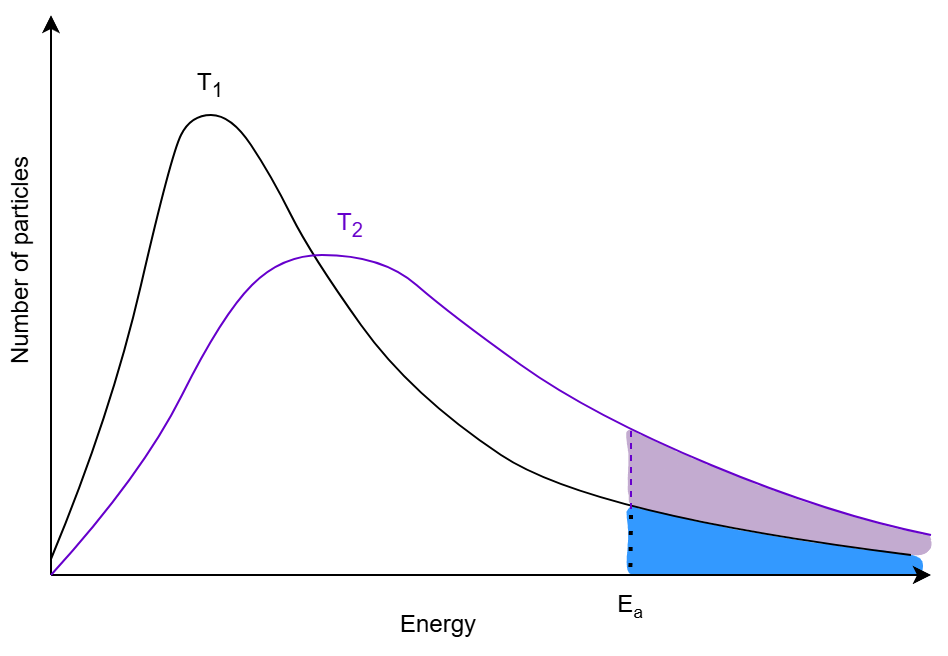
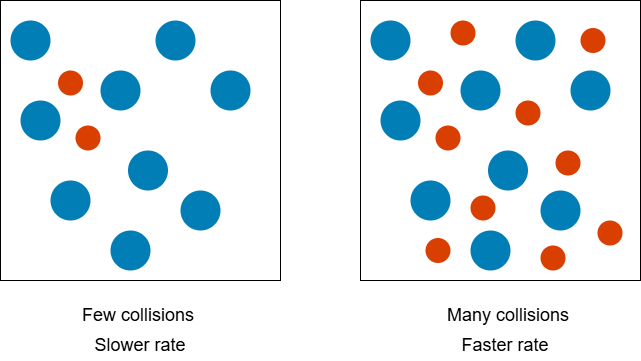
A catalyst is a molecule or chemical substance that can act to increase the rate of reaction. It is present in the reaction mixture and lowers the activation energy for the reaction to occur. Importantly, catalysts are not consumed by the chemical reaction.
A catalyst lowers the activation energy for a given reaction by providing a lower energy pathway for the reaction to proceed. Catalysts are widely used in the chemical manufacturing industry because of their significant ability to make reactions occur more quickly.
The energy profile diagram below illustrates the effect of adding a catalyst to a reaction mixture.

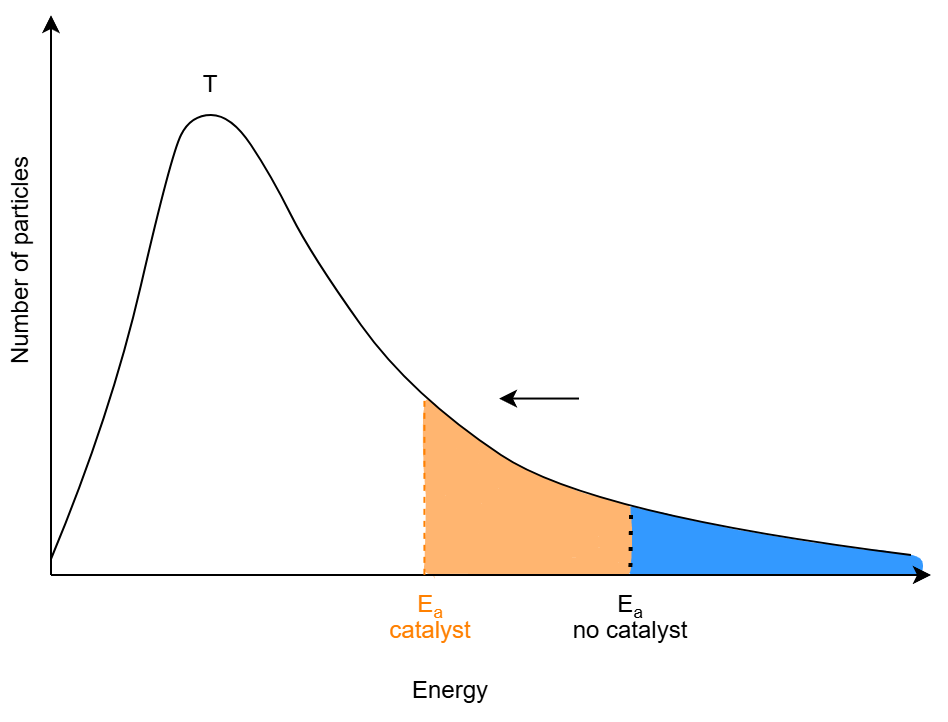
When a catalyst is added to a reaction mixture, the activation energy is lowered. This means a greater proportion of molecules can now react at a given temperature, as more of them have the required energy. This process is illustrated in the diagram below. This leads to an increased rate of reaction.
Typically, industrial chemists use a heterogeneous catalyst (a catalyst in a different state compared to the reaction mixture) to make it easier to separate the products from the catalyst. For solid catalysts, they use powdered or sponge-like catalysts. This increase in the surface area of the catalyst further increases the rate of reaction.