
Dynamic equilibrium
A reversible chemical reaction will proceed until it reaches equilibrium, a dynamic state where both the forward and reverse reactions are continuing but the amount of reactants and products remains stable.
In a closed system, as soon as products of the forward reaction are formed, they can begin reacting via the reverse reaction to reform the reactants. This means that the forward reaction and the reverse reaction are both occurring simultaneously. At equilibrium, both of these reactions will be occuring at the same rate, so that amount of reactant or product remains unchanged
Use this page to revise the following concepts within dynamic equilibrium:
Open and closed systems
An open system is one where both matter and energy can enter and leave the system, for example the flame on a Bunsen burner. Both energy and matter can be added into the system (for example, increasing the rate of the gas flowing into the Bunsen burner) but can also leave the system (for example, as the flame generates heat energy, and the products escape into the atmosphere).

In contrast, a closed system is sealed against the surroundings. In industrial chemistry, many reactions take place in large sealed systems, where the matter does not leave, but energy can be added to or removed from the system while the reaction is taking place. These are important systems in the context of learning about reaction yield.
In these reactions, the products and the reactant s are contained together in the same reaction vessel. The products can undergo collisions and react to re-form products.
Check your understanding
View

Reversible and irreversible reactions
Many chemical reactions are irreversible as they proceed in only one direction until all the possible product is formed from the reactants. These reactions are called irreversible. For example, the flame in a Bunsen burner combusts methane in the presence of oxygen, yielding carbon dioxide and water. The products of this reaction leave the Bunsen burner, enter the atmosphere and do not reform into methane and oxygen.
However, with a reversible reaction, no matter how long the system is left, it will never be composed of 100% products. Once the reactants begin forming products, those products then start to react to form reactants. When we represent a reversible chemical equation, we use the equilibrium arrows (⇌) to indicate that the reaction can go in either direction, and both reactions are occurring simultaneously. The actual amount of products formed is known as the chemical yield.
Industrial chemists are interested in maximising the chemical yield for useful industrial reactions. The chemical yield is different from the rate of reaction that is explored in applications of equilibrium concepts. Chemical reactions have both a rate (how fast they generate a product per unit time) and a yield (the total amount or proportion of product formed).
Dynamic equilibrium
Dynamic equilibrium refers to both forward and reverse reactions occurring simultaneously, at the same rate, while the amount of reactants and products remains unchanged.
To simplify equilibrium, we will only consider homogeneous equilibrium systems, that is, systems where substances are all aqueous or all gaseous. An example is shown below.
\[A(g)+B(g)\rightleftharpoons 2C(g)\quad \quad\Delta{H}=-ve\]
If equal mole amounts of A and B are added in a 1.00 L reaction vessel at a fixed temperature and pressure, they will begin to react to form C. However, the reaction mixture will never be composed of only C, despite this being what is predicted stoichiometrically. This is because once C is formed, it begins to react in the reverse reaction, forming A and B. At equilibrium, there will be a mix of A, B, and C.

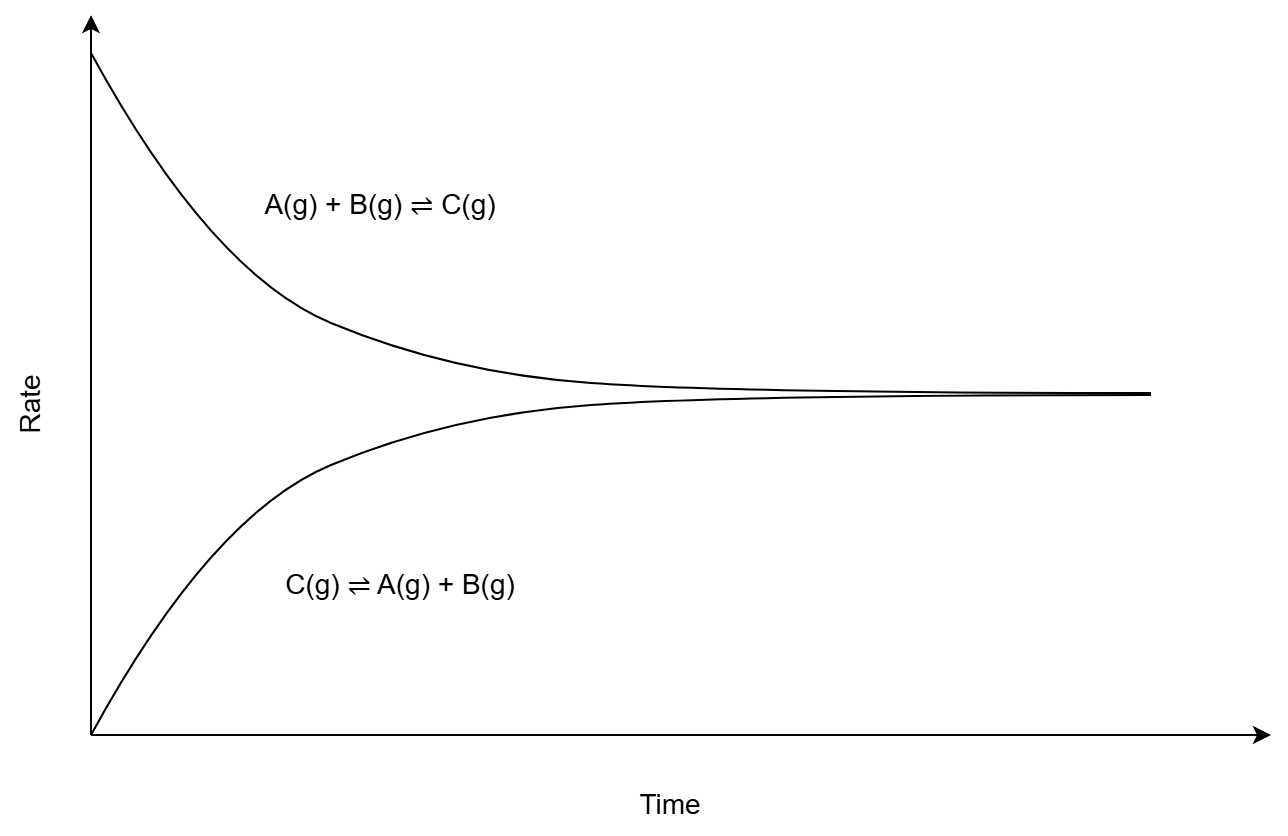
Rate-Time Graphs
Another way of illustrating equilibrium is to use a rate-time graph. The rate of forward reaction will start off high, and decrease as the amount of reactants decreases. Conversely, the reverse reaction rate starts at zero, as there are no particles of C, and it only increases once the reaction proceeds. Both the rates will continue to change until they equalise. At this point, they remain constant and equal, assuming that the temperature and pressure of the reaction vessel remains constant.
Key ideas
|