
Application of Equilibrium Concepts
In an equilibrium system, the reaction does not go to completion. At equilibrium there will be both reactants and products present in the reaction vessel. Industrial chemists use Le Chatelier’s principle to increase the yield of the desired chemical products.
Some of the factors that increase yield oppose factors that make chemical reactions occur at a high rate, so there is often a compromise between rate and yield. In addition, chemists also try to minimise the energy used to create chemicals, and often use catalysts to help this goal. These are connected to the green chemistry principles of catalysis and design for energy efficiency.
Investigate the following examples of industrial production of common chemicals, and how applications of Le Chatelier's principle are balanced with factors affecting the rate of reaction, and energy efficiency.
Methanol is made by reacting carbon monoxide and hydrogen, with a copper catalyst. It has the following equation:
\[\text{CO(g)} + 2\text{H}_2\text{(g)} \rightleftharpoons \text{CH}_3\text{OH(g)} \quad \quad \Delta\text{H}= -\text{ve}\]
| Factor | To maximise yield | To maximise rate | Compromise |
|---|---|---|---|
| Exothermic reaction | Decrease temperature | Increase temperature | Moderate temperature of 500 K |
| Less moles on product side | Increase pressure | Increase pressure | Very expensive and energy intensive to increase pressure thus a compromised pressure of 10,000 kPa is used |
| Catalyst | No effect | Use a catalyst | A copper catalyst is used |
The hydration of ethene uses a phosphoric acid catalyst. It has the following equation:
\[C_2H_4(g)+H_2O(g) \rightleftharpoons C_2H_5OH(g) \quad \quad \Delta\text{H} = \text{-ve}\]
| Factor | To maximise yield | To maximise rate | Compromise |
|---|---|---|---|
| Exothermic reaction | Decrease temperature | Increase temperature | Moderate temperature of 570 \(K\) |
| Less moles on product side | Increase pressure | Increase pressure | Very expensive and energy intensive to increase pressure thus a compromised pressure of 6,500 \(kPa\) is used |
| Adding a reactant | Add a reactant | Too much reactant dilutes the catalyst and slows rate | The product, ethanol, is continuously removed instead |
| Catalyst | No effect | Use a catalyst | A phosphoric acid catalyst is used |
Another method of production of ethanol is the fermentation of glucose, according to the reaction below:
\[\text{C}_6\text{H}{12}\text{O}_6\text{(aq)} \longrightarrow \text{C}_2\text{H}_5\text{OH(aq)} + \text{CO}_2\text{(g)}\]
The fermentation of glucose can be directly compared with the hydration of ethene to produce ethanol:
| Fermentation of glucose | Hydration of ethene | |
|---|---|---|
| Efficiency | Lower - occurs in batches and the waste is often discarded | Higher - can be continuously produced in a sealed reaction vessel |
| Atom Economy | Lower (waste \(CO_2\) ) | Higher - 100% |
| Rate of Reaction | Slow rate of reaction | High rate of reaction |
| Reaction Conditions | Low temperature and atmospheric pressure - yeast produces enzymes that catalyse the reaction and can only survive at low temperatures | High temperature and pressure maximise rate and yield of reaction, but use more energy |
| Sustainability | Plant material is renewable (if the ethanol is used as a fuel it is almost carbon neutral due to photosynthesis that plants undergo during growth) | Ethene is normally sourced from crude oil, which is a finite fossil fuel |
The production of sulfuric acid is called the contact process and takes place in a number of steps. The equilibrium step converts sulfur dioxide into sulfur trioxide. This uses a vanadium (V) oxide catalyst:
\[2\text{SO}_2\text{(g)} + \text{O}2\text{(g)} \rightleftharpoons 2\text{SO}_3\text{(g)} \quad \quad \Delta\text{H}= -\text{ve}\]
| Factor | To maximise yield | To maximise rate | Compromise |
|---|---|---|---|
| Exothermic reaction | Decrease temperature | Increase temperature | Moderate temperature of 670 \(K\) |
| Less moles on product side | Increase pressure | Increase pressure | Very expensive and energy intensive to increase pressure thus a compromised pressure of 200 \(kPa\) is used |
| Adding a reactant | Add a reactant | Too much oxygen dilutes the other reactant | Add equal amounts of \(SO_2\) and \(O_2\) and continuously remove \(SO_3\) |
| Catalyst | No effect | Use a catalyst | Use a vanadium oxide catalyst |
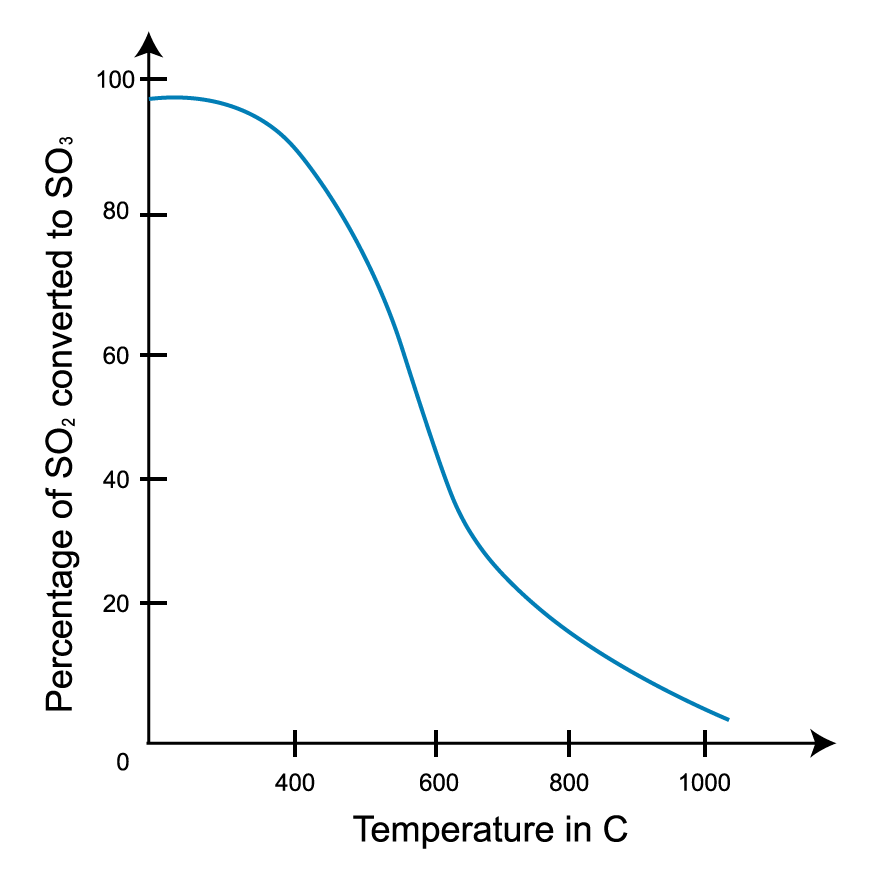
This reaction is exothermic; as such the yield of reaction decreases significantly with increasing temperature, as seen in the graph of yield vs temperature below.
Ammonia is made in a reversible reaction called the Haber process, using an iron catalyst:
\[3\text{H}_2\text{(g)} + \text{N}_2\text{(g)} \rightleftharpoons 2\text{NH}_3\text{(g)} \quad \quad \Delta\text{H}= -\text{ve}\]
| Factor | To maximise yield | To maximise rate | Compromise |
|---|---|---|---|
| Exothermic reaction | Decrease temperature | Increase temperature | Moderate temperature of 670 \(K\) |
| Less moles on product side | Increase pressure | Increase pressure | Very expensive and energy intensive to increase pressure thus a compromised pressure of 20,000 \(kPa\) is used |
| Adding a reactant | Add a reactant | Needs to be stoichiometrically balanced for maximum rate | Continuously remove ammonia product to favour high yield |
| Catalyst | No effect | Use a catalyst | Use a iron catalyst |
Pressure and temperature must be optimised for the Haber process; higher temperatures give a faster rate but lower yield, while increasing pressure increases yield but has a very high cost. The graph below shows the effect of both pressure and temperature on reaction yield.

