
Reactions in an Electrolytic Cell
Reactions in Electrolytic Cells
The outcomes of electrolysis depend on several factors, including the concentration and nature of the electrolyte, as well as the type of electrodes used. The concentration affects the availability of ions for the reactions, the electrolyte's nature determines which ions are present, and the electrode material can influence which reactions occur at the anode and cathode .
Determine Reactions in Electrolysis
- List all potential reduction reactions that can occur and rank them based on the electrochemical series, including reactions involving water if the solution is aqueous.
- Identify and highlight the oxidising agents and reducing agents in each reaction.
- The strongest oxidising agent will be reduced at the cathode. This will have the highest positive \(E_0\) value.
- The strongest reducing agent will be oxidised at the anode. This will have the lowest \(E_0\) value.
In general, species that are closest to each other in the electrochemical series are more likely to participate in a reaction under standard laboratory conditions (1 \(M\) concentration, 25\(^{\circ}C\), and 100 \(kPa\)). Exceptions can occur when experimental conditions deviate from these standards, such as changes in concentration, temperature, pressure, or the application of higher voltage.
Overpotential, which refers to the additional voltage required beyond the theoretical electrode potential to drive a non-spontaneous electrochemical reaction can play a role in these deviations. This is important in processes like electrolysis, where more energy is required than predicted by the electrochemical series, explaining why real-world electrochemical reactions may require higher voltage than ideal predictions suggest.
Use this page to revise the following concepts within reactions in an Electrolytic Cell:
Electrolysis of Molten Salts
For molten salts, only the cations and anions from the salt will be present. Inert electrodes are used in this example.
Electrolysis of Molten Potassium Chloride (KCl)

| Relevant Reactions | Standard electrode potential (\(E_0\)) at \(25^{\circ}C\)°C |
|---|---|
| \(Cl_2(s) + 2e^- \rightleftharpoons \textcolor{green}{2Cl^{-(aq)}}\) | \(+1.36 V\) |
| \(\textcolor{green}{K^{+(aq)}} + e^- \rightleftharpoons K(s)\) | \(-2.93 V\) |
The electrochemical series helps determine the products formed at the anode and cathode during electrolysis. However, in the case of a molten electrolyte , the states of the substances must be considered when determining the half-reactions and the overall redox process.
Molten KCl dissociates into \(K^+(l)\) and \(Cl^-(l)\)
Oxidation Half Reaction: \(2Cl^-(l) \rightarrow Cl_2(g) + 2e^-\)
Reduction Half Reaction: \(K^+(l) +e^- \rightarrow K(s)\)
Overall Redox Reaction: \(2K^+(l) +2Cl^-(l) \rightarrow 2K(s) + Cl_2(g)\)
Potassium metal \((K)\) is produced at the cathode and chlorine gas \((Cl_2)\) at the anode.
Electrolysis of Water
Inert electrodes are used in this example.

| Relevant Reactions | Standard electrode potential \((E_0)\) at \(25^{\circ}C\) |
|---|---|
|
\[ O_2(g) + 4H^+(aq) + 4e^- \rightleftharpoons \textcolor{green}{2H_{2}O(l)} \] | \(+1.23 V\) |
| \(\textcolor{green}{2H2O(l)}+ 2e^- \rightleftharpoons H_2(g) + 2OH^-(aq)\) | \(-0.83 V\) |
Oxidation Half Reaction: \(2H_2O(l) \rightarrow O_2(g) + 4H^+(aq) + 4e^-\)
Reduction Half Reaction: \(2H_2O(l) + 2e^- \rightarrow H_2(g) + 2OH^-(aq)\)
Overall Redox Reaction: \(2H_2O(l) \rightarrow 2H_2(g) + O_2(g)\)
Hydrogen gas \((H_2)\) is produced at the cathode and oxygen gas \((O_2)\) is produced at the anode.
Electrolysis of Aqueous Solutions
For aqueous solutions, the ions from the solute and water will be present.
Electrolysis of Aqueous Solutions with Inert Electrodes
This solution contains potassium ions \((K^+)\) and iodide ions \((I^-)\) from the potassium iodide salt \((KI)\), as well as water molecules.

| Relevant Reactions | Standard electrode potential \((E_0)\) at \(25^{\circ}C\) |
|---|---|
| \(O_2(g) + 4H^+(aq) + 4e^- \rightleftharpoons \textcolor{green}{2H_2O(l)}\) | \(+1.23 V \) |
| \(I_2(s) + 2e^- \rightleftharpoons \textcolor{green}{2I^{-(aq)}}\) | \( +0.54 V \) |
| \(\textcolor{green}{2H_2O(l)} + 2e^- \rightleftharpoons H_2(g) + 2OH^{-(aq)}\) | \( -0.83 V \) |
| \(\textcolor{green}{K^{+(aq)}} + e^- \rightleftharpoons K(s)\) | \(-2.93 V\) |
The strongest oxidising agent present in the solution is \(H_2O\) and the strongest reducing agent present is \(I^-\), so these two species will react.
Oxidation Half Reaction: \(2I^-(aq) \rightarrow I_2(s) + 2e^-\)
Reduction Half Reaction: \(2H_2O(l) + 2e^- \rightarrow H_2(g) + 2OH^-(aq)\)
Overall Redox Reaction: \(2H_2O(l) + 2I^-(aq) \rightarrow 2H_2(g) + 2OH^-(aq) + I_2(s)\)
Hydrogen gas \((H_2)\) and hydroxide ions \((OH^-)\) are produced at the cathode and iodine \((I_2)\) is produced at the anode .
Electrolysis of Aqueous Solutions with Metal Electrodes
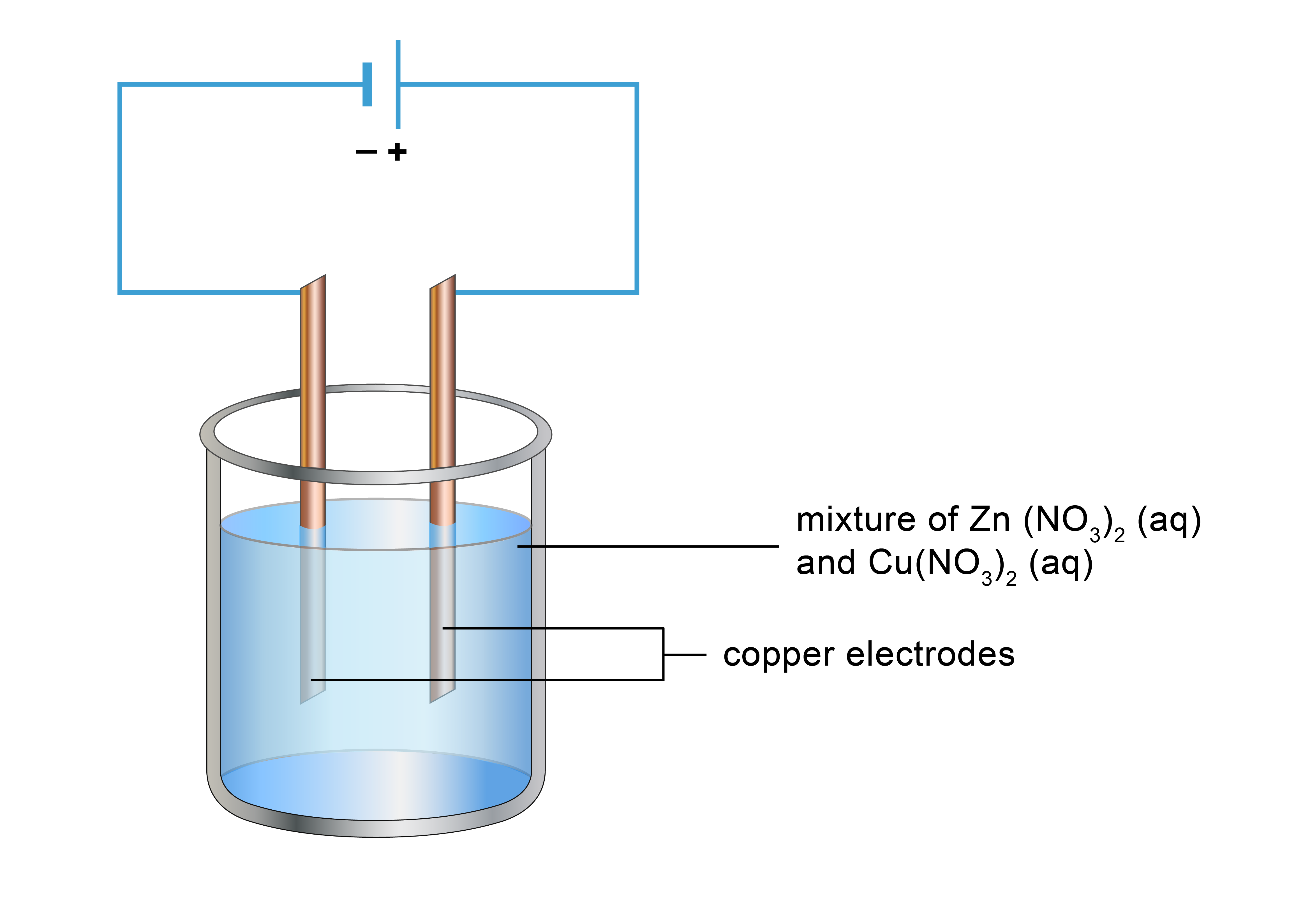
This electrolytic cell includes copper electrodes, in a mixture of zinc nitrate and copper nitrate solutions. The zinc nitrate solution provides zinc ions, while the copper nitrate solution provides copper ions. Nitrate ions are spectator ions that do not participate in the redox reaction. Water molecules are also present in the solution, dissociating into hydrogen ions and hydroxide ions. The copper electrodes serve as the sites for oxidation and reduction reactions during the electrolysis process.
Over time, as the copper ions reduce to form solid copper at the cathode they will be used up. Once there is none left in solution, the zinc ions will then start reacting to form solid zinc on the cathode, as they are the next strongest oxidising agent.
| Relevant Reactions | Standard electrode potential \((E_0)\) at \(25^{\circ}C\) |
|---|---|
| \(O_2(g) + 4H^+(aq) + 4e^- \rightleftharpoons 2H_2O(l)\) | \(+1.23 V\) |
| \(Cu^{2+} (aq) + 2e^- \rightleftharpoons Cu(s)\) | \(+0.34 V\) |
| \(Cu^{2+} (aq) + 2e^- \rightleftharpoons Cu(s)\) | \(+0.34 V\) |
| \(Zn^{2+} (aq) + 2e^- \leftrightharpoons Zn(s)\) | \(-0.76 V\) |
| \(2H_2O(l) + 2e^- \rightleftharpoons H_2(g) + 2OH^-(aq)\) | \(-0.83 V\) |
The strongest oxidising agent present in the solution is \(Cu^{2+}\) and the strongest reducing agent present is solid \(Cu\), so these two species will react.
Oxidation Half Reaction: \(Cu(s) \rightarrow Cu^{2+}(aq) + 2e^-\)
Reduction Half Reaction: \(Cu^{2+}(aq) + 2e^- \rightarrow Cu(s)\)
Overall Reaction: \(Cu^{2+}(aq) + Cu(s) \rightarrow Cu(s) + Cu^{2+}(aq)\)
