
Secondary Cells
Use this page to revise the following concepts within a Secondary Cells:
A secondary cell is a type of galvanic cell that is able to be recharged. When generating electricity (discharging), it uses a spontaneous chemical reaction that generates a flow of electrons. When it is being recharged, the reverse of the discharge reaction, a non-spontaneous reaction , is driven by an external power supply, to reform reactants at the electrodes. This process is similar to the reaction in an electrolytic cell as this reaction would not be able to occur without the addition of an external source of energy.
The main benefit of secondary cells is that they are reusable, and are thus more sustainable . Many modern portable devices use secondary cells; mobile phones, laptops and even electric vehicles.

Structure of a secondary cell
Components of the cell
Commercial secondary cells have some of the same key features of galvanic cells. This includes the cathode, anode, an electrolyte, and external circuit. An example is shown below, the lead-acid accumulator. This is a common rechargeable battery found in vehicles.
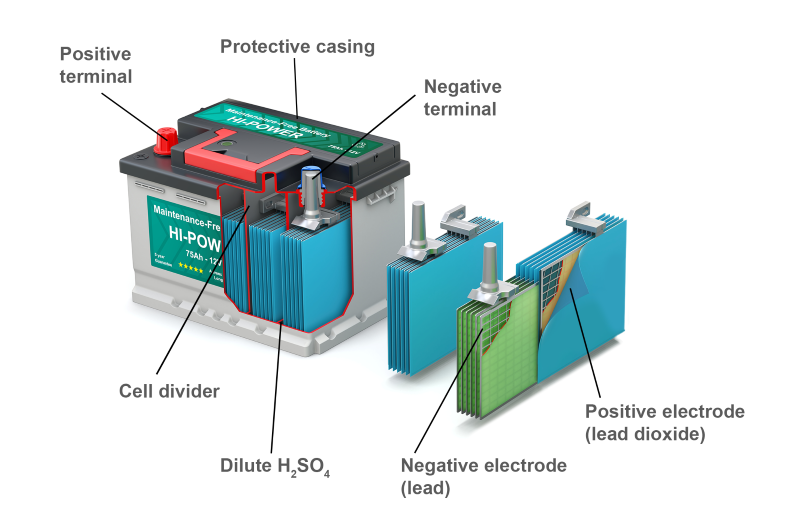
The discharge reaction and the recharge reaction are shown below:
In the accordions above, we can see that during discharge, the cell operates as a galvanic cell. The strongest oxidising agent is reduced at the cathode, and the strongest reducing agent is oxidised at the anode. During recharge, the reverse reaction occurs at each electrode. Products of each reaction are converted back to the reactants. The anode \((-)\) becomes the cathode \((-)\), and the cathode \((+)\) becomes the anode \((+)\). The polarity of the electrodes does not change when an external power supply is attached, only the direction of the reaction. The electrode where oxidation is occurring is always called the anode. The electrode where reduction is occurring is always called the cathode.
NoteDuring discharging and recharging of a secondary cell, the polarity of each electrode remains the same. However, the name (anode or cathode) of each electrode changes. |
Recharging
In a secondary cell, in order to be recharged, the products of the reaction must stay in contact with the electrodes.
The image of the lead-acid rechargeable battery shows an example of this below. The white lead sulfate forms on both the anode and cathode. During recharging the lead sulfate is ready to undergo the reverse reactions in both electrodes.

