Enzymes

Enzymes are biological catalysts, increasing the rate of a reaction in a living organism without themselves being changed in the reaction. Each enzyme has a unique shape, including a pocket in its structure called an active site. The active site binds to a molecule that undergoes a reaction, named a substrate. It is the unique complex shape of each active site that allows it to interact with other molecules and catalyse the reactions in the body.


Use this page to revise the following concepts within enzymes:


Lock-and-key model

The lock-and-key model below is used to illustrate how an enzyme catalyses a reaction. The enzyme’s active site specifically fits the reacting molecule, known as substrate. The substrate attaches to this active site and the covalent bonds within the substrate are weakened. The activation energy for the reaction is lowered, enabling the catalytic reaction to happen. Once the reaction is complete, the active site of the enzyme becomes vacant for another reaction.

A graphic depicting the lock and key model. 3 circles are ordered vertically. Each has the same wedge sized shape removed. In the circle on top, there is a matching wedge piece designed to fit the gap. This wedge is labeled substrate. To the right of this circle is the text, molecule matches shape of enzyme. In the middle circle the substrate wedge partly fits in the gap in the circle. To the right of this circle is the text bonds in molecule weakened. In the bottom circle the substrate wedge has broken in two with a smaller part located in part of the gap in the circle, and the other part lying underneath the circle. To the right of this circle is the text enzyme site cleared to function again.

An energy profile diagram , such as the one below, shows how a catalyst provides an alternative pathway for a reaction that has a lower activation energy.

A graph with the x-axis labeled progress of reaction and the y-axis labeled energy. A third of the way up the y-axis a line, labeled reactants, runs parallel with the x-axis. About a third of the way along the x-axis this line splits into two, with both variations sharply curving up the y-axis before cresting and sharply declining before they reunite about about a quarter of the way up the y-axis and continue parallel with the x-axis. This reunified line is labeled products. The distance between the original line, labeled reactants, and the apex of the first curved line, which rises higher than the other, is labeled activation energy without catalyst. The distance between the original line, labeled reactants, and the apex of the second curved line, which rises lower than the other, is labeled activation energy with catalyst.

An example of an enzyme is sucrase (Note: many enzymes have names that end in -ase). Sucrase acts as a catalyst for the hydrolysis of sucrose (table sugar) to glucose and fructose.

A graphic depicting the hydrolysis of sucrose with sucrase. On the left hand side of the graphic is the chemical structure for sucrose. To the right of this chemical structure is a plus symbol and next to this plus symbol is the chemical symbol for water. To the right of this symbol is an arrow pointing to the right labeled sucrase. To the right of this arrow is the chemical structure for glucose. To the right of that chemical structure is a plus sign and to the right of that plus sign is the chemical structure for fructose.

The mechanism of sucrase is described below:

  • Sucrase is represented by the purple shape in the diagram below.
  • Sucrose molecules (the green substrate) fit the active site and form bonds to sucrase.
  • The glycosidic bond in sucrose joining the glucose and fructose breaks.
  • The fructose and glucose leave the site and sucrase can repeat its action with another sucrose molecule.

A graphic depicting the mechanism of sucrase. In the centre of the graphic are three half-circle shapes with 2 hexagonal shape gaps in each, placed in a cycle. The half-circle shape to the left-side of the graphic is labeled enzyme (sucrose). The gap created by the two hexagonal missing shapes is labeled active site. An arrow labeled entering the active site, points toward the active site and is connected to two connected hexagonal shapes labeled substrate (sucrose). An arrow points away from the active site to two separate hexagonal shapes, one labeled glucose and the other fructose which are collectively labeled products. This arrow is labeled leaving active site. Above the half-circle shaped labeled enzyme (sucrose) is an arrow pointing to the next half-circle shape which depicts its two hexagonal gaps as filled in by the linked hexagonal shapes labeled substrate (sucrose). This half circle is labeled enzyme substrate complex. To the right of this half circle shape is another arrow pointing to the next half circle shape. Another arrow points to this arrow and sits alongside an image of a raindrop labeled H20. The final half circle shape depicts its two hexagonal gaps as filled by the glucose and fructose shapes and this half circle is labeled enzyme product complex covalent bond within the substract breaks to form products. A final arrow connects this half-circle image back to the first one, completing the cycle.

Optimal conditions of enzymes

Enzymes have evolved to operate in living things and are highly sensitive to both temperature and pH. Each enzyme has an optimum operating temperature and pH. Their effectiveness is the highest if the organism operates near optimal conditions but the effectiveness drops as conditions deviate further from the optimum. This occurs because the bonds leading to the shape of enzyme active sites can be disrupted by changes in conditions, preventing the enzyme from binding effectively to the substrate and catalysing the reaction.

Temperature

In humans, enzymes have an optimal operating temperature, often around 37 °C to match that of blood. The graph below shows:

  • At a lower temperature, the enzyme effectiveness is low. Many of the particles do not have sufficient energy to react.
  • As temperature increases to the optimal temperature, the reaction rate increases as the particles collide more frequently and more vigorously.
  • As the temperatures rise above the optimal, the tertiary and secondary structures break down. The primary structure is left intact. The change of secondary and tertiary structures disrupts the 3D shape of enzymes permanently. This is a process known as denaturation. Denaturation prevents enzymes from forming a complementary fit with the substrates, making them unable to catalyse the reaction.

A graph with the x-axis labeled temperature in degrees celsius, and the y-axis labeled rate of reaction. Along the x-axis figures are listed at intervals of ten starting from 0 and ending at 70. From 0 degrees celsius a line curves up the y-axis reaching its apex at the 40 degree celsius mark, and then descending again to meet the x-axis at the 70 degree celsius mark. A dotted line runs from the 40 degree marker on the x-axis to the apex of the curved line and this dotted line is labeled optimal temperature.

pH

Enzymes operate effectively over a narrow pH range. The graph below shows the activity of amylase on the hydrolysis of starch, with its highest activity of hydrolysing starch at a pH of 8. This aligns with the typical pH of saliva, where this amylase is found. In highly acidic or alkaline solutions, the enzyme is denatured and ineffective. The optimum pH of each enzyme varies with where in the body it operates.

 A graph with the x-axis labeled ph, and the y-axis labeled rate of reaction. Along the x-axis figures are listed at intervals of one starting from 4 and ending at 11. From 4 a line curves up the y-axis reaching its apex at the 8 mark, and then descends again to meet the x-axis at the 10.5mark. A dotted line runs from the 8 mark on the x-axis to the apex of the curved line and this dotted line is labeled optimal ph.

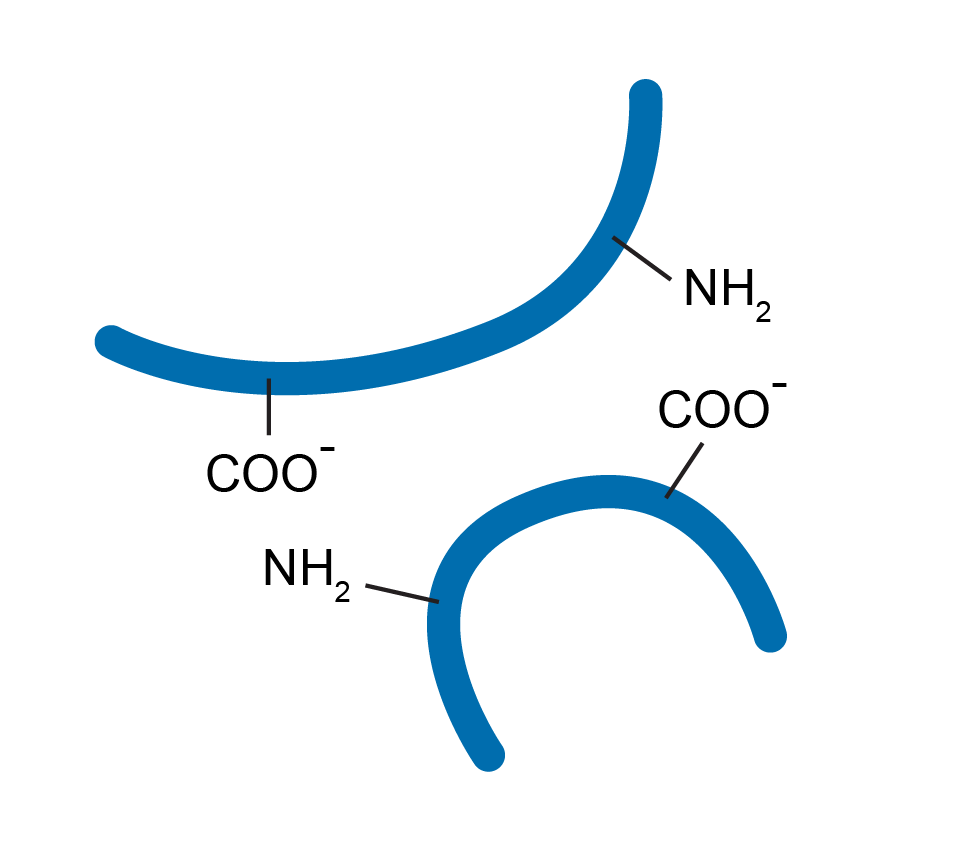
As with temperature changes, pH changes mainly affect the tertiary structure of the enzyme, in particular the ionic bonds between R groups. The presence of additional H+ or OH- ions will disrupt the hydrogen bonds, ionic bonds and dipole-dipole interactions , causing the enzyme to change shape, or denature. For example, examine the ionic bonds formed between the amino and carboxyl groups of -R groups of some amino acids. They can exist only when there is a neutral pH.

Lower pH Neutral pH Higher pH
A graphic depicting lower pH. Two lines form two half circles. Points toward the ends of one half circle are marked COOH and NH3 plus. Points closer to the centre of the other curved line are labeled NH3 plus and COOH.A graphic depicting neutral. Two lines form two half circles. Points toward the ends of one half circle are marked COOH and NH3 plus. Points closer to the centre of the other curved line are labeled NH3 plus and COOH. Dotted lines, labeled ionic bonds, connect each COOH marker to the corresponding NH3 marker on the other line.A graphic depicting higher pH. Two lines form two half circles. Points toward the ends of one half circle are marked COO- and NH2. Points closer to the centre of the other curved line are labeled NH2 and COO-.
Ionic bonding is disrupted, causing the polypeptide chain to unfold. The protein is denatured. The ionic bonding between amino acid side chains allows the proper folding of the polypeptide to form the tertiary structure of the protein. Ionic bonding is disrupted, causing the polypeptide chain to unfold. The protein is denatured.

Competitive enzyme inhibitors

When a person is sick, sometimes their body produces unwanted substances that exacerbate the symptoms of the disease. When this is the case, medical scientists try to develop drugs that inhibit the formation of these toxins. A drug that works to block the active site of an enzyme is acting as a competitive enzyme inhibitor.

An example of a competitive enzyme inhibition involves the medicine methotrexate. Folic acid is an important nutrient that can be converted to other chemicals that are critical for cell growth and division in the body. This conversion is catalysed by the enzyme dihydrofolate reductase (DHFR). However, for a person with cancer, DHFR promotes rapid cancer cell growth and becomes problematic. The diagram below illustrates how the folic acid (shown in green) fits the active site of DHFR. To prevent the catalytic function of DHFR, methotrexate, an organic molecule designed to block the active site of DHFR, is introduced. Methotrexate binds to the active site of DHFR, preventing the substrate, folic acid, from binding. Some of the enzymes may still catalyse folic acid conversion, but many will be blocked by the methotrexate. This limits the conversion of folic acid to a growth-promoting agent.

A graphic depicting competitive inhibition. On the left side of the graphic is an image of a circle with a gap shaped like a rounded wedge and another gap shaped like a triangular wedge. This circle is labeled enzyme DHFR. To the right of this circle is a plus sign. To the right of the plus sign is a shape which is circular on top and triangular on the bottom. This shape is labeled substrate folic acid. To the right of this shape is a plus sign. To the right of the plus sign is a shape which is rectangular on top and triangular on the bottom. This shape is labeled inhibitor methotrexate. To the right of this shape is an arrow pointing to the right. To the right of this arrow is an image of the original circle shape with its triangular shaped gap filled by the triangular bottom of the inhibitor methotrexate shape. The substrate folic acid shape is depicted hovering above the circle and slightly to the left. This entire image is labeled enzyme-inhibitor complex. To the right of this image is an arrow pointing to the right. To the right of this arrow is an image of the words no reaction with a crossed circle overlapping them. Above this image is the text inhibitor binds to the active site. Below this image are the words directly blocks the active site. To the left of these final words is an arrow pointing to the left back toward the label enzyme-inhibitor complex from the previous image.