
Protein structure
Use this page to revise the following concepts within protein structure:
Protein structure
Medications often target enzymes to regulate biochemical processes in the body. Understanding the structure of proteins is a key to understanding enzyme function, as almost all enzymes are proteins. This knowledge enables scientists to design medications that precisely target enzymes for desired therapeutic effects.
2-amino acids
Amino acids are the building blocks of all proteins. There are twenty different amino acids found in living things. They have in common an amino group and a carboxyl group attached to a central carbon atom. They differ by the R group attached to this central carbon atom.
As the name suggests, 2-amino acids contain an amino group, attached to carbon 2, and a carboxyl group, bonded to a common carbon atom.

There are twenty amino acids that differ only by the R groups attached to the central carbon atom. Three examples are shown below, with the R group circled in blue.

The nature of the R group determines the solubility of the amino acid. Alanine, with a non-polar methyl group, has a lower solubility in water than serine, with a polar hydroxyl group.
The R groups on many amino acids are larger and more complex than those above, as shown in the examples below:

Check your understanding
View

Zwitterions
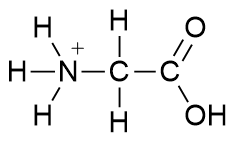
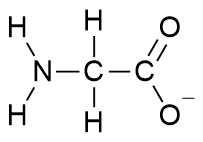
Amino acids can exist in aqueous solutions as a dipolar ion, known as a zwitterion. This ion forms as the carboxyl group donates a proton to the amino group on the other end of the molecule. The diagram below shows glycine and its zwitterion. Zwitterions are always electrically neutral, as their charges cancel out.

The pH of different organs and regions of the body varies. The overall charge of an amino acid depends upon the pH of the surrounding environment. For example,
- Glycine will form a cation in acidic conditions (low pH) due to the presence of H+ ions.
- Glycine will form an anion in alkaline conditions (high pH) due to the presences of OH- ions.
Levels of protein structure
Proteins are large molecules formed from condensation reactions between amino acids. They have complex shapes that allow them to facilitate various reactions in living things. An understanding of this shape involves learning about the levels of structure of protein. These levels are labelled primary, secondary, tertiary and quaternary.
The carboxyl group on one amino acid bonds readily to the amino group on another amino acid. The products are a dipeptide and water. The bond joining the amino acids is called a peptide link or an amide link. The formation of a dipeptide is an example of a condensation reaction, as water is also formed.

More amino acids can bond to the carboxyl end and amino end of the dipeptide via further condensation reactions and eventually form a polymer.

Proteins can have thousands of amino acids in a long polypeptide chain. Insulin, a hormone that regulates blood sugar levels, containing 51 amino acids, is one of the smaller proteins.
However, proteins are not simply long, linear molecules. They have several structural features that lead them to fold into intricate shapes that allow the biological functions in a living organism.
Check your understanding
View
Primary structure
The sequence of amino acids in the protein is referred to as its primary structure. Shorthand notation using the three letter abbreviation for each amino acid is often used to show the primary structure.

Secondary structure
The presence of oxygen and nitrogen atoms in protein chains leads to significant dipoles on the peptide links (see the diagram below).

These dipoles enable hydrogen bonding between the polypeptide backbone of different parts of the same protein chain, which drives the formation of the protein's secondary structure. This bonding pulls the protein into specific shapes, such as a helical structure or a pleated sheet as shown below.

Tertiary and quaternary structures
Interactions between the R groups on amino acids lead to further shaping of the protein chains and gives each protein its unique 3D structure. The diagram below highlights various types of bonds that can form between R groups. The bonding types include:
- covalent disulfide bond (between R groups from two cysteine amino acids)
- dispersion forces (between non-polar R groups)
- hydrogen bonding (between -OH, -COOH or -NH groups within R groups)
- ionic bonds (between COO-formed from carboxyl groups and NH3+ formed from amino groups).

Summary of protein structural levels

| Level of bonding | Definition | Impact |
|---|---|---|
| Primary | Sequence of amino acids in the polypeptide backbone. | Each protein has an unique sequence, involving many different amino acids bonded together. This level of structure determines all higher structural levels. |
| Secondary | Hydrogen bonds between atoms of the polypeptide backbone cause the protein to curl into a helical or sheet structure. | The presence of nitrogen and oxygen atoms in the peptide chain allows hydrogen bonds. |
| Tertiary | Folding of protein coils due to interactions between the –R groups. | The unique 3-D shape formed allows the protein to perform its function, for example to act as an enzyme. |
| Quaternary | Different protein chains interact to add to the complexity of the structure. | Most larger proteins require more than one polypeptide for the complex structures that are essential to protein function. |