
Galvanic Cells
In direct redox reactions, chemical energy is released in the form of heat, but when the same reactions occur indirectly in a galvanic cell the energy can be converted into usable electrical energy. Galvanic cells convert chemical energy into electrical energy through a spontaneous redox reaction occurring in two physically separated half-cells. In this page, we focus on non-rechargeable galvanic cells.
Use this page to revise the following concepts within galvanic cells:
The common design features of galvanic cells
For a galvanic cell to function, it should include these key components:
- Half-Cells: one half cell undergoes oxidation and the other reduction. Each half cell contains:
- Electrodes which could be an inert solid or the metal involved in the reaction. An electrode conducts electrons in or out of the half cell:
- Electrons move out of the anode, and this is where oxidation happens. The anode has a negative polarity (-) in the galvanic cel.
- Electrons move into the cathode and this is where reduction happens. The cathode has a positive polarity (+) in the galvanic cell.
- Electrolyte, prepared by dissolving ionic substances in water, which enables a complete circuit. Some ions in the electrolyte may also participate in the reaction.
- Electrodes which could be an inert solid or the metal involved in the reaction. An electrode conducts electrons in or out of the half cell:
- Salt Bridge : The salt bridge connects the half-cells through the internal circuit , allowing ions to move and maintain electrical neutrality in the half-cells. It also enables a complete circuit. KNO₃ is the commonly used ionic substance in salt bridges.
- Anions move toward the anode to balance the positive charge created by oxidation in the anode half cell.
- Cations move toward the cathode to balance the negative charge created by reduction in the cathode half cell.
- External Circuit : The external circuit connects the two electrodes, allowing electrons to flow and power the load or appliance.
Watch the animation below to see each of these key components in action.
Unlike a direct redox reaction, where chemical energy is primarily released as heat, a galvanic cell converts chemical energy into electrical energy. However, this conversion is not 100% efficient, and a small amount of heat is generated over time. Therefore, the temperature of half cells may rise slightly with use.
Check your understanding
View

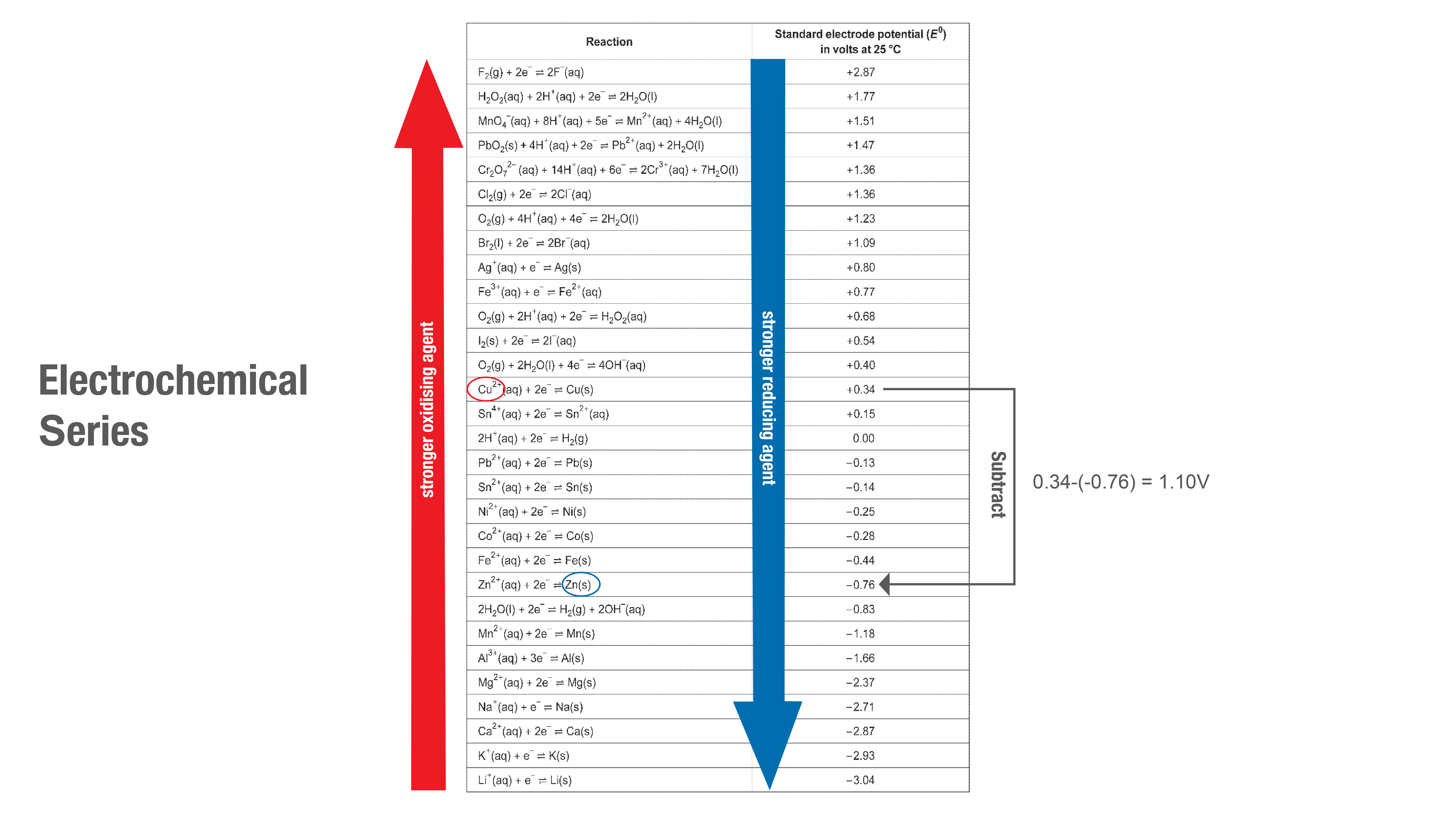
Electrochemical Series
The electrochemical series ranks half-reactions based on their relative strengths as oxidising or reducing agents. The position of a species in this series helps predict whether a redox reaction will occur spontaneously:
- Stronger oxidising agents are higher on the left side in the series, and they are more likely to undergo reduction reactions. They have a higher standard electrode potential (E⁰).
- Stronger reducing agents are lower on the right side in the series, and they are more likely to undergo oxidation reactions. They have a lower standard electrode potential (E⁰).
Determine the spontaneous reaction using electrochemical series
Electrochemical series can help to identify which two chemicals will be involved in the spontaneous reaction in two connected half-cells. The stronger oxidising agent undergoes reduction, while the stronger reducing agent undergoes oxidation.

The chemicals that could potentially react in the two half-cells are \(\ce{Zn^2+}\), \(\ce{Zn}\), and \(\ce{H2O}\) from the zinc half cell and \(\ce{Cu^2+}\), \(\ce{Cu}\), and \(\ce{H2O}\) from the copper half cell. Among these, the strongest oxidising agent is \(\ce{Cu^2+}\), and the strongest reducing agent is \(\ce{Zn}\).
Hence, when the above two half cells are connected:
- \(\ce{Cu^{2+}}\) is reduced: \(\ce{Cu^{2+}(aq) + 2e^{-} \rightarrow Cu(s)}\)
- \(\ce{Zn}\) is oxidised: \(\ce{Zn(s) \rightarrow Zn^{2+}(aq) + 2e^{-}}\)
Check your understanding
View
Predicting voltage using electrochemical series
The standard electrode potential, denoted as E⁰, is a measure of the tendency of a half-cell to gain or lose electrons under standard conditions. It indicates the potential difference (voltage) between a specific half-cell and the standard hydrogen electrode (SHE), which is assigned an arbitrary value of 0.00 V. E⁰ is measured at 100 kPa, 25oC, and uses 1 molL-1 for electrolyte solution.
The voltage of a galvanic cell, or its potential difference, can be calculated using the standard electrode potentials of the two half-cells:
\(\text{Potential Difference}=E^{0}\text{ (reduction at cathode) }−E^{0}\text{ (oxidation at anode)}\)
Worked Example
What is the voltage generated from the galvanic cell shown below?
Solution:
The \(E^{0}\) for the \(\ce{Zn^{2+}/Zn}\) is \(-0.76V\) and \(E^{0}\) for the \(\ce{Cu^{2+}/Cu}\) is \(+0.34V\).
\[ \begin{aligned} \text{Voltage (potential difference)} &= E^{0} \text{ (reduction at cathode)} - E^{0} \text{ (oxidation at anode)} \\ &= +0.34 - (-0.76) = 1.10\,\text{V} \end{aligned} \]
There are some limitations of using electrochemical series:
- The \(E^{0}\) values are measured in standard conditions. Hence the prediction of the voltage of a galvanic cell using \(E^{0}\) values may be inaccurate under non-standard conditions.
- The electrochemical series only indicates whether a reaction can happen spontaneously but does not account for reaction rates. Predicted observations may not be observed because a reaction may occur too slowly.
- The electrochemical series does not consider side reactions, and this can affect the actual cell voltage and product formation.