
Living the Principles We Teach: Three decades at the frontline of responsible business
A/Prof Terence Jeyaretnam, 2026
Purpose
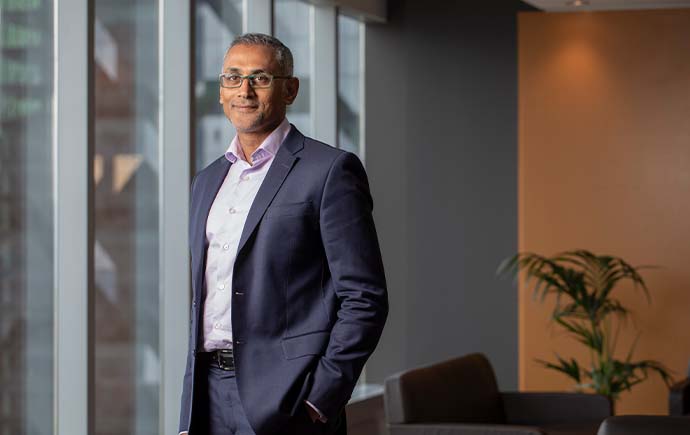
Associate Professor Terence Jeyaretnam
Responsible management education asks a simple question of those who teach it: are we living the principles we ask our students to adopt? Professor Terence Jeyaretnam AM, Professor of Practice at Monash Business School, was recognised in the 2026 King's Birthday Honours “for significant service to social justice, and to environmental conservation and sustainability.” He accepted this recognition in that spirit – to demonstrate that a career built at the intersection of sustainability, climate, governance and human rights is not a peripheral concern for business education, but central to the future wellbeing, resilience and prosperity of the economy our graduates will lead. He wanted to model, visibly, that doing this work well and doing good business are not in tension.
Practice
Over more than three decades, Terence has worked to give voice to interests that too often go unheard in commercial decision-making: ecosystems, future generations, animals, and people whose concerns are easily lost. As Professor of Practice, he brings that practice into the School through teaching, research engagement and thought leadership on sustainability, governance and assurance. Alongside this he sustains a substantial voluntary contribution through governance roles, including as Chair of Amnesty International Australia, Chair of Global Citizen (Australia), Treasurer of the Australian Conservation Foundation, a Director of the Biodiversity Council and ProVeg Australia, a Councillor of the Royal Society of Victoria, and a member of the Auditing and Assurance Standards Board – connecting students and colleagues directly to the standards, institutions and debates shaping responsible business in Australia.
Output
The immediate consequence of the honour was recognition, within the School and beyond, that applied sustainability leadership is scholarship of consequence. It gave a concrete, credible reference point for the argument made in the classroom: that climate, nature and social justice are legitimate and urgent business concerns. It also strengthened the School's ability to point to a member of its faculty whose external standing evidences its PRME commitments in practice rather than principle.
Outcome
For the primary stakeholders – our students – the longer-term outcome is exposure to a model of responsible leadership that is lived, not theorised. They see that a values-led career is achievable and respected, and that the frameworks they study, from assurance standards to climate disclosure, are built and applied by people they can learn from directly. For the School, the outcome reinforces a culture in which responsible management is embedded in who we are and who we recognise, not confined to a single unit or elective.
Impact
The wider impact reaches the organisations our graduates join and the communities those organisations serve. Recognition of this kind helps normalise the expectation that sustainability, governance integrity and social justice belong at the centre of business, contributing to more resilient supply chains, greater customer and community trust, and lower long-term risk. As someone who arrived in Australia as a refugee, Terence also hopes it signals something quieter to the broader community: that this country offers not only safety and opportunity, but the chance to contribute – and that responsible management education is one of the ways that contribution is passed on to the next generation of leaders.