
Season 2, episode 3
Season 2, Episode 3
The Insiders Behind the Mic –
Career Pivots and Public Health Perspectives
In this special episode of Public Health Insiders, we’re turning the tables. Hosts Kirsten Marks and Bethany Howard step into the guest seats to discuss their own non-linear career paths and what "public health" really means in practice. From laboratory benches to health communications and higher education, their journeys highlight that there is no single "right" way to build a career in this field.
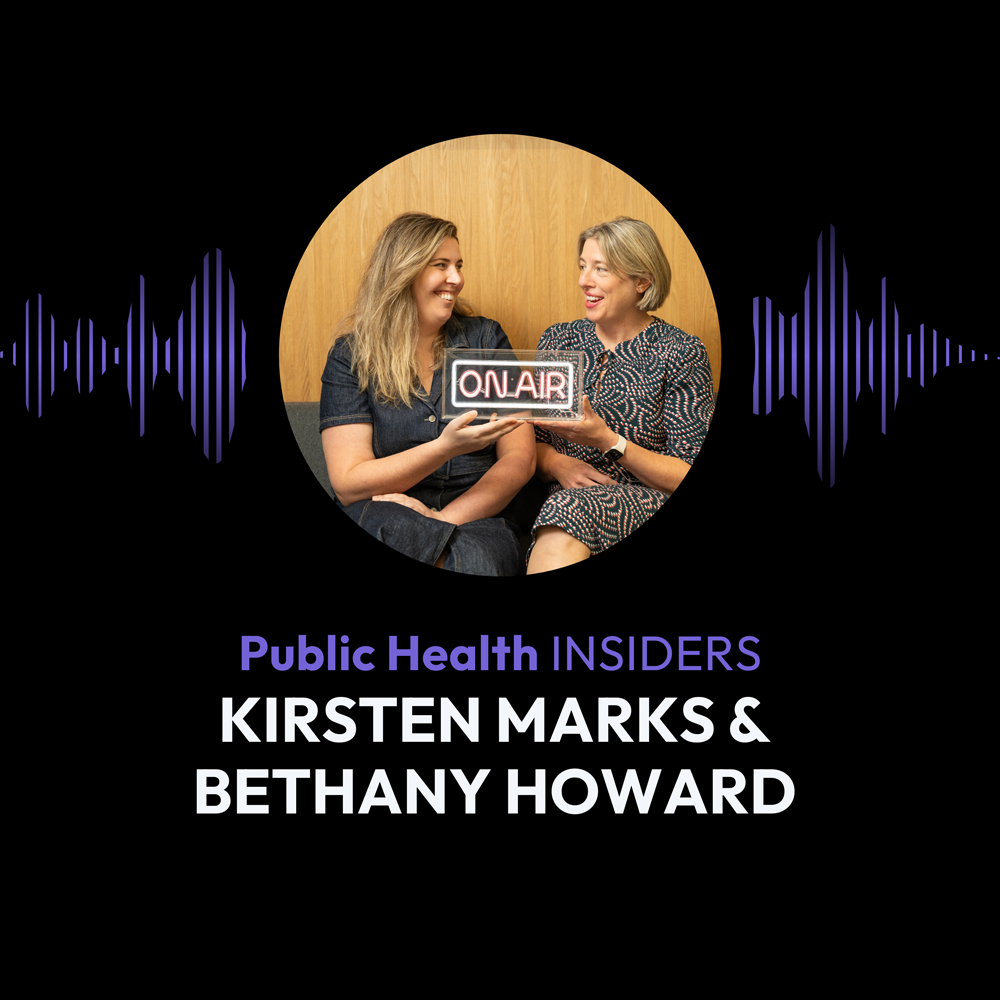
Meet your hosts
Kirsten’s career began in biochemistry and molecular biology, leading to a role as a medical scientist in pathology. After five years in London, she returned to Australia to complete a Masters in Genetic Counselling. It was during her time as a Research Assistant in a healthy lifestyle laboratory that she met Bethany. Realising she preferred communicating research over conducting it, Kirsten transitioned into health communications. After twelve years in health comms, she's recently taken another big step – outside health for the first time – and is working in partnerships communications.
Bethany is a Senior Lecturer of Public Health and Preventive Medicine at Monash University, bringing over fifteen years of teaching experience to the podcast. With a background in Exercise and Sports Science (Honours) and a Master’s in Education, she has been recognised with numerous awards for teaching excellence. Her research and teaching focus on enhancing student employability, aiming to deeply understand the career experiences of health graduates to better prepare them for the workforce.
Key concepts
What is public health?
Public health focuses on improving health at the population level rather than through one-on-one clinical care. It considers how policies, environments, and systems can improve outcomes for whole communities.
Public health can be applied across many disciplines, from infectious disease and cancer research to environmental health and physical activity. It provides a lens for understanding how health interventions can benefit the greatest number of people.
Prevention versus treatment
A core idea in public health is prevention. Instead of only treating health problems after they occur, public health asks what upstream factors are causing them and how those risks can be reduced. Prevention usually reduces the incidence of disease and mortality, improves quality of life, and is far more cost-effective for health systems.
Diversity in public health careers
Careers in public health rarely follow a straight line. Many professionals enter the field from other areas such as science, clinical practice, research, communications or policy.
Skills needed in public health roles
Given the wide range of activities that come under the public health umbrella, it isn’t surprising that a wide range of skills can come in useful. Aside from strong research skills and broad knowledge and health and health systems, communication, creativity, organisation, and the ability to work across disciplines are often essential. Public health professionals often collaborate with researchers, policymakers, industry partners and communities.
Tips for students
- Be open to unexpected opportunities and jobs
Many public health professionals discover their career direction through exploring different opportunities rather than following a single planned trajectory. - Focus on your next step rather than the entire path
You may not be able to predict exactly where your career will end up. Instead, think about the next opportunity that aligns with your interests and values. - Develop strong communication skills
Public health professionals need to explain complex ideas clearly to different audiences, including policymakers, researchers, and the public. - Build transferable skills
Skills such as project management, teamwork, writing, and critical thinking are valuable across many roles in public health. - Learn from a variety of experiences
Even roles that seem unrelated can help you develop knowledge and skills that later combine to create new career opportunities. - Take advice seriously and act on it
Mentors and supervisors can provide valuable guidance. Being willing to apply feedback and follow through on suggestions can open doors and strengthen professional relationships.