
Holly Wild
Holly Wild
Bachelor of Health Sciences (Honours)
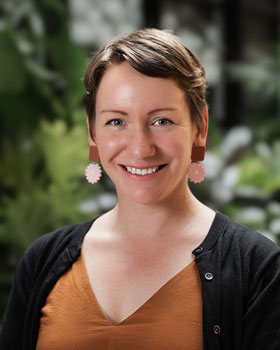
 I'd encourage anyone to undertake Honours if they have any interest at all in research – it's a great way to test the waters. But it is very different from undergraduate study – you need to be self-motivated, and step up a level. You get support, but not hand-holding – it's a really exciting and important opportunity to challenge yourself and grow.
Holly Wild came back to Honours after several years in the workforce, having already completed a degree in health sciences majoring in clinical nutrition, and a Master of Public Health focusing on global health.
"I loved the content of both degrees, but at the end of the Masters, which was by coursework, I realised that I really wanted more in the way of research skills," she says. "By this stage I'd been studying for quite a few years, and was juggling that with raising a young family and lecturing in nutrition and public health nutrition with Torrens University."
A chance meeting with her future Honours and now main PhD supervisors, Associate Professor Danijela Gasevic and Dr Alice Owen from our School, helped Holly realise the best way to achieve her dream was to undertake an Honours project. Her interest in nutrition led her to undertake a project exploring the drivers behind meal skipping among older people, and the health outcomes associated with it.
"Eating healthy food regularly is a really important part of maintaining good physical and cognitive health into older age," she says. "But we believed there was fairly scant evidence around the impact of meal skipping, and thought it’d be great to explore that association further, then take a step towards closing that knowledge gap."
She undertook a scoping review, to first establish that their hunch about the lack of evidence was correct, and explore the available evidence around associations between meal skipping and mortality.
Working with what evidence had been publicly published, she then completed a systematic review, exploring the socio-ecological correlates of meal skipping in adults over the age of 65 years. Correlates in this context are the underlying characteristics and factors that drive our behaviours. She identified five domains: sociodemographic, behavioural, biomedical, psychological, and social.
Once that was completed, Holly undertook a primary analysis of data housed within the ASPREE Longitudinal Study of Older Persons (ALSOP) database. ALSOP is a sub-study of our landmark ASPirin in Reducing Events in the Elderly (ASPREE) clinical trial, and is a treasure trove of data for researchers investigating healthy ageing.
Specifically, Holly investigated correlates of meal skipping, and the association between meal skipping and all-cause mortality. She found that the prevalence of meal skipping in the ALSOP cohort was about 19.5 per cent, and that higher odds of meal skipping were seen in people that lived alone, smoked, consumed high levels of alcohol, had poor oral health and had been diagnosed with conditions such as diabetes & frailty. She found no association between meal skipping and mortality.
"At the end of it, I presented both my systematic review and correlates of meal skipping analysis at the 2022 ISBNPA Conference, and my analysis of meal skipping and all-cause mortality at the Australian Association of Gerontology Annual Conference, also in 2022. They were great opportunities to share our newly-found knowledge, and practice my public presenting and communication skills."
The Honours year gave Holly exactly the skills and confidence she was looking for, and she’s now embarked on her PhD with the same supervisors, exploring protein intake in older adults using the same database.
"I’m loving it!" she says. "A PhD is in some ways a similar experience to Honours, but on a far grander scale, with more space and time to really dive into a topic. There's more structure and guidance in Honours than in the PhD, but that’s obviously appropriate. In a PhD I'm really responsible for driving the project, much more so than in Honours, but Honours gave me a great grounding on which to do this.
"I'd encourage anyone to undertake Honours if they have any interest at all in research – it's a great way to test the waters. But it is very different from undergraduate study – you need to be self-motivated, and step up a level. You get support, but not hand-holding – it's a really exciting and important opportunity to challenge yourself and grow."