
Morwell Neighbourhood House: ‘They go into bat for me’
Project Summary
This report examines the role of Morwell Neighbourhood House (MNH) in recovery from the Hazelwood mine fire, focusing on the transformation of the House’s program and priorities, and two recovery initiatives: the Valley-to-Valley project, and a public talk by Dr John Hewson on transition from coal.
Background and Situation Context
In 2014, fire impacted the town of Morwell and the Morwell open cut mine in the Latrobe Valley that burnt for 45 days. Morwell was at times overwhelmed by smoke and ash making it difficult for people to go about their daily lives and affecting their health and wellbeing. The most significant effects were about loss of trust in government and authorities; feeling abandoned as a community; future health concerns; and how the community sees itself and its future. MNH initiated several recovery activities to assist the community to make sense of the event, to ensure their voice continued to be heard, and to rebuild pride in where they live. MNH was responding to the needs of its community and the benefits of its initiatives were felt by its immediate Neighbourhood House community, the Morwell community more generally, the Latrobe Valley communities, and for the Valley to Valley project the communities of the Hunter Valley in NSW.
Activities
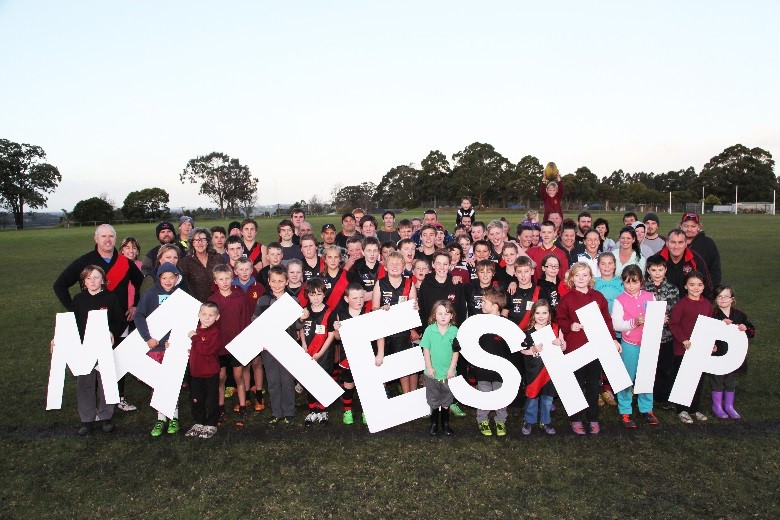
The mine fire and its impact on the community provided a moment and an opportunity for MNH to reflect on how it could best support their community. MNH changed the types of activities it offered. There were fewer accredited courses and more social support activities, including facilitated workshops to allow community members to tell their story of the mine fire. In April 2015, floods devastated the Hunter Valley in New South Wales. MNH saw this as an opportunity to reach out to another community that had been hit by a disaster and initiated a project that became known as the Valley-to-Valley project. There were two aspects to the project: a series of photo shoots with community groups where they used large letters to spell out a message of support and hope, and a message book where people were asked to write messages of support. In July 2016 MNH facilitated a talk by Dr John Hewson on transition from coal, as part of MNH’s commitment to inform and empower the community as it navigates the future.
Results
At the end of the Valley-to-Valley project, nearly 1000 people had taken part in 40 photo shoots; there were nearly 500 handwritten messages and 28 pieces of artwork. The photos and messages were compiled into a book and delivered to Maitland and Dungog in the Hunter Valley communities. The photos were also exhibited at the Latrobe Regional Art Gallery in Morwell. This was an inspirational and inspired community development initiative that appears to have had a significant impact on both communities and contributed to the recovery process in Morwell. In many ways this initiative turns ideas of recovery on its head by asking those affected to reach out and help others rather than being helped; it enabled people to ‘break out’ of the victim role and perhaps to even feel like heroes. Dr Hewson’s talk enjoyed a good attended. The outcome was unexpected in that a transition project was proposed. MNH used its networks to facilitate the formation of a community committee to assess the proposal. The proposal is still under discussion. MNH empowered community members providing an opportunity for their voices to be heard and to be involved in the decision-making process about the future of Latrobe Valley.
Reflection
The Valley-to-Valley project and the Hewson event were innovative and inspirational recovery initiatives that responded to both current needs and future aspirations. However, the more important lesson for people learn from the recovery activities of MNH is the importance of its process and framework, underpinned by a community development approach. A community development approach, such as that adopted by MNH, is likely to be more successful for long-term social recovery and to deliver recovery that ‘builds back better’. It does this through promoting participation, empowerment, social connectivity and ensuring actions and strategies are community-led. A process based on empowerment and participation can contribute as much, if not more, to recovery than any other factor or outcome. The impact of a community development approach on recovery can be in many ways greater than the sum of various initiatives. Understanding MNH’s impact on recovery from the mine fire and its impact in the community more generally, cannot be discerned by only looking at individual projects. It must be seen in the context of its process and framework: a community-led, empowering and capacity-building framework, a commitment to listen to what people need and to work in partnership with them to achieve outcomes.
Additional Project Details
| Lead organisations | Morwell Neighbourhood House and Federation University Australia |
| Partner/s | Nil specified |
| Funding source | Not specified |
| Funding amount | Not specified |
| Contact name | Tracie Lund (Co-ordinator), Morwell Neighbourhood House, coordinator@morwellnh.org.au Dr Sue Whyte, Federation University Australia, s.whyte@federation.edu.au |
| Contact email | coordinator@morwellnh.org.au |
| Contact telephone | (03) 5134-5488 |
| Hurdles submitting details of project | N/A |
| Project URL | http://federation.edu.au/__data/assets/pdf_file/0011/347564/They-go-into-bat-for-me-Feb-2017-Final-report.pdf |